Cologne Center for Ethics, Rights, Economics, and Social Sciences of Health, University of Cologne, Albertus Magnus Platz, 50923, Cologne, Germany.
a.r.t.e.s. Graduate School for the Humanities Cologne, University of Cologne, Cologne, Germany.
Z Gerontol Geriatr. 2021 Nov;54(Suppl 2):85-92. doi: 10.1007/s00391-021-01974-9. Epub 2021 Oct 1.
Individuals' ideals and aspirations are considered to constitute a central reference frame for subjective evaluations of their perceived reality, and, thus, to be crucial for individual quality of life (QoL) outcomes. By examining individual values and spirituality in very old people, the aim of this study was to describe two constructs representing the aspirations of the individual, as well as the relation of these constructs to both hedonic and eudaimonic QoL outcomes in very old age (VOA).
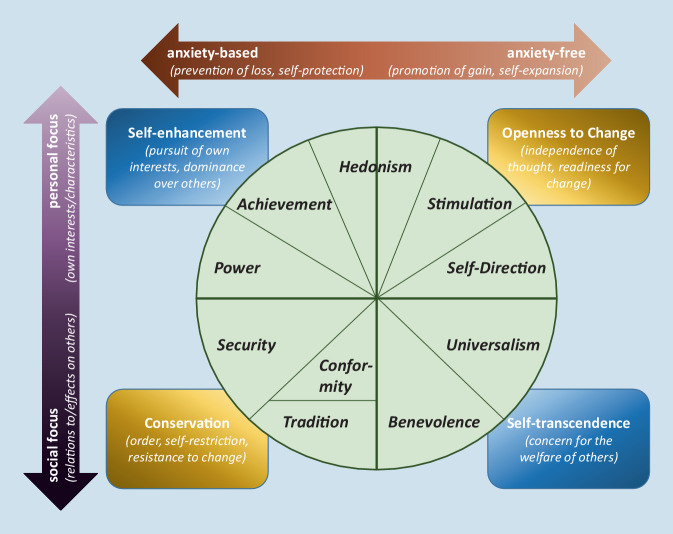
Cross-sectional data from a representative survey of people in VOA (NRW80+, n = 1863) were used. Individual values were assessed based on the Portrait Value Questionnaire. A revised questionnaire was developed drawing on the Spiritual Health and Life-Orientation Measure. Individual values and spirituality were studied using descriptive statistics, and hierarchical linear regression models were used to analyze their predictive value for two QoL outcomes: 1) affective well-being as an indicator of hedonic QoL, which was assessed using the positive affect subscale of the short form of the Positive and Negative Affect Schedule, and 2) engagement with life, which captures eudaimonic aspects and which was measured with a subscale of the Valuation of Life Scale.
The most important values were both protection and growth-oriented values with a social focus. However, only values representing strivings for growth had a positive association with QoL outcomes. Spirituality was of high relevance to very old people, although not in the sense of religious institutions or practices. Rather, it predominantly consisted in environmental, interpersonal, and transcendental connectedness, all of which were positively connected to QoL outcomes.
Individual values and spirituality can be an important resource for hedonic as well as eudaimonic QoL; however, age-related losses may lead to an emphasis of protective values that are not beneficial in terms of QoL. To support older people on their spiritual journey, a broad concept of spirituality needs to be established among researchers as well as practitioners.
个人的理想和抱负被认为构成了对个人感知现实的主观评价的一个核心参考框架,因此,对个人的生活质量(QoL)结果至关重要。通过研究非常老年人的个体价值观和精神性,本研究旨在描述代表个体抱负的两个结构,以及这些结构与非常老年(VOA)中享乐和幸福 QoL 结果的关系。
使用来自代表 VOA 人群的代表性调查(NRW80+,n=1863)的横断面数据。个体价值观基于肖像价值观问卷进行评估。基于精神健康和生活取向量表开发了一个修订后的问卷。使用描述性统计方法研究个体价值观和精神性,使用分层线性回归模型分析它们对两种 QoL 结果的预测价值:1)积极情感作为享乐 QoL 的指标,使用短形式的积极和消极情感量表的积极情感子量表评估;2)与生活的融合,捕捉幸福论方面,使用生活价值观量表的一个子量表进行测量。
最重要的价值观是具有社会焦点的保护和成长导向的价值观。然而,只有代表成长愿望的价值观与 QoL 结果呈正相关。尽管不是宗教机构或实践的意义上,精神性对非常老年人具有重要意义。相反,它主要包括环境、人际关系和超越的联系,所有这些都与 QoL 结果呈正相关。
个体价值观和精神性可以成为享乐和幸福论 QoL 的重要资源;然而,与年龄相关的损失可能导致强调对 QoL 没有益处的保护价值观。为了在精神之旅中支持老年人,研究人员和实践者需要建立一个广泛的精神性概念。