Kidess Evelien, Kleerebezem Michiel, Brugman Sylvia
Animal Sciences Group, Host-Microbe Interactomics, Wageningen University and Research, Wageningen, Netherlands.
Front Microbiol. 2021 Sep 17;12:729053. doi: 10.3389/fmicb.2021.729053. eCollection 2021.
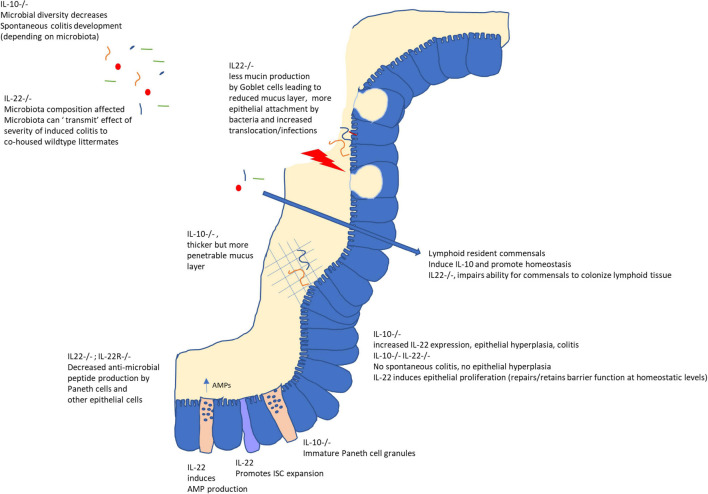
Our world is filled with microbes. Each multicellular organism has developed ways to interact with this microbial environment. Microbes do not always pose a threat; they can contribute to many processes that benefit the host. Upon colonization both host and microbes adapt resulting in dynamic ecosystems in different host niches. Regulatory processes develop within the host to prevent overt inflammation to beneficial microbes, yet keeping the possibility to respond when pathogens attempt to adhere and invade tissues. This review will focus on microbial colonization and the early (innate) host immune response, with special emphasis on the microbiota-modifying roles of IL-10 and IL-22 in the intestine. IL-10 knock out mice show an altered microbial composition, and spontaneously develop enterocolitis over time. IL-22 knock out mice, although not developing enterocolitis spontaneously, also have an altered microbial composition and increase of epithelial-adherent bacteria, mainly caused by a decrease in mucin and anti-microbial peptide production. Recently interesting links have been found between the IL-10 and IL-22 pathways. While IL-22 can function as a regulatory cytokine at the mucosal surface, it also has inflammatory roles depending on the context. For example, lack of IL-22 in the IL-10-/- mice model prevents spontaneous colitis development. Additionally, the reduced microbial diversity observed in IL-10-/- mice was also reversed in IL-10/IL-22 double mutant mice (Gunasekera et al., 2020). Since in early life, host immunity develops in parallel and in interaction with colonizing microbes, there is a need for future studies that focus on the effect of the timing of colonization in relation to the developmental phase of the host. To illustrate this, examples from zebrafish research will be compared with studies performed in mammals. Since zebrafish develop from eggs and are directly exposed to the outside microbial world, timing of the development of host immunity and subsequent control of microbial composition, is different from mammals that develop and only get exposed after birth. Likewise, colonization studies using adult germfree mice might yield different results from those using neonatal germfree mice. Lastly, special emphasis will be given to the need for host genotype and environmental (co-housing) control of experiments.
我们的世界充满了微生物。每一种多细胞生物都已形成了与这种微生物环境相互作用的方式。微生物并不总是构成威胁;它们能促进许多有益于宿主的过程。在定殖后,宿主和微生物都会发生适应性变化,从而在不同的宿主生态位中形成动态生态系统。宿主会形成调节过程,以防止对有益微生物产生过度炎症反应,同时保留在病原体试图黏附和侵入组织时作出反应的可能性。本综述将聚焦于微生物定殖以及宿主早期(固有)免疫反应,特别强调白细胞介素-10(IL-10)和白细胞介素-22(IL-22)在肠道中对微生物群的调节作用。IL-10基因敲除小鼠的微生物组成发生改变,并随着时间的推移自发发展为小肠结肠炎。IL-22基因敲除小鼠虽然不会自发发展为小肠结肠炎,但其微生物组成也发生了改变,上皮黏附细菌增多,这主要是由黏蛋白和抗菌肽产量降低所致。最近,人们发现IL-10和IL-22信号通路之间存在有趣的联系。虽然IL-22在黏膜表面可作为一种调节性细胞因子发挥作用,但根据具体情况它也具有炎症作用。例如,在IL-10基因敲除小鼠模型中缺乏IL-22可阻止自发结肠炎的发展。此外,在IL-10/IL-22双突变小鼠中,IL-10基因敲除小鼠中观察到的微生物多样性降低也得到了逆转(古纳塞克拉等人,2020年)。由于在生命早期,宿主免疫与定殖微生物同时并行发展并相互作用,因此未来需要开展研究,重点关注定殖时间与宿主发育阶段之间的关系所产生的影响。为了说明这一点,将把斑马鱼研究中的例子与在哺乳动物中进行的研究进行比较。由于斑马鱼由卵发育而来,并直接暴露于外部微生物世界,因此宿主免疫发育的时间以及随后对微生物组成的控制,与出生后才发育并接触微生物的哺乳动物不同。同样,使用成年无菌小鼠进行的定殖研究可能会得出与使用新生无菌小鼠不同的结果。最后,将特别强调实验中对宿主基因型和环境(同笼饲养)进行控制的必要性。