Sui He, Ma Ruhang, Liu Lin, Gao Yaozong, Zhang Wenhai, Mo Zhanhao
China-Japan Union Hospital of Jilin University, Changchun, China.
Radiology Department, Weifang People's Hospital, Weifang, China.
Front Oncol. 2021 Sep 16;11:700210. doi: 10.3389/fonc.2021.700210. eCollection 2021.
To develop a deep learning-based model using esophageal thickness to detect esophageal cancer from unenhanced chest CT images.
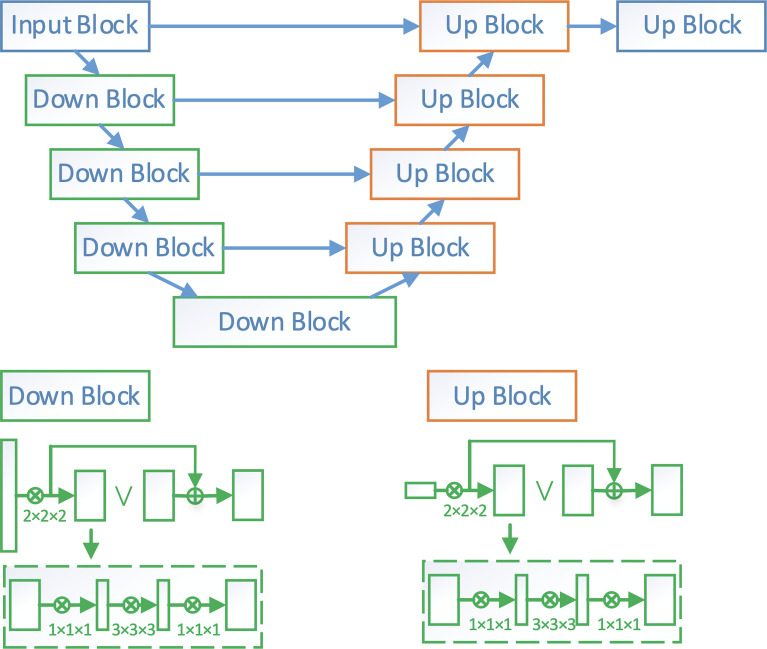
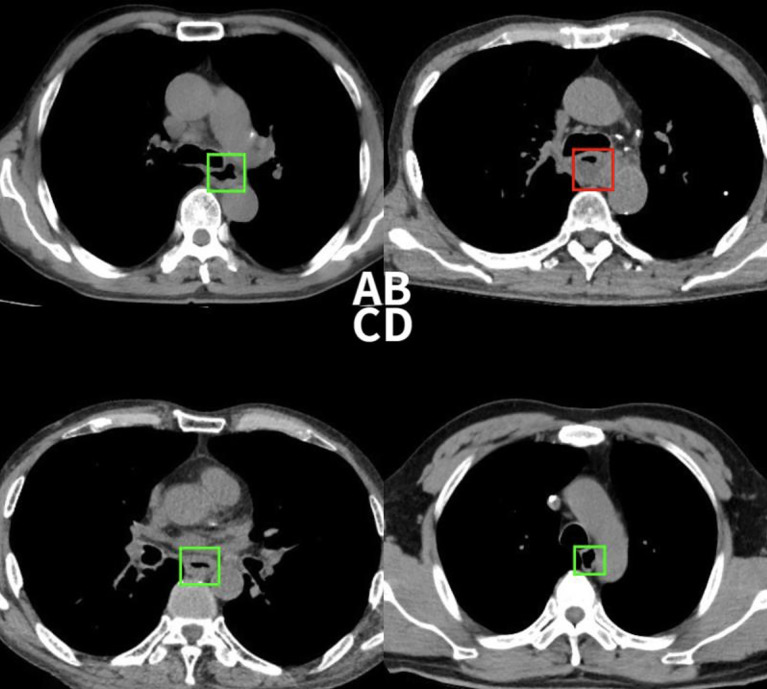
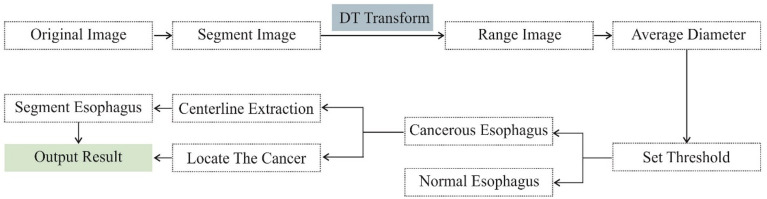
We retrospectively identified 141 patients with esophageal cancer and 273 patients negative for esophageal cancer (at the time of imaging) for model training. Unenhanced chest CT images were collected and used to build a convolutional neural network (CNN) model for diagnosing esophageal cancer. The CNN is a VB-Net segmentation network that segments the esophagus and automatically quantifies the thickness of the esophageal wall and detect positions of esophageal lesions. To validate this model, 52 false negatives and 48 normal cases were collected further as the second dataset. The average performance of three radiologists and that of the same radiologists aided by the model were compared.
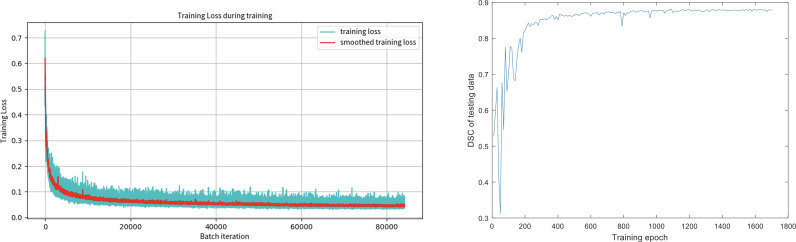
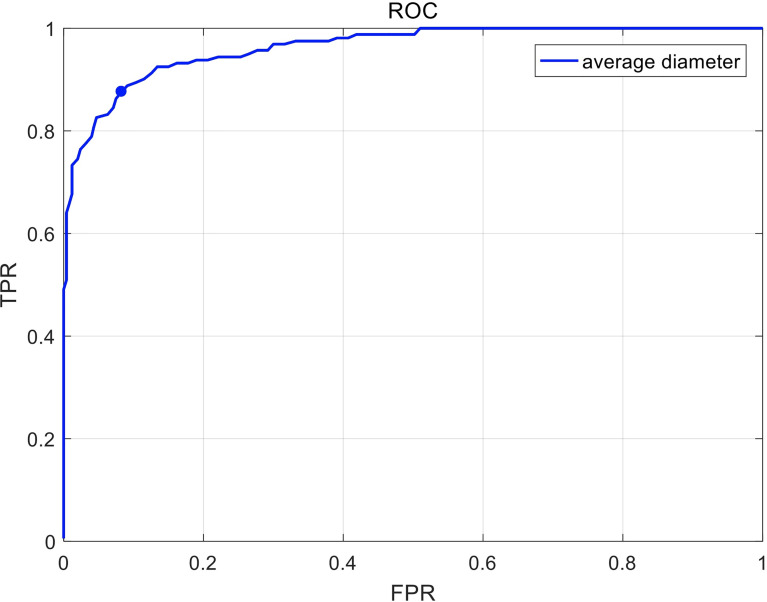
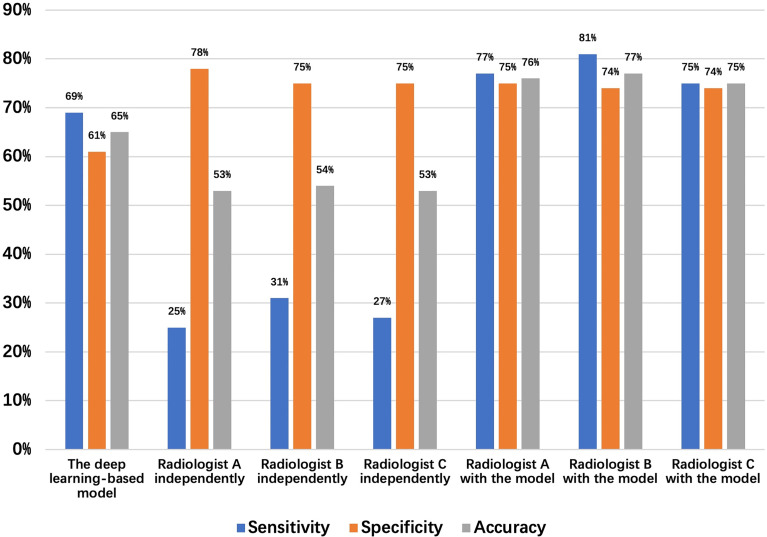
The sensitivity and specificity of the esophageal cancer detection model were 88.8% and 90.9%, respectively, for the validation dataset set. Of the 52 missed esophageal cancer cases and the 48 normal cases, the sensitivity, specificity, and accuracy of the deep learning esophageal cancer detection model were 69%, 61%, and 65%, respectively. The independent results of the radiologists had a sensitivity of 25%, 31%, and 27%; specificity of 78%, 75%, and 75%; and accuracy of 53%, 54%, and 53%. With the aid of the model, the results of the radiologists were improved to a sensitivity of 77%, 81%, and 75%; specificity of 75%, 74%, and 74%; and accuracy of 76%, 77%, and 75%, respectively.
Deep learning-based model can effectively detect esophageal cancer in unenhanced chest CT scans to improve the incidental detection of esophageal cancer.
开发一种基于深度学习的模型,利用食管厚度从胸部平扫CT图像中检测食管癌。
我们回顾性确定了141例食管癌患者和273例食管癌阴性患者(在成像时)用于模型训练。收集胸部平扫CT图像并用于构建诊断食管癌的卷积神经网络(CNN)模型。该CNN是一个VB-Net分割网络,可分割食管并自动量化食管壁厚度,检测食管病变位置。为验证该模型,进一步收集了52例假阴性和48例正常病例作为第二个数据集。比较了三位放射科医生的平均表现以及在该模型辅助下同一放射科医生的表现。
对于验证数据集,食管癌检测模型的敏感性和特异性分别为88.8%和90.9%。在52例漏诊的食管癌病例和48例正常病例中,深度学习食管癌检测模型的敏感性、特异性和准确性分别为69%、61%和65%。放射科医生的独立结果敏感性为25%、31%和27%;特异性为78%、75%和75%;准确性为53%、54%和53%。在该模型的辅助下,放射科医生的结果提高到敏感性为分别为77%、81%和75%;特异性为75%、74%和74%;准确性为76%、77%和75%。
基于深度学习的模型可以有效地在胸部平扫CT扫描中检测食管癌,以提高食管癌的偶然发现率。