Moschetta Matteo, Chiacchiaretta Martina, Cesca Fabrizia, Roy Ipsita, Athanassiou Athanassia, Benfenati Fabio, Papadopoulou Evie L, Bramini Mattia
Center for Synaptic Neuroscience and Technologies, Istituto Italiano di Tecnologia, Genova, Italy.
Department of Experimental Medicine, University of Genova, Genova, Italy.
Front Neurosci. 2021 Sep 20;15:731198. doi: 10.3389/fnins.2021.731198. eCollection 2021.
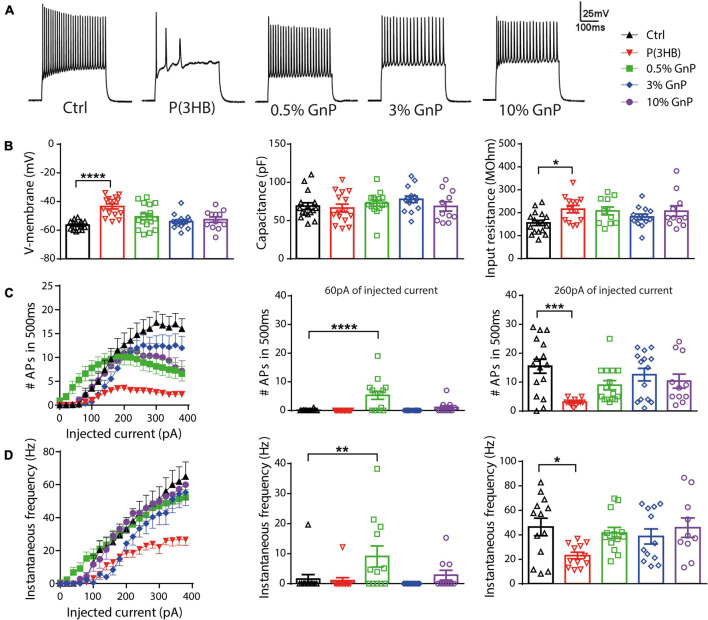
The use of composite biomaterials as innovative bio-friendly neuronal interfaces has been poorly developed so far. Smart strategies to target neuro-pathologies are currently exploiting the mixed and complementary characteristics of composite materials to better design future neural interfaces. Here we present a polymer-based scaffold that has been rendered suitable for primary neurons by embedding graphene nanoplatelets (GnP). In particular, the growth, network formation, and functionality of primary neurons on poly(3-hydroxybutyrate) [P(3HB)] polymer supports functionalized with various concentrations of GnP were explored. After growing primary cortical neurons onto the supports for 14 days, all specimens were found to be biocompatible, revealing physiological growth and maturation of the neuronal network. When network functionality was investigated by whole patch-clamp measurements, pure P(3HB) led to changes in the action potential waveform and reduction in firing frequency, resulting in decreased neuronal excitability. However, the addition of GnP to the polymer matrix restored the electrophysiological parameters to physiological values. Interestingly, a low concentration of graphene was able to promote firing activity at a low level of injected current. The results indicate that the P(3HB)/GnP composites show great potential for electrical interfacing with primary neurons to eventually target central nervous system disorders.
到目前为止,复合生物材料作为创新的生物友好型神经界面的应用还很不完善。针对神经病理学的智能策略目前正在利用复合材料的混合和互补特性,以更好地设计未来的神经界面。在此,我们展示了一种通过嵌入石墨烯纳米片(GnP)而适用于原代神经元的聚合物基支架。具体而言,我们研究了在不同浓度GnP功能化的聚(3-羟基丁酸酯)[P(3HB)]聚合物载体上原代神经元的生长、网络形成和功能。将原代皮质神经元接种到载体上培养14天后,发现所有标本均具有生物相容性,显示出神经网络的生理性生长和成熟。当通过全细胞膜片钳测量研究网络功能时,纯P(3HB)导致动作电位波形改变和放电频率降低,导致神经元兴奋性降低。然而,向聚合物基质中添加GnP可将电生理参数恢复到生理值。有趣的是,低浓度的石墨烯能够在低注入电流水平下促进放电活动。结果表明,P(3HB)/GnP复合材料在与原代神经元进行电连接以最终治疗中枢神经系统疾病方面具有巨大潜力。