• 文献检索
  • 文档翻译
  • 深度研究
  • 学术资讯
  • Suppr Zotero 插件Zotero 插件
  • 邀请有礼
  • 套餐&价格
  • 历史记录
应用&插件
Suppr Zotero 插件Zotero 插件浏览器插件Mac 客户端Windows 客户端微信小程序
定价
高级版会员购买积分包购买API积分包
服务
文献检索文档翻译深度研究API 文档MCP 服务
关于我们
关于 Suppr公司介绍联系我们用户协议隐私条款
关注我们

Suppr 超能文献

核心技术专利:CN118964589B侵权必究
粤ICP备2023148730 号-1Suppr @ 2026

文献检索

告别复杂PubMed语法,用中文像聊天一样搜索,搜遍4000万医学文献。AI智能推荐,让科研检索更轻松。

立即免费搜索

文件翻译

保留排版,准确专业,支持PDF/Word/PPT等文件格式,支持 12+语言互译。

免费翻译文档

深度研究

AI帮你快速写综述,25分钟生成高质量综述,智能提取关键信息,辅助科研写作。

立即免费体验

一种用于预测急诊科胸痛患者重症监护结局的机器学习模型。

A machine learning model to predict critical care outcomes in patient with chest pain visiting the emergency department.

机构信息

The School of Nursing, Fujian Medical University, Fuzhou, Fujian, China.

Department of Emergency, Fujian Provincial Hospital, Fuzhou, Fujian, China.

出版信息

BMC Emerg Med. 2021 Oct 7;21(1):112. doi: 10.1186/s12873-021-00501-8.

DOI:10.1186/s12873-021-00501-8
PMID:34620086
原文链接:https://pmc.ncbi.nlm.nih.gov/articles/PMC8496015/
Abstract

BACKGROUND

Currently, the risk stratification of critically ill patient with chest pain is a challenge. We aimed to use machine learning approach to predict the critical care outcomes in patients with chest pain, and simultaneously compare its performance with HEART, GRACE, and TIMI scores.

METHODS

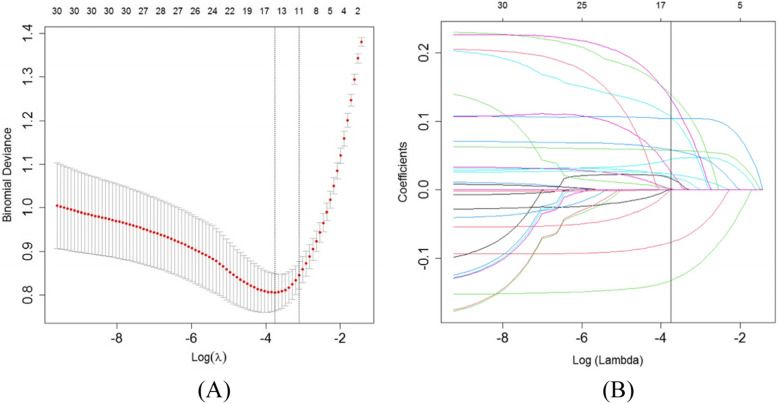
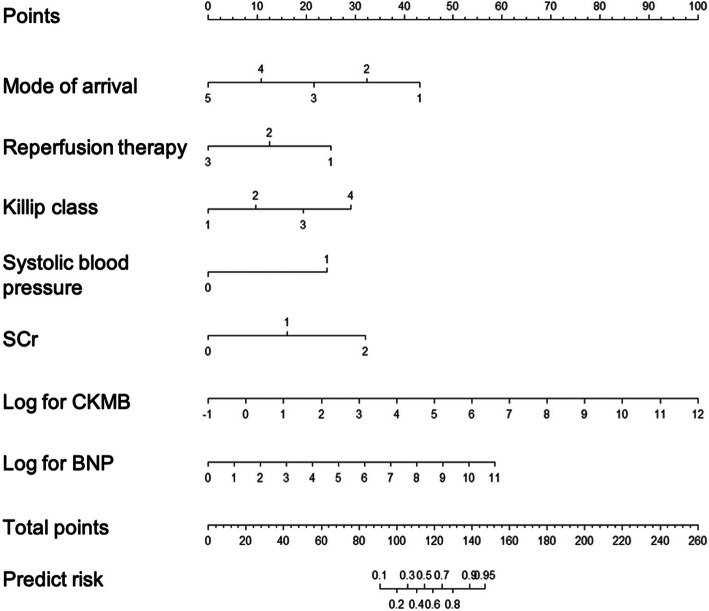
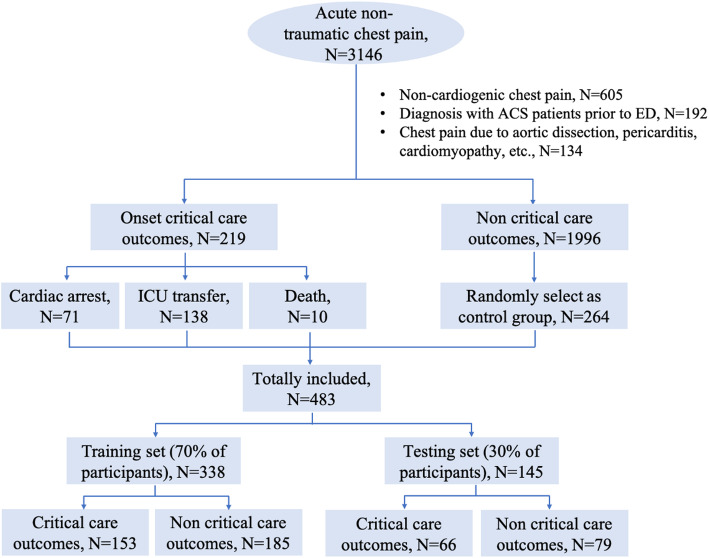
This was a retrospective, case-control study in patients with acute non-traumatic chest pain who presented to the emergency department (ED) between January 2017 and December 2019. The outcomes included cardiac arrest, transfer to ICU, and death during treatment in ED. In the randomly sampled training set (70%), a LASSO regression model was developed, and presented with nomogram. The performance was measured in both training set (70% participants) and testing set (30% participants), and findings were compared with the three widely used scores.

RESULTS

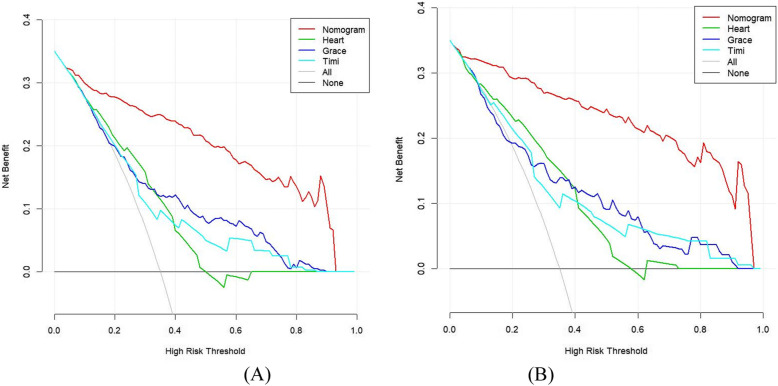
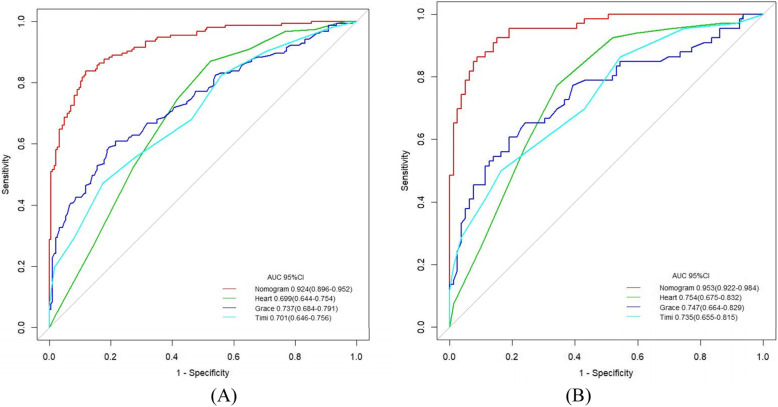
We proposed a LASSO regression model incorporating mode of arrival, reperfusion therapy, Killip class, systolic BP, serum creatinine, creatine kinase-MB, and brain natriuretic peptide as independent predictors of critical care outcomes in patients with chest pain. Our model significantly outperformed the HEART, GRACE, TIMI score with AUC of 0.953 (95%CI: 0.922-0.984), 0.754 (95%CI: 0.675-0.832), 0.747 (95%CI: 0.664-0.829), 0.735 (95%CI: 0.655-0.815), respectively. Consistently, our model demonstrated better outcomes regarding the metrics of accuracy, sensitivity, specificity, positive predictive value, negative predictive value, and F1 score. Similarly, the decision curve analysis elucidated a greater net benefit of our model over the full ranges of clinical thresholds.

CONCLUSION

We present an accurate model for predicting the critical care outcomes in patients with chest pain, and provide substantial support to its application as a decision-making tool in ED.

摘要

背景

目前,对胸痛危重症患者进行风险分层是一个挑战。我们旨在采用机器学习方法预测胸痛患者的重症监护结局,并同时比较其与 HEART、GRACE 和 TIMI 评分的性能。

方法

这是一项回顾性病例对照研究,纳入 2017 年 1 月至 2019 年 12 月期间因急性非创伤性胸痛就诊于急诊科的患者。结局包括心脏骤停、转入 ICU 和 ED 治疗期间死亡。在随机抽样的训练集中(70%的参与者),建立了 LASSO 回归模型,并呈现为列线图。在训练集(70%的参与者)和测试集(30%的参与者)中测量性能,并与三种广泛使用的评分进行比较。

结果

我们提出了一个 LASSO 回归模型,将到达方式、再灌注治疗、Killip 分级、收缩压、血清肌酐、肌酸激酶同工酶和脑利钠肽作为胸痛患者重症监护结局的独立预测因子。我们的模型在 AUC 方面显著优于 HEART、GRACE 和 TIMI 评分,分别为 0.953(95%CI:0.922-0.984)、0.754(95%CI:0.675-0.832)和 0.747(95%CI:0.664-0.829)、0.735(95%CI:0.655-0.815)。同样,我们的模型在准确性、敏感性、特异性、阳性预测值、阴性预测值和 F1 评分等方面的表现都更好。同样,决策曲线分析表明,与全范围临床阈值相比,我们的模型具有更大的净获益。

结论

我们提出了一种用于预测胸痛患者重症监护结局的准确模型,并为其作为 ED 决策工具的应用提供了有力支持。
https://cdn.ncbi.nlm.nih.gov/pmc/blobs/4982/8496015/91715b1f1746/12873_2021_501_Fig5_HTML.jpg
https://cdn.ncbi.nlm.nih.gov/pmc/blobs/4982/8496015/6fdb799b3270/12873_2021_501_Fig1_HTML.jpg
https://cdn.ncbi.nlm.nih.gov/pmc/blobs/4982/8496015/2307a13050d7/12873_2021_501_Fig2_HTML.jpg
https://cdn.ncbi.nlm.nih.gov/pmc/blobs/4982/8496015/efb348acb290/12873_2021_501_Fig3_HTML.jpg
https://cdn.ncbi.nlm.nih.gov/pmc/blobs/4982/8496015/e117e5f06f4b/12873_2021_501_Fig4_HTML.jpg
https://cdn.ncbi.nlm.nih.gov/pmc/blobs/4982/8496015/91715b1f1746/12873_2021_501_Fig5_HTML.jpg
https://cdn.ncbi.nlm.nih.gov/pmc/blobs/4982/8496015/6fdb799b3270/12873_2021_501_Fig1_HTML.jpg
https://cdn.ncbi.nlm.nih.gov/pmc/blobs/4982/8496015/2307a13050d7/12873_2021_501_Fig2_HTML.jpg
https://cdn.ncbi.nlm.nih.gov/pmc/blobs/4982/8496015/efb348acb290/12873_2021_501_Fig3_HTML.jpg
https://cdn.ncbi.nlm.nih.gov/pmc/blobs/4982/8496015/e117e5f06f4b/12873_2021_501_Fig4_HTML.jpg
https://cdn.ncbi.nlm.nih.gov/pmc/blobs/4982/8496015/91715b1f1746/12873_2021_501_Fig5_HTML.jpg

相似文献

1
A machine learning model to predict critical care outcomes in patient with chest pain visiting the emergency department.一种用于预测急诊科胸痛患者重症监护结局的机器学习模型。
BMC Emerg Med. 2021 Oct 7;21(1):112. doi: 10.1186/s12873-021-00501-8.
2
Emergency department triage prediction of clinical outcomes using machine learning models.运用机器学习模型对急诊科患者临床结局进行分诊预测。
Crit Care. 2019 Feb 22;23(1):64. doi: 10.1186/s13054-019-2351-7.
3
Machine Learning-Based Prediction of Clinical Outcomes for Children During Emergency Department Triage.基于机器学习的急诊科分诊中儿童临床结局预测。
JAMA Netw Open. 2019 Jan 4;2(1):e186937. doi: 10.1001/jamanetworkopen.2018.6937.
4
Advancing Emergency Department Triage Prediction With Machine Learning to Optimize Triage for Abdominal Pain Surgery Patients.利用机器学习提高急诊科分诊预测能力,优化腹痛手术患者的分诊。
Surg Innov. 2024 Dec;31(6):583-597. doi: 10.1177/15533506241273449. Epub 2024 Aug 16.
5
Chest pain presenting to the Emergency Department--to stratify risk with GRACE or TIMI?因胸痛就诊于急诊科——采用GRACE评分还是TIMI评分来分层风险?
Resuscitation. 2007 Jul;74(1):90-3. doi: 10.1016/j.resuscitation.2006.11.023. Epub 2007 Mar 13.
6
Comparing HEART, TIMI, and GRACE scores for prediction of 30-day major adverse cardiac events in high acuity chest pain patients in the emergency department.比较HEART、TIMI和GRACE评分对急诊科高敏胸痛患者30天主要不良心脏事件的预测价值。
Int J Cardiol. 2016 Oct 15;221:759-64. doi: 10.1016/j.ijcard.2016.07.147. Epub 2016 Jul 10.
7
Comparison of the GRACE, HEART and TIMI score to predict major adverse cardiac events in chest pain patients at the emergency department.比较GRACE、HEART和TIMI评分以预测急诊科胸痛患者的主要不良心脏事件。
Int J Cardiol. 2017 Jan 15;227:656-661. doi: 10.1016/j.ijcard.2016.10.080. Epub 2016 Oct 30.
8
Development and Assessment of an Interpretable Machine Learning Triage Tool for Estimating Mortality After Emergency Admissions.开发和评估一种可解释的机器学习分诊工具,用于估算急诊入院后的死亡率。
JAMA Netw Open. 2021 Aug 2;4(8):e2118467. doi: 10.1001/jamanetworkopen.2021.18467.
9
Risk stratifying chest pain patients in the emergency department using HEART, GRACE and TIMI scores, with a single contemporary troponin result, to predict major adverse cardiac events.使用 HEART、GRACE 和 TIMI 评分以及单次当代肌钙蛋白结果对急诊科胸痛患者进行风险分层,以预测主要不良心脏事件。
Emerg Med J. 2018 Jul;35(7):420-427. doi: 10.1136/emermed-2017-207172. Epub 2018 Apr 5.
10
Utilizing machine learning dimensionality reduction for risk stratification of chest pain patients in the emergency department.利用机器学习降维对急诊科胸痛患者进行风险分层。
BMC Med Res Methodol. 2021 Apr 17;21(1):74. doi: 10.1186/s12874-021-01265-2.

引用本文的文献

1
Research status, hotspots and perspectives of artificial intelligence applied to pain management: a bibliometric and visual analysis.人工智能应用于疼痛管理的研究现状、热点与展望:一项文献计量学与可视化分析
Updates Surg. 2025 Jun 28. doi: 10.1007/s13304-025-02296-w.
2
A meta-analysis of the diagnostic test accuracy of artificial intelligence predicting emergency department dispositions.人工智能预测急诊科处置情况诊断测试准确性的荟萃分析。
BMC Med Inform Decis Mak. 2025 May 15;25(1):187. doi: 10.1186/s12911-025-03010-x.
3
Machine Learning Applications in Acute Coronary Syndrome: Diagnosis, Outcomes and Management.

本文引用的文献

1
Heart rate n-variability (HRnV) and its application to risk stratification of chest pain patients in the emergency department.心率变异性(HRnV)及其在急诊科胸痛患者危险分层中的应用。
BMC Cardiovasc Disord. 2020 Apr 10;20(1):168. doi: 10.1186/s12872-020-01455-8.
2
Clinical outcomes and need for intensive care after non-ST-segment-elevation myocardial infarction.非 ST 段抬高型心肌梗死患者的临床转归和对重症监护的需求。
Eur J Intern Med. 2020 Jun;76:58-63. doi: 10.1016/j.ejim.2020.02.008. Epub 2020 Feb 20.
3
Heart Disease and Stroke Statistics-2020 Update: A Report From the American Heart Association.
机器学习在急性冠状动脉综合征中的应用:诊断、预后与管理
Adv Ther. 2025 Feb;42(2):636-665. doi: 10.1007/s12325-024-03060-z. Epub 2024 Dec 6.
4
Improving triage performance in emergency departments using machine learning and natural language processing: a systematic review.利用机器学习和自然语言处理提高急诊科分诊性能的系统评价。
BMC Emerg Med. 2024 Nov 18;24(1):219. doi: 10.1186/s12873-024-01135-2.
5
Use of Artificial Intelligence in Triage in Hospital Emergency Departments: A Scoping Review.人工智能在医院急诊科分诊中的应用:一项范围综述
Cureus. 2024 May 8;16(5):e59906. doi: 10.7759/cureus.59906. eCollection 2024 May.
6
Use of Artificial Intelligence in Improving Outcomes in Heart Disease: A Scientific Statement From the American Heart Association.人工智能在改善心脏病治疗效果中的应用:美国心脏协会的科学声明。
Circulation. 2024 Apr 2;149(14):e1028-e1050. doi: 10.1161/CIR.0000000000001201. Epub 2024 Feb 28.
7
Current challenges in adopting machine learning to critical care and emergency medicine.将机器学习应用于重症监护和急诊医学的当前挑战。
Clin Exp Emerg Med. 2023 Jun;10(2):132-137. doi: 10.15441/ceem.23.041. Epub 2023 May 15.
8
An external validation study of the Score for Emergency Risk Prediction (SERP), an interpretable machine learning-based triage score for the emergency department.基于可解释机器学习的急诊分诊评分——急诊风险预测评分(SERP)的外部验证研究。
Sci Rep. 2022 Oct 19;12(1):17466. doi: 10.1038/s41598-022-22233-w.
9
Emerging Applications of Deep Learning in Bone Tumors: Current Advances and Challenges.深度学习在骨肿瘤中的新兴应用:当前进展与挑战
Front Oncol. 2022 Jul 19;12:908873. doi: 10.3389/fonc.2022.908873. eCollection 2022.
《心脏病与卒中统计-2020 更新:来自美国心脏协会的报告》。
Circulation. 2020 Mar 3;141(9):e139-e596. doi: 10.1161/CIR.0000000000000757. Epub 2020 Jan 29.
4
Developing neural network models for early detection of cardiac arrest in emergency department.开发用于急诊科心脏骤停早期检测的神经网络模型。
Am J Emerg Med. 2020 Jan;38(1):43-49. doi: 10.1016/j.ajem.2019.04.006. Epub 2019 Apr 7.
5
Emergency department triage prediction of clinical outcomes using machine learning models.运用机器学习模型对急诊科患者临床结局进行分诊预测。
Crit Care. 2019 Feb 22;23(1):64. doi: 10.1186/s13054-019-2351-7.
6
HEART Score Risk Stratification of Low-Risk Chest Pain Patients in the Emergency Department: A Systematic Review and Meta-Analysis.急诊低危胸痛患者 HEART 评分风险分层:系统评价和荟萃分析。
Ann Emerg Med. 2019 Aug;74(2):187-203. doi: 10.1016/j.annemergmed.2018.12.010. Epub 2019 Feb 2.
7
Machine Learning-Based Prediction of Clinical Outcomes for Children During Emergency Department Triage.基于机器学习的急诊科分诊中儿童临床结局预测。
JAMA Netw Open. 2019 Jan 4;2(1):e186937. doi: 10.1001/jamanetworkopen.2018.6937.
8
Comparison of clinical risk scores for triaging high-risk chest pain patients at the emergency department.比较用于急诊科高危胸痛患者分诊的临床风险评分。
Am J Emerg Med. 2019 Mar;37(3):461-467. doi: 10.1016/j.ajem.2018.06.020. Epub 2018 Jun 8.
9
Risk Score to Predict Need for Intensive Care in Initially Hemodynamically Stable Adults With Non-ST-Segment-Elevation Myocardial Infarction.预测最初血流动力学稳定的非 ST 段抬高型心肌梗死成人需要重症监护的风险评分。
J Am Heart Assoc. 2018 May 25;7(11):e008894. doi: 10.1161/JAHA.118.008894.
10
Secondary analysis of frequency, circumstances and consequences of calculation errors of the HEART (history, ECG, age, risk factors and troponin) score at the emergency departments of nine hospitals in the Netherlands.对荷兰九家医院急诊科HEART(病史、心电图、年龄、危险因素和肌钙蛋白)评分计算错误的频率、情况及后果进行二次分析。
BMJ Open. 2017 Oct 22;7(10):e017259. doi: 10.1136/bmjopen-2017-017259.