Zhou Xiaowen, Wang Hua, Feng Chengyao, Xu Ruilin, He Yu, Li Lan, Tu Chao
Department of Orthopaedics, The Second Xiangya Hospital, Central South University, Changsha, China.
Xiangya School of Medicine, Central South University, Changsha, China.
Front Oncol. 2022 Jul 19;12:908873. doi: 10.3389/fonc.2022.908873. eCollection 2022.
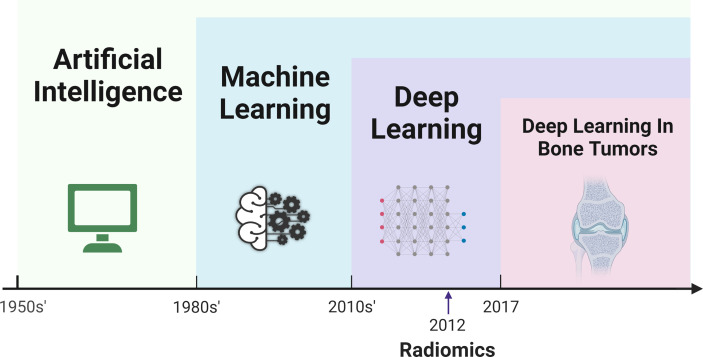
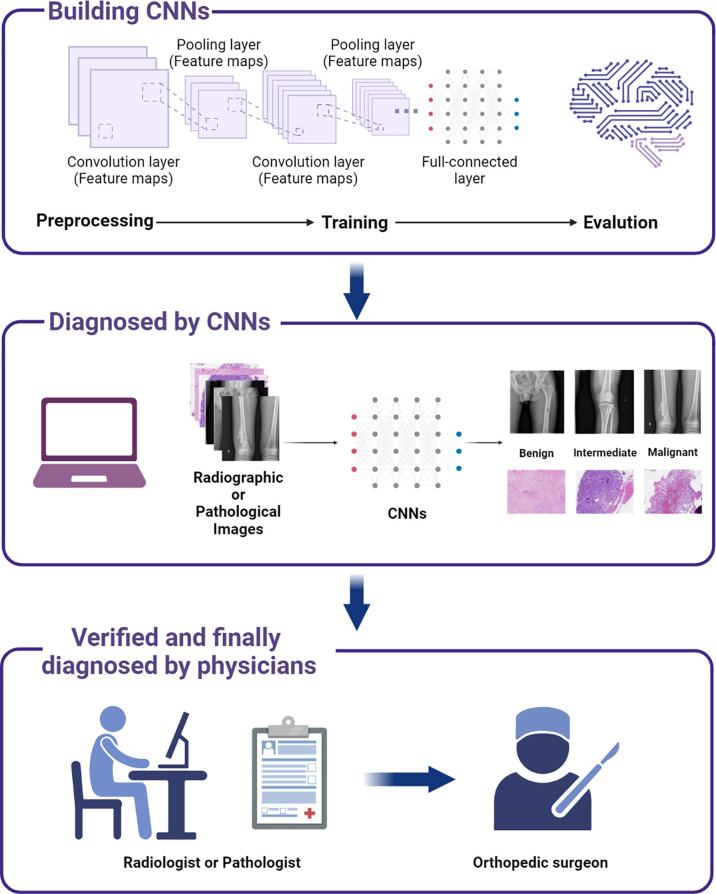
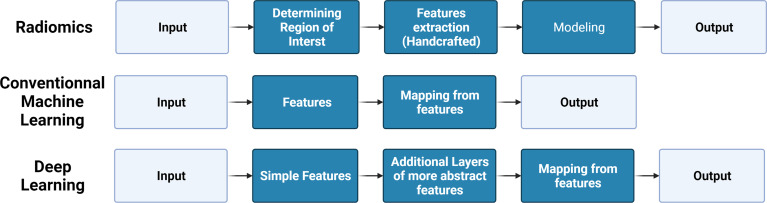
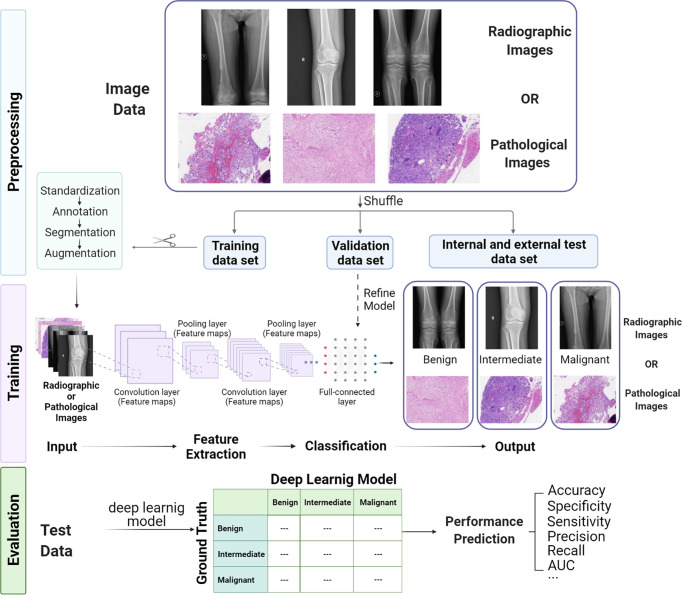
Deep learning is a subfield of state-of-the-art artificial intelligence (AI) technology, and multiple deep learning-based AI models have been applied to musculoskeletal diseases. Deep learning has shown the capability to assist clinical diagnosis and prognosis prediction in a spectrum of musculoskeletal disorders, including fracture detection, cartilage and spinal lesions identification, and osteoarthritis severity assessment. Meanwhile, deep learning has also been extensively explored in diverse tumors such as prostate, breast, and lung cancers. Recently, the application of deep learning emerges in bone tumors. A growing number of deep learning models have demonstrated good performance in detection, segmentation, classification, volume calculation, grading, and assessment of tumor necrosis rate in primary and metastatic bone tumors based on both radiological (such as X-ray, CT, MRI, SPECT) and pathological images, implicating a potential for diagnosis assistance and prognosis prediction of deep learning in bone tumors. In this review, we first summarized the workflows of deep learning methods in medical images and the current applications of deep learning-based AI for diagnosis and prognosis prediction in bone tumors. Moreover, the current challenges in the implementation of the deep learning method and future perspectives in this field were extensively discussed.
深度学习是最先进的人工智能(AI)技术的一个子领域,多种基于深度学习的AI模型已应用于肌肉骨骼疾病。深度学习已显示出在一系列肌肉骨骼疾病中辅助临床诊断和预后预测的能力,包括骨折检测、软骨和脊柱病变识别以及骨关节炎严重程度评估。与此同时,深度学习也在前列腺癌、乳腺癌和肺癌等多种肿瘤中得到了广泛探索。最近,深度学习在骨肿瘤中的应用出现了。越来越多的深度学习模型在基于放射学(如X射线、CT、MRI、SPECT)和病理图像的原发性和转移性骨肿瘤的检测、分割、分类、体积计算、分级以及肿瘤坏死率评估方面表现出良好性能,这意味着深度学习在骨肿瘤诊断辅助和预后预测方面具有潜力。在本综述中,我们首先总结了医学图像中深度学习方法的工作流程以及基于深度学习的AI在骨肿瘤诊断和预后预测中的当前应用。此外,还广泛讨论了深度学习方法实施中的当前挑战以及该领域的未来前景。