
与伦巴第大区 COVID-19 疾病严重医院负担相关的风险因素:一项队列研究。
Risk factors associated with severe hospital burden of COVID-19 disease in Regione Lombardia: a cohort study.
机构信息
Medical Research Council Biostatistics Unit, School of Clinical Medicine, University of Cambridge, Cambridge, UK.
Postgraduate School of Public Health, Department of Biomedical Sciences for Health, University of Milan, Milan, Italy.
出版信息
BMC Infect Dis. 2021 Oct 7;21(1):1041. doi: 10.1186/s12879-021-06750-z.
BACKGROUND
Understanding the risk factors associated with hospital burden of COVID-19 is crucial for healthcare planning for any future waves of infection.
METHODS
An observational cohort study is performed, using data on all PCR-confirmed cases of COVID-19 in Regione Lombardia, Italy, during the first wave of infection from February-June 2020. A multi-state modelling approach is used to simultaneously estimate risks of progression through hospital to final outcomes of either death or discharge, by pathway (via critical care or not) and the times to final events (lengths of stay). Logistic and time-to-event regressions are used to quantify the association of patient and population characteristics with the risks of hospital outcomes and lengths of stay respectively.
RESULTS
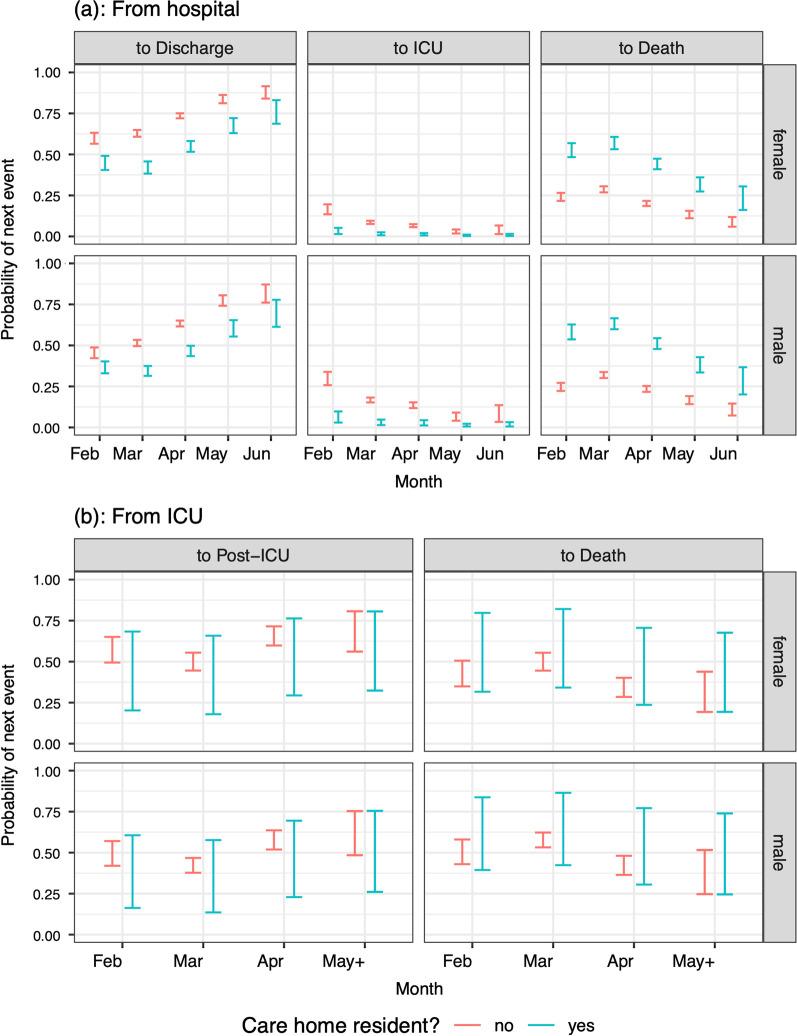
Risks of severe outcomes such as ICU admission and mortality have decreased with month of admission (for example, the odds ratio of ICU admission in June vs March is 0.247 [0.120-0.508]) and increased with age (odds ratio of ICU admission in 45-65 vs 65 + age group is 0.286 [0.201-0.406]). Care home residents aged 65 + are associated with increased risk of hospital mortality and decreased risk of ICU admission. Being a healthcare worker appears to have a protective association with mortality risk (odds ratio of ICU mortality is 0.254 [0.143-0.453] relative to non-healthcare workers) and length of stay. Lengths of stay decrease with month of admission for survivors, but do not appear to vary with month for non-survivors.
CONCLUSIONS
Improvements in clinical knowledge, treatment, patient and hospital management and public health surveillance, together with the waning of the first wave after the first lockdown, are hypothesised to have contributed to the reduced risks and lengths of stay over time.
背景
了解与 COVID-19 医院负担相关的风险因素对于任何未来感染浪潮的医疗保健规划都至关重要。
方法
本研究采用观察性队列研究,使用意大利伦巴第大区 2020 年 2 月至 6 月第一波感染期间所有经聚合酶链反应(PCR)确诊的 COVID-19 病例数据。采用多状态建模方法,同时估计通过重症监护或非重症监护途径进入医院并最终死亡或出院的风险,以及最终事件(住院时间)的时间。使用逻辑回归和生存时间回归分别量化患者和人群特征与医院结局和住院时间风险的相关性。
结果
重症结局(如 ICU 入院和死亡率)的风险随着入院月份而降低(例如,6 月 ICU 入院的比值比为 0.247[0.120-0.508],3 月入院的比值比为 0.120-0.508),随着年龄增加而升高(45-65 岁年龄组 ICU 入院的比值比为 0.286[0.201-0.406],65 岁以上年龄组 ICU 入院的比值比为 0.286[0.201-0.406])。65 岁以上的养老院居民与住院死亡率增加和 ICU 入院风险降低相关。医护人员的死亡率风险(与非医护人员相比,ICU 死亡率的比值比为 0.254[0.143-0.453])和住院时间似乎具有保护相关性。幸存者的住院时间随着入院月份的增加而减少,但非幸存者的住院时间似乎不随月份变化。
结论
随着第一波疫情在第一次封锁后逐渐消退,临床知识、治疗、患者和医院管理以及公共卫生监测的改善,假设这有助于降低风险和住院时间。




 Zotero 插件