Division of Infectious Diseases, Department of Medicine, Edison Family Center for Genome Sciences & Systems Biology, Washington University School of Medicine, St. Louis, MO, USA.
Division of Infectious Diseases, Department of Medicine, Edison Family Center for Genome Sciences & Systems Biology, Washington University School of Medicine, St. Louis, MO, USA; Department of Molecular Microbiology, Washington University School of Medicine, St. Louis, MO, USA.
Trends Immunol. 2021 Nov;42(11):1009-1023. doi: 10.1016/j.it.2021.09.003. Epub 2021 Oct 7.
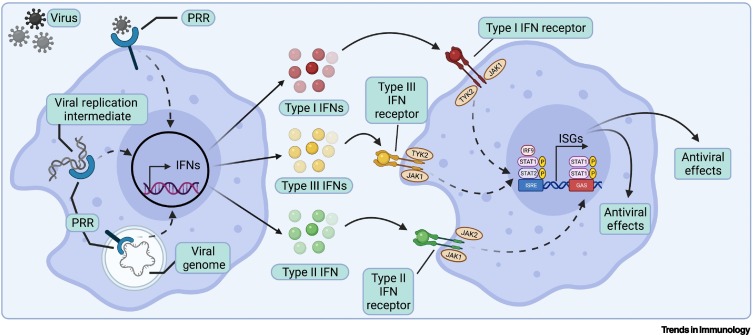
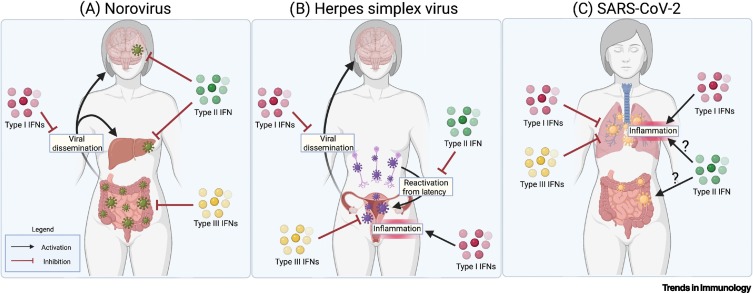
Interferons (IFNs) are among the first vertebrate immune pathways activated upon viral infection and are crucial for control of viral replication and dissemination, especially at mucosal surfaces as key locations for host exposure to pathogens. Inhibition of viral establishment and spread at and from these mucosal sites is paramount for preventing severe disease, while concomitantly limiting putative detrimental effects of inflammation. Here, we compare the roles of type I, II, and III IFNs in regulating three archetypal viruses - norovirus, herpes simplex virus, and severe acute respiratory virus coronavirus 2 (SARS-CoV-2) - which infect distinct mammalian mucosal tissues. Emerging paradigms include highly specific roles for IFNs in limiting local versus systemic infection, synergistic activities, and a spectrum of protective versus detrimental effects of IFNs during the infection response.
干扰素 (IFNs) 是脊椎动物在病毒感染后最早激活的免疫途径之一,对于控制病毒复制和传播至关重要,尤其是在作为宿主暴露于病原体的关键部位的黏膜表面。抑制这些黏膜部位的病毒建立和传播对于预防严重疾病至关重要,同时限制炎症的潜在不利影响。在这里,我们比较了 I 型、II 型和 III 型 IFNs 在调节三种典型病毒(诺如病毒、单纯疱疹病毒和严重急性呼吸综合征冠状病毒 2 (SARS-CoV-2))中的作用,这些病毒感染不同的哺乳动物黏膜组织。新出现的模式包括 IFNs 在限制局部与全身感染、协同作用以及 IFN 在感染反应中的保护与不利影响谱方面的高度特异性作用。