Ye Miaomiao, Lin Yibin, Pan Shuya, Wang Zhi-Wei, Zhu Xueqiong
Center of Uterine Cancer Diagnosis & Therapy Research of Zhejiang Province, Department of Obstetrics and Gynecology, the Second Affiliated Hospital of Wenzhou Medical University, Wenzhou, China.
Front Oncol. 2021 Sep 24;11:745808. doi: 10.3389/fonc.2021.745808. eCollection 2021.
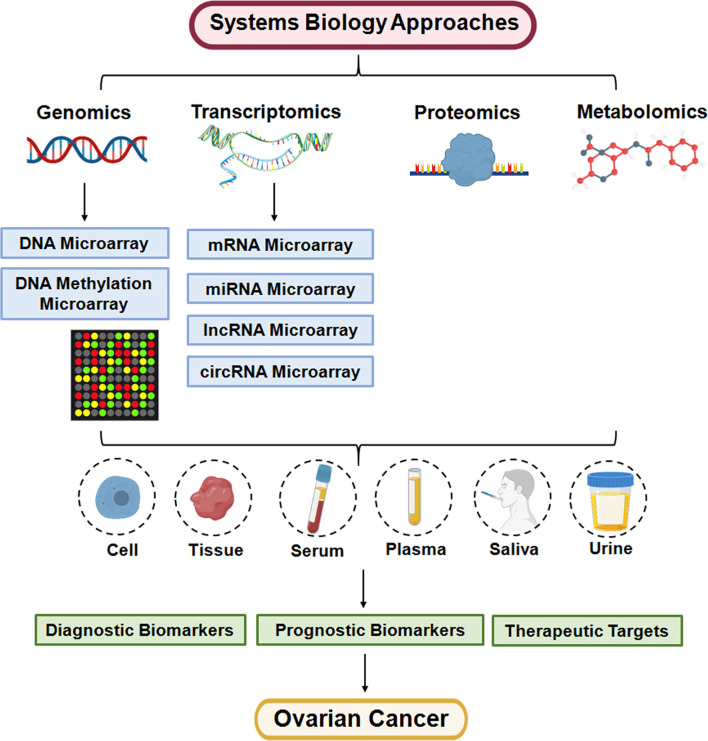
Ovarian cancer ranks as the fifth most common cause of cancer-related death in females. The molecular mechanisms of ovarian carcinogenesis need to be explored in order to identify effective clinical therapies for ovarian cancer. Recently, multi-omics approaches have been applied to determine the mechanisms of ovarian oncogenesis at genomics (DNA), transcriptomics (RNA), proteomics (proteins), and metabolomics (metabolites) levels. Multi-omics approaches can identify some diagnostic and prognostic biomarkers and therapeutic targets for ovarian cancer, and these molecular signatures are beneficial for clarifying the development and progression of ovarian cancer. Moreover, the discovery of molecular signatures and targeted therapy strategies could noticeably improve the prognosis of ovarian cancer patients.
卵巢癌是女性癌症相关死亡的第五大常见原因。为了确定卵巢癌的有效临床治疗方法,需要探索卵巢癌发生的分子机制。最近,多组学方法已被应用于在基因组学(DNA)、转录组学(RNA)、蛋白质组学(蛋白质)和代谢组学(代谢物)水平上确定卵巢肿瘤发生的机制。多组学方法可以识别一些卵巢癌的诊断和预后生物标志物以及治疗靶点,这些分子特征有助于阐明卵巢癌的发展和进展。此外,分子特征和靶向治疗策略的发现可以显著改善卵巢癌患者的预后。