Nam Kihoon, Dos Santos Harim T, Maslow Frank, Trump Bryan G, Lei Pedro, Andreadis Stelios T, Baker Olga J
Bond Life Sciences Center, University of Missouri, Columbia, MO, United States.
Department of Otolaryngology-Head and Neck Surgery, School of Medicine, University of Missouri, Columbia, MO, United States.
Front Bioeng Biotechnol. 2021 Sep 24;9:729180. doi: 10.3389/fbioe.2021.729180. eCollection 2021.
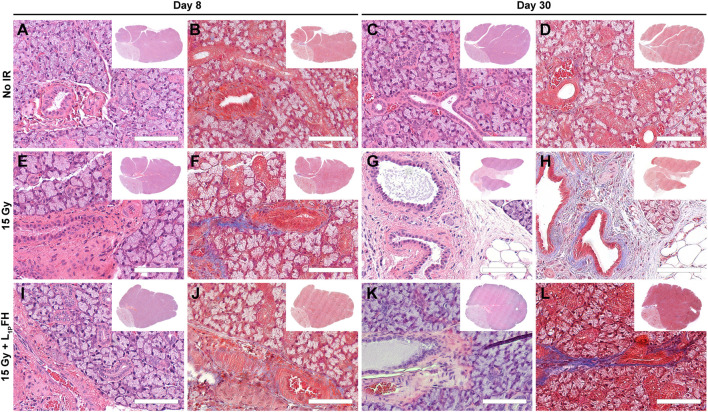
Previous studies demonstrated that salivary gland morphogenesis and differentiation are enhanced by modification of fibrin hydrogels chemically conjugated to Laminin-1 peptides. Specifically, Laminin-1 peptides (A99: CGGALRGDN-amide and YIGSR: CGGADPGYIGSRGAA-amide) chemically conjugated to fibrin promoted formation of newly organized salivary epithelium both ( using organoids) and ( in a wounded mouse model). While these studies were successful, the model's usefulness for inducing regenerative patterns after radiation therapy remains unknown. Therefore, the goal of the current study was to determine whether transdermal injection with the Laminin-1 peptides A99 and YIGSR chemically conjugated to fibrin hydrogels promotes tissue regeneration in irradiated salivary glands. Results indicate that A99 and YIGSR chemically conjugated to fibrin hydrogels promote formation of functional salivary tissue when transdermally injected to irradiated salivary glands. In contrast, when left untreated, irradiated salivary glands display a loss in structure and functionality. Together, these studies indicate that fibrin hydrogel-based implantable scaffolds containing Laminin-1 peptides promote secretory function of irradiated salivary glands.
先前的研究表明,与层粘连蛋白-1肽化学偶联的纤维蛋白水凝胶的修饰可增强唾液腺的形态发生和分化。具体而言,与纤维蛋白化学偶联的层粘连蛋白-1肽(A99:CGGALRGDN-酰胺和YIGSR:CGGADPGYIGSRGAA-酰胺)在(使用类器官)和(在受伤小鼠模型中)均促进了新组织的唾液上皮的形成。虽然这些研究取得了成功,但该模型在放射治疗后诱导再生模式的实用性仍不清楚。因此,本研究的目的是确定经皮注射与纤维蛋白水凝胶化学偶联的层粘连蛋白-1肽A99和YIGSR是否能促进受照射唾液腺的组织再生。结果表明,与纤维蛋白水凝胶化学偶联的A99和YIGSR经皮注射到受照射的唾液腺时,可促进功能性唾液组织的形成。相比之下,未经处理时,受照射的唾液腺会出现结构和功能丧失。总之,这些研究表明,含有层粘连蛋白-1肽的基于纤维蛋白水凝胶的可植入支架可促进受照射唾液腺的分泌功能。