• 文献检索
  • 文档翻译
  • 深度研究
  • 学术资讯
  • Suppr Zotero 插件Zotero 插件
  • 邀请有礼
  • 套餐&价格
  • 历史记录
应用&插件
Suppr Zotero 插件Zotero 插件浏览器插件Mac 客户端Windows 客户端微信小程序
定价
高级版会员购买积分包购买API积分包
服务
文献检索文档翻译深度研究API 文档MCP 服务
关于我们
关于 Suppr公司介绍联系我们用户协议隐私条款
关注我们

Suppr 超能文献

核心技术专利:CN118964589B侵权必究
粤ICP备2023148730 号-1Suppr @ 2026

文献检索

告别复杂PubMed语法,用中文像聊天一样搜索,搜遍4000万医学文献。AI智能推荐,让科研检索更轻松。

立即免费搜索

文件翻译

保留排版,准确专业,支持PDF/Word/PPT等文件格式,支持 12+语言互译。

免费翻译文档

深度研究

AI帮你快速写综述,25分钟生成高质量综述,智能提取关键信息,辅助科研写作。

立即免费体验

临床试验中运动障碍学会统一帕金森病评定量表监测的新方法:纵向项目反应理论模型

Novel Approach to Movement Disorder Society-Unified Parkinson's Disease Rating Scale Monitoring in Clinical Trials: Longitudinal Item Response Theory Models.

作者信息

Luo Sheng, Zou Haotian, Goetz Christopher G, Choi Dongrak, Oakes David, Simuni Tanya, Stebbins Glenn T

机构信息

Department of Biostatistics and Bioinformatics Duke University Durham North Carolina USA.

Department of Biostatistics University of North Carolina at Chapel Hill Chapel Hill North Carolina USA.

出版信息

Mov Disord Clin Pract. 2021 Aug 3;8(7):1083-1091. doi: 10.1002/mdc3.13311. eCollection 2021 Oct.

DOI:10.1002/mdc3.13311
PMID:34631944
原文链接:https://pmc.ncbi.nlm.nih.gov/articles/PMC8485609/
Abstract

BACKGROUND

Although nontremor and tremor Part 3 Movement Disorder Society-Unified Parkinson's Disease Rating Scale items measure different impairment domains, their distinct progression and drug responsivity remain unstudied longitudinally. The total score may obscure important time-based and treatment-based changes occurring in the individual domains.

OBJECTIVE

Using the unique advantages of item response theory (IRT), we developed novel longitudinal unidimensional and multidimensional models to investigate nontremor and tremor changes occurring in an interventional Parkinson's disease (PD) study.

METHOD

With unidimensional longitudinal IRT, we assessed the 33 Part 3 item data (22 nontremor and 10 tremor items) of 336 patients with early PD from the STEADY-PD III (Safety, Tolerability, and Efficacy Assessment of Isradipine for PD, placebo vs. isradipine) study. With multidimensional longitudinal IRT, we assessed the progression rates over time and treatment (in overall motor severity, nontremor, and tremor domains) using Markov Chain Monte Carlo implemented in Stan.

RESULTS

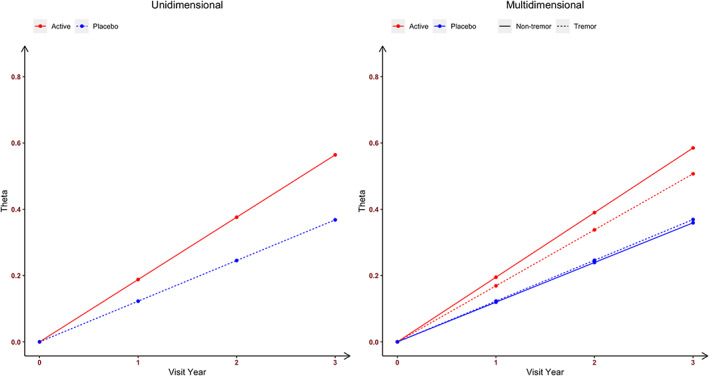
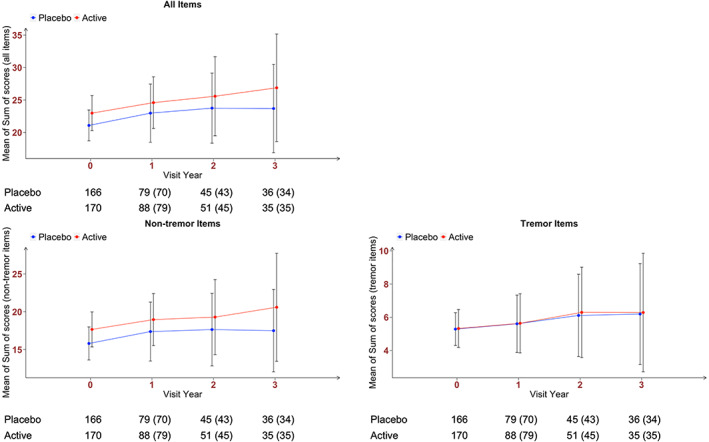
Regardless of treatment, patients showed significant but different time-based deterioration rates for total motor, nontremor, and tremor scores. Isradipine was associated with additional significant deterioration over placebo in total score and nontremor scores, but not in tremor score. Further highlighting the 2 separate latent domains, nontremor and tremor severity changes were positively but weakly correlated (correlation coefficient, 0.108).

CONCLUSIONS

Longitudinal IRT analysis is a novel statistical method highly applicable to PD clinical trials. It addresses limitations of traditional linear regression approaches and previous IRT investigations that either applied cross-sectional IRT models to longitudinal data or failed to estimate all parameters simultaneously. It is particularly useful because it can separate nontremor and tremor changes both over time and in response to treatment interventions.

摘要

背景

尽管非震颤和震颤部分3运动障碍协会统一帕金森病评定量表项目测量的是不同的损伤领域,但它们不同的进展情况和药物反应性尚未进行纵向研究。总分可能会掩盖各个领域中发生的基于时间和治疗的重要变化。

目的

利用项目反应理论(IRT)的独特优势,我们开发了新颖的纵向单维和多维模型,以研究帕金森病(PD)干预性研究中发生的非震颤和震颤变化。

方法

采用单维纵向IRT,我们评估了来自STEADY-PD III(伊拉地平治疗PD的安全性、耐受性和疗效评估,安慰剂与伊拉地平对照)研究的336例早期PD患者的33个部分3项目数据(22个非震颤项目和10个震颤项目)。采用多维纵向IRT,我们使用在Stan中实现的马尔可夫链蒙特卡罗方法评估了随时间和治疗(在总体运动严重程度、非震颤和震颤领域)的进展率。

结果

无论治疗如何,患者在总运动、非震颤和震颤评分方面均显示出显著但不同的基于时间的恶化率。与安慰剂相比,伊拉地平在总分和非震颤评分方面与额外的显著恶化相关,但在震颤评分方面没有。进一步突出了两个独立的潜在领域,非震颤和震颤严重程度变化呈正相关但相关性较弱(相关系数为0.108)。

结论

纵向IRT分析是一种高度适用于PD临床试验的新颖统计方法。它解决了传统线性回归方法和以前IRT研究的局限性,以前的研究要么将横断面IRT模型应用于纵向数据,要么未能同时估计所有参数。它特别有用,因为它可以区分非震颤和震颤随时间以及对治疗干预的变化。
https://cdn.ncbi.nlm.nih.gov/pmc/blobs/5b62/8485609/166b4103b35f/MDC3-8-1083-g002.jpg
https://cdn.ncbi.nlm.nih.gov/pmc/blobs/5b62/8485609/2d56c23738b3/MDC3-8-1083-g001.jpg
https://cdn.ncbi.nlm.nih.gov/pmc/blobs/5b62/8485609/166b4103b35f/MDC3-8-1083-g002.jpg
https://cdn.ncbi.nlm.nih.gov/pmc/blobs/5b62/8485609/2d56c23738b3/MDC3-8-1083-g001.jpg
https://cdn.ncbi.nlm.nih.gov/pmc/blobs/5b62/8485609/166b4103b35f/MDC3-8-1083-g002.jpg

相似文献

1
Novel Approach to Movement Disorder Society-Unified Parkinson's Disease Rating Scale Monitoring in Clinical Trials: Longitudinal Item Response Theory Models.临床试验中运动障碍学会统一帕金森病评定量表监测的新方法:纵向项目反应理论模型
Mov Disord Clin Pract. 2021 Aug 3;8(7):1083-1091. doi: 10.1002/mdc3.13311. eCollection 2021 Oct.
2
Dissecting the Domains of Parkinson's Disease: Insights from Longitudinal Item Response Theory Modeling.剖析帕金森病的领域:来自纵向项目反应理论建模的见解。
Mov Disord. 2022 Sep;37(9):1904-1914. doi: 10.1002/mds.29154. Epub 2022 Jul 16.
3
Item Response Theory Analysis of the MDS-UPDRS Motor Examination: Tremor vs. Nontremor Items.MDS-UPDRS 运动检查的项目反应理论分析:震颤与非震颤项目。
Mov Disord. 2020 Sep;35(9):1587-1595. doi: 10.1002/mds.28110. Epub 2020 May 29.
4
Using Movement Disorder Society Unified Parkinson's Disease Rating Scale Parts 2 and 3 Simultaneously: Combining the Patient Voice with Clinician Ratings.同时使用运动障碍学会统一帕金森病评定量表第 2 部分和第 3 部分:将患者声音与临床医生评分相结合。
Mov Disord. 2023 Mar;38(3):453-463. doi: 10.1002/mds.29308. Epub 2023 Jan 9.
5
Application of longitudinal item response theory models to modeling Parkinson's disease progression.纵向项目反应理论模型在帕金森病进展建模中的应用。
CPT Pharmacometrics Syst Pharmacol. 2022 Oct;11(10):1382-1392. doi: 10.1002/psp4.12853. Epub 2022 Aug 9.
6
Modelling item scores of Unified Parkinson's Disease Rating Scale Part III for greater trial efficiency.建立统一帕金森病评定量表第三部分的项目评分模型以提高试验效率。
Br J Clin Pharmacol. 2021 Sep;87(9):3608-3618. doi: 10.1111/bcp.14777. Epub 2021 Mar 15.
7
Zonisamide effects on sleep problems and depressive symptoms in Parkinson's disease.左乙拉西坦对帕金森病睡眠问题和抑郁症状的影响。
Brain Behav. 2021 Mar;11(3):e02026. doi: 10.1002/brb3.2026. Epub 2021 Jan 5.
8
Structural connectivity differences in motor network between tremor-dominant and nontremor Parkinson's disease.震颤为主型与非震颤型帕金森病运动网络的结构连接差异
Hum Brain Mapp. 2017 Sep;38(9):4716-4729. doi: 10.1002/hbm.23697. Epub 2017 Jun 20.
9
Predicting the longitudinal changes of levodopa dose requirements in Parkinson's disease using item response theory assessment of real-world Unified Parkinson's Disease Rating Scale.使用真实世界统一帕金森病评定量表的项目反应理论评估预测帕金森病左旋多巴剂量需求的纵向变化。
CPT Pharmacometrics Syst Pharmacol. 2021 Jun;10(6):611-621. doi: 10.1002/psp4.12632. Epub 2021 May 3.
10
Longitudinal Change and Progression Indicators Using the Movement Disorder Society-Unified Parkinson's Disease Rating Scale in Two Independent Cohorts with Early Parkinson's Disease.在两个独立的早期帕金森病队列中,使用运动障碍协会统一帕金森病评定量表的纵向变化和进展指标
J Parkinsons Dis. 2022;12(1):437-452. doi: 10.3233/JPD-212860.

引用本文的文献

1
Sparse item testing of clinical scales in neurology trials to alleviate burden to patients.神经病学试验中临床量表的稀疏项目测试以减轻患者负担。
J Neurol. 2024 Oct;271(10):6847-6855. doi: 10.1007/s00415-024-12650-4. Epub 2024 Aug 30.
2
Assessing tilavonemab efficacy in early Alzheimer's disease via longitudinal item response theory modeling.通过纵向项目反应理论建模评估替拉沃单抗在早期阿尔茨海默病中的疗效。
Alzheimers Dement (N Y). 2024 Jun 4;10(2):e12471. doi: 10.1002/trc2.12471. eCollection 2024 Apr-Jun.
3
Using Movement Disorder Society Unified Parkinson's Disease Rating Scale Parts 2 and 3 Simultaneously: Combining the Patient Voice with Clinician Ratings.

本文引用的文献

1
Modelling item scores of Unified Parkinson's Disease Rating Scale Part III for greater trial efficiency.建立统一帕金森病评定量表第三部分的项目评分模型以提高试验效率。
Br J Clin Pharmacol. 2021 Sep;87(9):3608-3618. doi: 10.1111/bcp.14777. Epub 2021 Mar 15.
2
Performance of longitudinal item response theory models in shortened or partial assessments.在缩短或部分评估中纵向项目反应理论模型的性能。
J Pharmacokinet Pharmacodyn. 2020 Oct;47(5):461-471. doi: 10.1007/s10928-020-09697-x. Epub 2020 Jul 2.
3
Item Response Theory Analysis of the MDS-UPDRS Motor Examination: Tremor vs. Nontremor Items.
同时使用运动障碍学会统一帕金森病评定量表第 2 部分和第 3 部分:将患者声音与临床医生评分相结合。
Mov Disord. 2023 Mar;38(3):453-463. doi: 10.1002/mds.29308. Epub 2023 Jan 9.
4
Application of longitudinal item response theory models to modeling Parkinson's disease progression.纵向项目反应理论模型在帕金森病进展建模中的应用。
CPT Pharmacometrics Syst Pharmacol. 2022 Oct;11(10):1382-1392. doi: 10.1002/psp4.12853. Epub 2022 Aug 9.
5
Dissecting the Domains of Parkinson's Disease: Insights from Longitudinal Item Response Theory Modeling.剖析帕金森病的领域:来自纵向项目反应理论建模的见解。
Mov Disord. 2022 Sep;37(9):1904-1914. doi: 10.1002/mds.29154. Epub 2022 Jul 16.
MDS-UPDRS 运动检查的项目反应理论分析:震颤与非震颤项目。
Mov Disord. 2020 Sep;35(9):1587-1595. doi: 10.1002/mds.28110. Epub 2020 May 29.
4
Isradipine Versus Placebo in Early Parkinson Disease: A Randomized Trial.氨氯地平与安慰剂治疗早期帕金森病的随机试验
Ann Intern Med. 2020 May 5;172(9):591-598. doi: 10.7326/M19-2534. Epub 2020 Mar 31.
5
Item Response Model Adaptation for Analyzing Data from Different Versions of Parkinson's Disease Rating Scales.帕金森病评定量表不同版本数据的项目反应模型适应性分析。
Pharm Res. 2019 Jul 17;36(9):135. doi: 10.1007/s11095-019-2668-6.
6
Does the MDS-UPDRS provide the precision to assess progression in early Parkinson's disease? Learnings from the Parkinson's progression marker initiative cohort.MDS-UPDRS 是否能精确评估早期帕金森病的进展?帕金森病进展标志物倡议队列的研究结果。
J Neurol. 2019 Aug;266(8):1927-1936. doi: 10.1007/s00415-019-09348-3. Epub 2019 May 9.
7
Progression of MDS-UPDRS Scores Over Five Years in De Novo Parkinson Disease from the Parkinson's Progression Markers Initiative Cohort.帕金森病进展标志物计划队列中初发性帕金森病患者的MDS-UPDRS评分五年进展情况
Mov Disord Clin Pract. 2018 Jan-Feb;5(1):47-53. doi: 10.1002/mdc3.12553. Epub 2017 Sep 22.
8
DYNAMIC PREDICTION FOR MULTIPLE REPEATED MEASURES AND EVENT TIME DATA: AN APPLICATION TO PARKINSON'S DISEASE.多重复测量和事件时间数据的动态预测:在帕金森病中的应用
Ann Appl Stat. 2017 Sep;11(3):1787-1809. doi: 10.1214/17-AOAS1059. Epub 2017 Oct 5.
9
Item Response Theory as an Efficient Tool to Describe a Heterogeneous Clinical Rating Scale in De Novo Idiopathic Parkinson's Disease Patients.项目反应理论作为一种有效的工具,可用于描述初发性特发性帕金森病患者中具有异质性的临床评分量表。
Pharm Res. 2017 Oct;34(10):2109-2118. doi: 10.1007/s11095-017-2216-1. Epub 2017 Jul 10.
10
A Longitudinal Item Response Theory Model to Characterize Cognition Over Time in Elderly Subjects.一种用于描述老年受试者随时间变化的认知功能的纵向项目反应理论模型。
CPT Pharmacometrics Syst Pharmacol. 2017 Sep;6(9):635-641. doi: 10.1002/psp4.12219. Epub 2017 Aug 29.