Department of Pediatrics, The Cognitive Neurophysiology Laboratory, Albert Einstein College of Medicine, Bronx, New York.
Department of Neuroscience, Albert Einstein College of Medicine, Bronx, New York.
J Neurophysiol. 2021 Nov 1;126(5):1783-1798. doi: 10.1152/jn.00329.2021. Epub 2021 Oct 13.
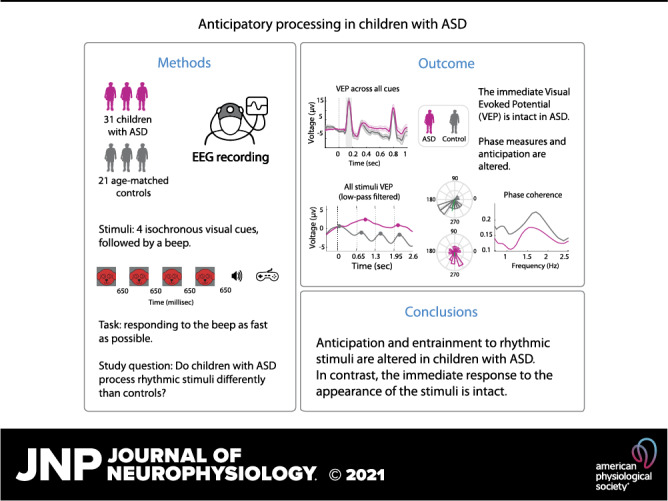
Anticipating near-future events is fundamental to adaptive behavior, whereby neural processing of predictable stimuli is significantly facilitated relative to nonpredictable events. Neural oscillations appear to be a key anticipatory mechanism by which processing of upcoming stimuli is modified, and they often entrain to rhythmic environmental sequences. Clinical and anecdotal observations have led to the hypothesis that people with autism spectrum disorder (ASD) may have deficits in generating predictions, and as such, a candidate neural mechanism may be failure to adequately entrain neural activity to repetitive environmental patterns, to facilitate temporal predictions. We tested this hypothesis by interrogating temporal predictions and rhythmic entrainment using behavioral and electrophysiological approaches. We recorded high-density electroencephalography in children with ASD and typically developing (TD) age- and IQ-matched controls, while they reacted to an auditory target as quickly as possible. This auditory event was either preceded by predictive rhythmic visual cues or was not preceded by any cue. Both ASD and control groups presented comparable behavioral facilitation in response to the Cue versus No-Cue condition, challenging the hypothesis that children with ASD have deficits in generating temporal predictions. Analyses of the electrophysiological data, in contrast, revealed significantly reduced neural entrainment to the visual cues and altered anticipatory processes in the ASD group. This was the case despite intact stimulus-evoked visual responses. These results support intact behavioral temporal prediction in response to a cue in ASD, in the face of altered neural entrainment and anticipatory processes. We examined behavioral and EEG indices of predictive processing in children with ASD to rhythmically predictable stimuli. Although behavioral measures of predictive processing and evoked neural responses were intact in the ASD group, neurophysiological measures of preparatory activity and entrainment were impaired. When sensory events are presented in a predictable temporal pattern, performance and neuronal responses in ASD may be governed more by the occurrence of the events themselves and less by their anticipated timing.
预测近期事件是适应行为的基础,在此过程中,相对于不可预测的事件,可显著促进对可预测刺激的神经处理。神经振荡似乎是一种关键的预期机制,通过该机制,对即将到来的刺激的处理会发生改变,并且它们通常会与节奏环境序列同步。临床和轶事观察导致了这样一种假设,即患有自闭症谱系障碍(ASD)的人可能在产生预测方面存在缺陷,因此,候选神经机制可能是无法充分将神经活动与重复的环境模式同步,以促进时间预测。我们通过使用行为和电生理方法来检验这一假设,研究了时间预测和节奏同步。我们在患有 ASD 和具有年龄和智商匹配的典型发育(TD)对照组的儿童中记录了高密度脑电图,同时他们尽快对听觉目标做出反应。这个听觉事件要么之前有预测性的节奏视觉线索,要么没有任何线索。ASD 和对照组在对 Cue 与 No-Cue 条件的反应中都表现出了类似的行为促进,这挑战了 ASD 儿童在产生时间预测方面存在缺陷的假设。相比之下,对电生理数据的分析表明,ASD 组的视觉线索的神经同步明显减少,并且预测过程发生了改变。尽管视觉刺激的诱发反应保持完整,但仍然如此。这些结果支持 ASD 中存在对线索做出反应的行为时间预测,尽管存在神经同步和预测过程的改变。我们在 ASD 儿童中检查了对节奏可预测刺激的预测处理的行为和 EEG 指标。尽管 ASD 组的预测处理的行为和诱发神经反应的测量值完整,但预备活动和同步的神经生理测量值受损。当感官事件以可预测的时间模式呈现时,ASD 中的表现和神经元反应可能更多地由事件的发生本身决定,而较少地由其预期时间决定。