Department of Public Health, North South University, Dhaka, Bangladesh.
Nutrition and Clinical Services Division (NCSD), International Centre for Diarrhoeal Disease Research, Bangladesh (ICDDR, B), Mohakhali, Dhaka, Bangladesh.
PLoS One. 2021 Oct 13;16(10):e0257421. doi: 10.1371/journal.pone.0257421. eCollection 2021.
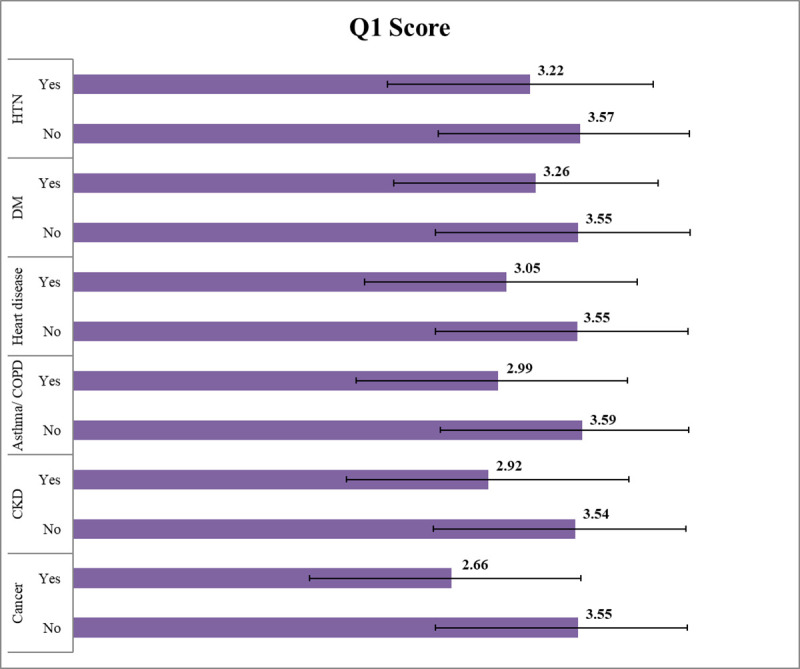
Coronavirus Disease-2019 (COVID-19) quickly surged the whole world and affected people's physical, mental, and social health thereby upsetting their quality of life. Therefore, we aimed to investigate the quality of life (QoL) of COVID-19 positive patients after recovery in Bangladesh. This was a study of adult (aged ≥18 years) COVID-19 individuals from eight divisions of Bangladesh diagnosed and confirmed by Reverse Transcription-Polymerase Chain Reaction (RT-PCR) from June 2020 to November 2020. Given a response rate of 60% in a pilot study, a random list of 6400 COVID-19 patients was generated to recruit approximately 3200 patients from eight divisions of Bangladesh and finally a total of 3244 participants could be recruited for the current study. The validated Bangla version of the World Health Organization Quality of Life Brief (WHOQOL-BREF) questionnaire was used to assess the QoL. Data were analyzed by STATA (Version 16.1) and R (Version 4.0.0). All the procedures were conducted following ethical approval and in accordance with the Declaration of Helsinki. The mean scores of QoL were highest for the physical domain (68.25±14.45) followed by social (65.10±15.78), psychological (63.28±15.48), and environmental domain (62.77±13.07). Psychological and physical domain scores among females were significantly lower than the males (p<0.001). The overall quality of life was lower in persons having a chronic disease. Participants over 45 years of age were 52% less likely to enjoy good physical health than the participants aged below 26 years (AOR: 0.48, CI: 0.28-0.82). The quality of life of employed participants was found 1.8 times higher than the unemployed (AOR: 1.80, CI: 1.11-2.91). Those who were admitted to hospitals during infection had a low QoL score in physical, psychological, and socials domains. However, QoL improved in all aspect except the psychological domain for each day passed after the diagnosis. These findings call for a focus on the quality of life of the COVID-19 affected population, with special emphasis given to females, older adults, unemployed, and people with comorbidities.
2019 年冠状病毒病(COVID-19)迅速席卷全球,影响了人们的身心健康,从而扰乱了他们的生活质量。因此,我们旨在调查孟加拉国 COVID-19 康复患者的生活质量(QoL)。这是一项针对孟加拉国八个地区成年(年龄≥18 岁)COVID-19 个体的研究,这些个体通过逆转录-聚合酶链反应(RT-PCR)于 2020 年 6 月至 2020 年 11 月被诊断和确认。在一项试点研究中,响应率为 60%,生成了一个随机的 6400 名 COVID-19 患者名单,以从孟加拉国的八个地区招募约 3200 名患者,最终共有 3244 名参与者被招募参加当前研究。使用经过验证的 Bangla 版本世界卫生组织生活质量简表(WHOQOL-BREF)问卷评估生活质量。数据由 STATA(版本 16.1)和 R(版本 4.0.0)进行分析。所有程序均经过伦理批准,并按照《赫尔辛基宣言》进行。生活质量的平均得分最高的是身体领域(68.25±14.45),其次是社会领域(65.10±15.78)、心理领域(63.28±15.48)和环境领域(62.77±13.07)。女性的心理和身体领域得分明显低于男性(p<0.001)。患有慢性病的人的整体生活质量较低。45 岁以上的参与者享受良好身体健康的可能性比 26 岁以下的参与者低 52%(AOR:0.48,CI:0.28-0.82)。与失业者相比,就业参与者的生活质量高出 1.8 倍(AOR:1.80,CI:1.11-2.91)。在感染期间住院的人在身体、心理和社会领域的生活质量评分较低。然而,自诊断以来,除了心理领域外,生活质量在各个方面都有所提高。这些发现呼吁关注 COVID-19 受影响人群的生活质量,特别关注女性、老年人、失业者和患有合并症的人群。