Center for Infection and Inflammation Research, University of Luebeck, Luebeck, Germany.
German Center for Infection Research (DZIF), Standort Hamburg-Borstel-Luebeck-Riems, Luebeck, Germany.
Front Public Health. 2021 Sep 27;9:732787. doi: 10.3389/fpubh.2021.732787. eCollection 2021.
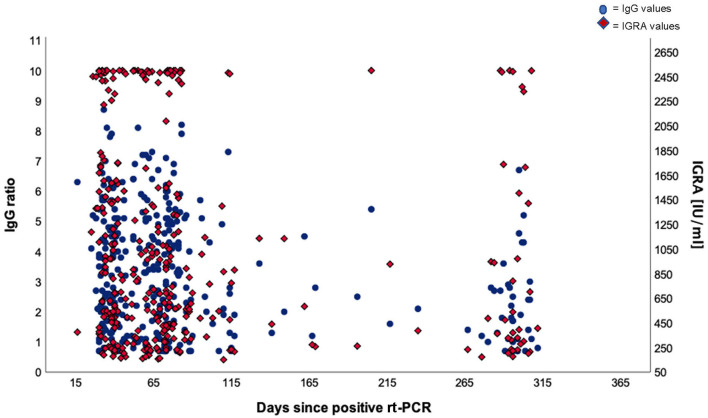
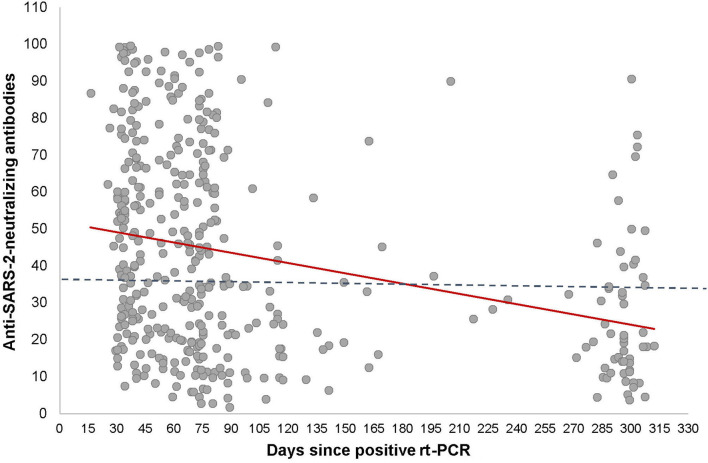
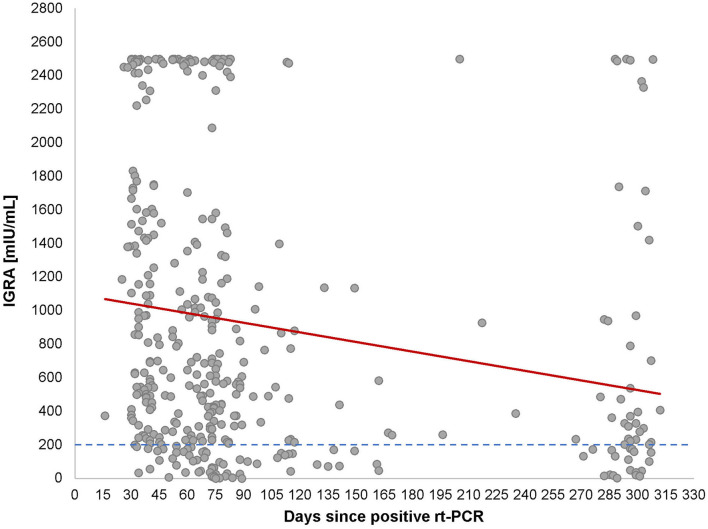
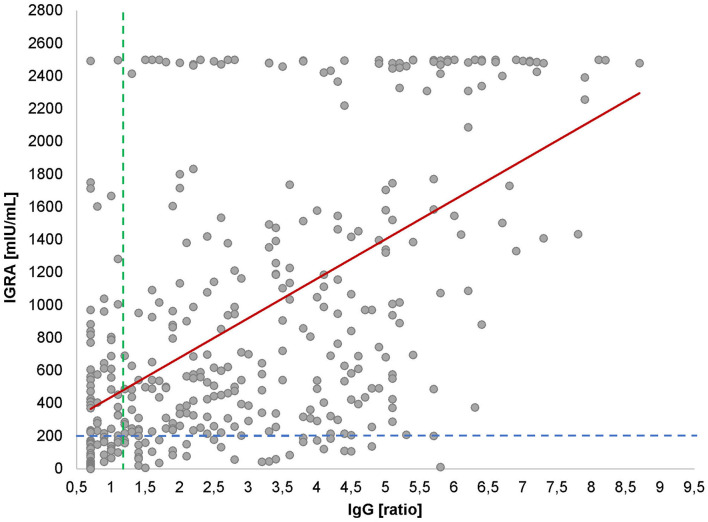
Characterization of the naturally acquired B and T cell immune responses to severe acute respiratory syndrome coronavirus 2 (SARS-CoV-2) is important for the development of public health and vaccination strategies to manage the burden of COVID-19 disease. We conducted a prospective, cross-sectional analysis in COVID-19 recovered patients at various time points over a 10-month period in order to investigate how circulating antibody levels and interferon-gamma (IFN-γ) release by peripheral blood cells change over time following natural infection. From March 2020 till January 2021, we enrolled 412 adults mostly with mild or moderate disease course. At each study visit, subjects donated peripheral blood for testing of anti-SARS-CoV-2 IgG antibodies and IFN-γ release after SARS-CoV-2 S-protein stimulation. Anti-SARS-CoV-2 immunoglobulin G (IgG) antibodies were positive in 316 of 412 (76.7%) and borderline in 31 of 412 (7.5%) patients. Our confirmation assay for the presence of neutralizing antibodies was positive in 215 of 412 (52.2%) and borderline in 88 of 412 (21.4%) patients. Likewise, in 274 of 412 (66.5%) positive IFN-γ release and IgG antibodies were detected. With respect to time after infection, both IgG antibody levels and IFN-γ concentrations decreased by about half within 300 days. Statistically, production of IgG and IFN-γ were closely associated, but on an individual basis, we observed patients with high-antibody titres but low IFN-γ levels and vice versa. Our data suggest that immunological reaction is acquired in most individuals after natural infection with SARS-CoV-2 and is sustained in the majority of patients for at least 10 months after infection after a mild or moderate disease course. Since, so far, no robust marker for protection against COVID-19 exists, we recommend utilizing both, IgG and IFN-γ release for an individual assessment of the immunity status.
对严重急性呼吸综合征冠状病毒 2(SARS-CoV-2)的自然获得的 B 和 T 细胞免疫反应进行特征分析对于制定公共卫生和疫苗接种策略以管理 COVID-19 疾病负担非常重要。我们对 COVID-19 恢复期患者进行了前瞻性、横断面分析,在 10 个月的时间内对不同时间点的患者进行了研究,以调查自然感染后外周血循环抗体水平和干扰素-γ(IFN-γ)释放随时间的变化情况。从 2020 年 3 月到 2021 年 1 月,我们招募了 412 名成年人,他们主要患有轻度或中度疾病。在每次研究访问中,受试者均捐献外周血,以检测抗 SARS-CoV-2 IgG 抗体和 SARS-CoV-2 S 蛋白刺激后外周血单个核细胞(PBMC)释放 IFN-γ。在 412 名患者中,有 316 名(76.7%)和 31 名(7.5%)患者的抗 SARS-CoV-2 免疫球蛋白 G(IgG)抗体呈阳性。我们的中和抗体存在的确认检测在 412 名患者中有 215 名(52.2%)和 88 名(21.4%)患者为阳性。同样,在 412 名患者中有 274 名(66.5%)检测到阳性 IFN-γ释放和 IgG 抗体。就感染后时间而言,在 300 天内,IgG 抗体水平和 IFN-γ 浓度均下降约一半。从统计学上讲,IgG 抗体和 IFN-γ 的产生密切相关,但就个体而言,我们观察到高抗体滴度但 IFN-γ 水平低的患者和相反的患者。我们的数据表明,在大多数个体中,自然感染 SARS-CoV-2 后会获得免疫反应,并且在轻度或中度疾病后至少 10 个月内,大多数患者的免疫反应会持续存在。由于迄今为止,尚无针对 COVID-19 的强大保护标志物,因此我们建议同时使用 IgG 和 IFN-γ 释放来评估个体的免疫状态。