Heslop Kareem A, Milesi Veronica, Maldonado Eduardo N
Department of Drug Discovery and Biomedical Sciences, Medical University of South Carolina, Charleston, SC, United States.
Facultad de Ciencias Exactas, Instituto de Estudios Inmunológicos y Fisiopatológicos (IIFP), UNLP, CONICET, CIC PBA, La Plata, Argentina.
Front Physiol. 2021 Sep 29;12:742839. doi: 10.3389/fphys.2021.742839. eCollection 2021.
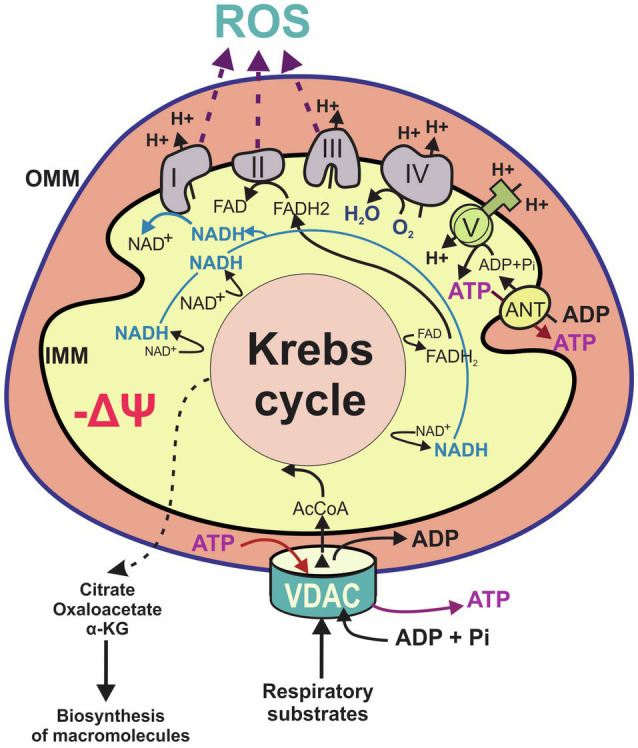
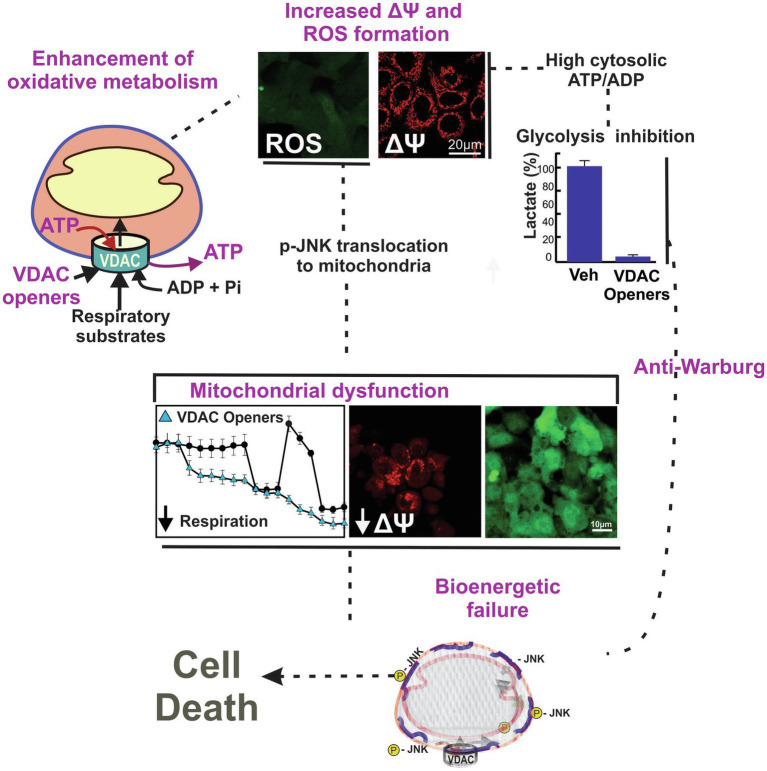
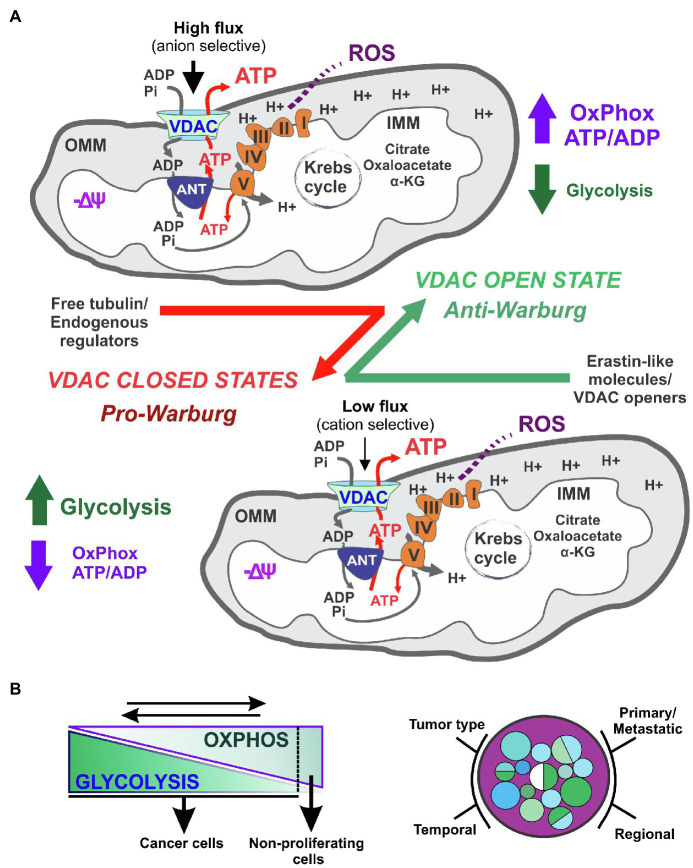
Most anionic metabolites including respiratory substrates, glycolytic adenosine triphosphate (ATP), and small cations that enter mitochondria, and mitochondrial ATP moving to the cytosol, cross the outer mitochondrial membrane (OMM) through voltage dependent anion channels (VDAC). The closed states of VDAC block the passage of anionic metabolites, and increase the flux of small cations, including calcium. Consequently, physiological or pharmacological regulation of VDAC opening, by conditioning the magnitude of both anion and cation fluxes, is a major contributor to mitochondrial metabolism. Tumor cells display a pro-proliferative Warburg phenotype characterized by enhanced aerobic glycolysis in the presence of partial suppression of mitochondrial metabolism. The heterogeneous and flexible metabolic traits of most human tumors render cells able to adapt to the constantly changing energetic and biosynthetic demands by switching between predominantly glycolytic or oxidative phenotypes. Here, we describe the biological consequences of changes in the conformational state of VDAC for cancer metabolism, the mechanisms by which VDAC-openers promote cancer cell death, and the advantages of VDAC opening as a valuable pharmacological target. Particular emphasis is given to the endogenous regulation of VDAC by free tubulin and the effects of VDAC-tubulin antagonists in cancer cells. Because of its function and location, VDAC operates as a switch to turn-off mitochondrial metabolism (closed state) and increase aerobic glycolysis (pro-Warburg), or to turn-on mitochondrial metabolism (open state) and decrease glycolysis (anti-Warburg). A better understanding of the role of VDAC regulation in tumor progression is relevant both for cancer biology and for developing novel cancer chemotherapies.
大多数阴离子代谢物,包括呼吸底物、糖酵解三磷酸腺苷(ATP)以及进入线粒体的小阳离子,还有从线粒体转运至细胞质的线粒体ATP,都是通过电压依赖性阴离子通道(VDAC)穿过线粒体外膜(OMM)的。VDAC的关闭状态会阻止阴离子代谢物的通过,并增加包括钙在内的小阳离子的通量。因此,通过调节阴离子和阳离子通量的大小,对VDAC开放进行生理或药理调节是线粒体代谢的一个主要因素。肿瘤细胞表现出一种促增殖的瓦伯格表型,其特征是在部分线粒体代谢受抑制的情况下有氧糖酵解增强。大多数人类肿瘤具有异质性和灵活的代谢特征,这使得细胞能够通过在主要的糖酵解或氧化表型之间切换来适应不断变化的能量和生物合成需求。在这里,我们描述了VDAC构象状态变化对癌症代谢的生物学影响、VDAC开放剂促进癌细胞死亡的机制,以及将VDAC开放作为一个有价值的药理靶点的优势。特别强调了游离微管蛋白对VDAC的内源性调节以及VDAC-微管蛋白拮抗剂在癌细胞中的作用。由于其功能和位置,VDAC起着一个开关的作用,关闭线粒体代谢(关闭状态)并增加有氧糖酵解(促进瓦伯格效应),或者开启线粒体代谢(开放状态)并减少糖酵解(抗瓦伯格效应)。更好地理解VDAC调节在肿瘤进展中的作用对于癌症生物学和开发新型癌症化疗药物都具有重要意义。