Gong Tao, Fu Jie, Shi Lexuan, Chen Xin, Zong Xin
Key Laboratory of Molecular Animal Nutrition, Ministry of Education, College of Animal Sciences, Zhejiang University, Hangzhou, China.
Guangzhou Dublin International College of Life Sciences and Technology, South China Agricultural University, Guangzhou, China.
Front Nutr. 2021 Sep 30;8:751010. doi: 10.3389/fnut.2021.751010. eCollection 2021.
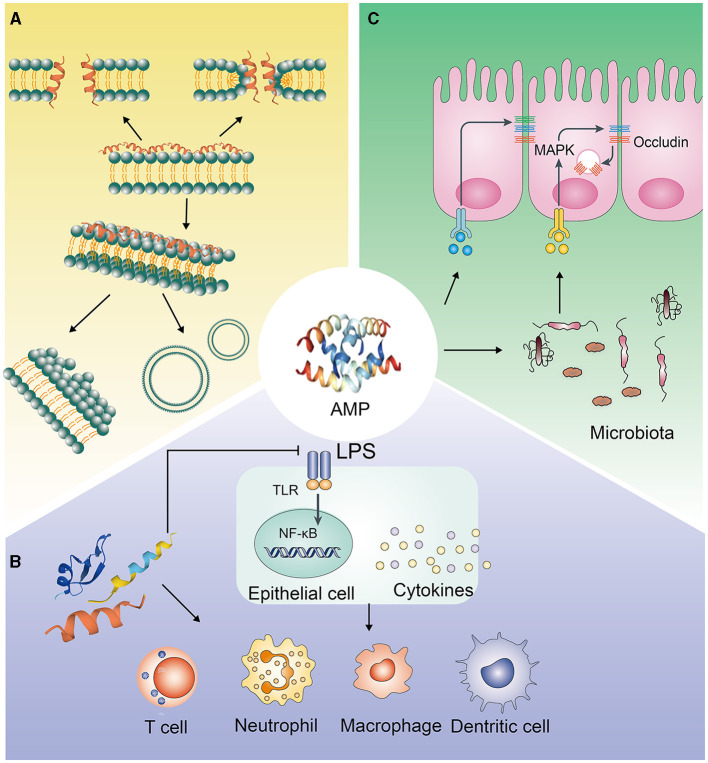
Animal antimicrobial peptides (AMPs), known as broad-spectrum and high-efficiency antibacterial activity, are important effector molecules in innate immune system. AMPs not only have antimicrobial, antiviral and antitumor effects but also exhibit important effects , such as anti-inflammatory response, recruiting immune cells, promoting epithelial damage repair, and promoting phagocytosis of bacteria. However, research on the application of AMPs is incomplete and controversial. This review mainly introduces the classification of AMPs, biological functions, as well as the mechanisms of action, expression rules, and nutrition regulation from three perspectives, aiming to provide important information for the application of AMPs.
动物抗菌肽(AMPs)具有广谱、高效的抗菌活性,是天然免疫系统中的重要效应分子。抗菌肽不仅具有抗菌、抗病毒和抗肿瘤作用,还表现出重要的效应,如抗炎反应、募集免疫细胞、促进上皮损伤修复以及促进细菌吞噬作用。然而,关于抗菌肽应用的研究并不完整且存在争议。本综述主要从三个方面介绍抗菌肽的分类、生物学功能以及作用机制、表达规律和营养调控,旨在为抗菌肽的应用提供重要信息。