Heyerdahl Leonardo W, Lana Benedetta, Giles-Vernick Tamara
Department of Global Health, Anthropology and Ecology of Disease Emergence Unit Institut Pasteur Paris France.
JMIR Infodemiology. 2021 Oct 6;1(1):e27472. doi: 10.2196/27472. eCollection 2021 Jan-Dec.
The COVID-19 pandemic has been widely described as an infodemic, an excess of rapidly circulating information in social and traditional media in which some information may be erroneous, contradictory, or inaccurate. One key theme cutting across many infodemic analyses is that it stymies users' capacities to identify appropriate information and guidelines, encourages them to take inappropriate or even harmful actions, and should be managed through multiple transdisciplinary approaches. Yet, investigations demonstrating how the COVID-19 information ecosystem influences complex public decision making and behavior offline are relatively few.
The aim of this study was to investigate whether information reported through the social media channel Twitter, linked articles and websites, and selected traditional media affected the risk perception, engagement in field activities, and protective behaviors of French Red Cross (FRC) volunteers and health workers in the Paris region of France from June to October 2020.
We used a hybrid approach that blended online and offline data. We tracked daily Twitter discussions and selected traditional media in France for 7 months, qualitatively evaluating COVID-19 claims and debates about nonpharmaceutical protective measures. We conducted 24 semistructured interviews with FRC workers and volunteers.
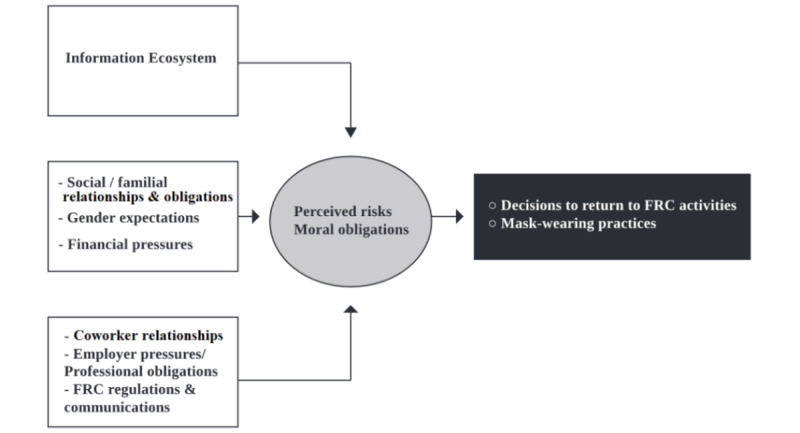
Social and traditional media debates about viral risks and nonpharmaceutical interventions fanned anxieties among FRC volunteers and workers. Decisions to continue conducting FRC field activities and daily protective practices were also influenced by other factors unrelated to the infodemic: familial and social obligations, gender expectations, financial pressures, FRC rules and communications, state regulations, and relationships with coworkers. Some respondents developed strategies for "tuning out" social and traditional media.
This study suggests that during the COVID-19 pandemic, the information ecosystem may be just one among multiple influences on one group's offline perceptions and behavior. Measures to address users who have disengaged from online sources of health information and who rely on social relationships to obtain information are needed. Tuning out can potentially lead to less informed decision making, leading to worse health outcomes.
新冠疫情被广泛描述为一场信息疫情,即社会媒体和传统媒体中迅速传播的过量信息,其中一些信息可能是错误、矛盾或不准确的。许多信息疫情分析的一个关键主题是,它阻碍了用户识别适当信息和指南的能力,鼓励他们采取不适当甚至有害的行动,因此应通过多种跨学科方法加以管理。然而,关于新冠疫情信息生态系统如何影响线下复杂公共决策和行为的调查相对较少。
本研究旨在调查通过社交媒体渠道推特、链接文章和网站以及选定的传统媒体报道的信息,是否影响了2020年6月至10月法国巴黎地区法国红十字会(FRC)志愿者和卫生工作者的风险认知、参与实地活动情况以及防护行为。
我们采用了一种融合在线和离线数据的混合方法。我们跟踪了法国推特上的每日讨论以及选定的传统媒体,为期7个月,对关于新冠疫情的说法以及有关非药物防护措施的辩论进行定性评估。我们对FRC工作人员和志愿者进行了24次半结构化访谈。
社交媒体和传统媒体关于病毒风险和非药物干预措施的辩论加剧了FRC志愿者和工作人员的焦虑情绪。继续开展FRC实地活动的决策以及日常防护措施也受到了与信息疫情无关的其他因素的影响:家庭和社会义务、性别期望、经济压力、FRC的规定和沟通、国家法规以及与同事的关系。一些受访者制定了“屏蔽”社交媒体和传统媒体的策略。
本研究表明,在新冠疫情期间,信息生态系统可能只是影响某一群体线下认知和行为的多种因素之一。需要采取措施应对那些不再使用在线健康信息来源、而是依靠社会关系获取信息的用户。屏蔽信息可能会导致决策时了解的信息较少,从而导致更差的健康结果。