School of Medicine and University Hospital, Federal University of Minas Gerais, Belo Horizonte, Brazil.
Clinical Research Center, Fundación Valle del Lili, Cali, Colombia.
Bull World Health Organ. 2022 Sep 1;100(9):544-561. doi: 10.2471/BLT.21.287654. Epub 2022 Jun 30.
To compare and summarize the literature regarding infodemics and health misinformation, and to identify challenges and opportunities for addressing the issues of infodemics.
We searched MEDLINE®, Embase®, Cochrane Library of Systematic Reviews, Scopus and Epistemonikos on 6 May 2022 for systematic reviews analysing infodemics, misinformation, disinformation and fake news related to health. We grouped studies based on similarity and retrieved evidence on challenges and opportunities. We used the AMSTAR 2 approach to assess the reviews' methodological quality. To evaluate the quality of the evidence, we used the Grading of Recommendations Assessment, Development and Evaluation guidelines.
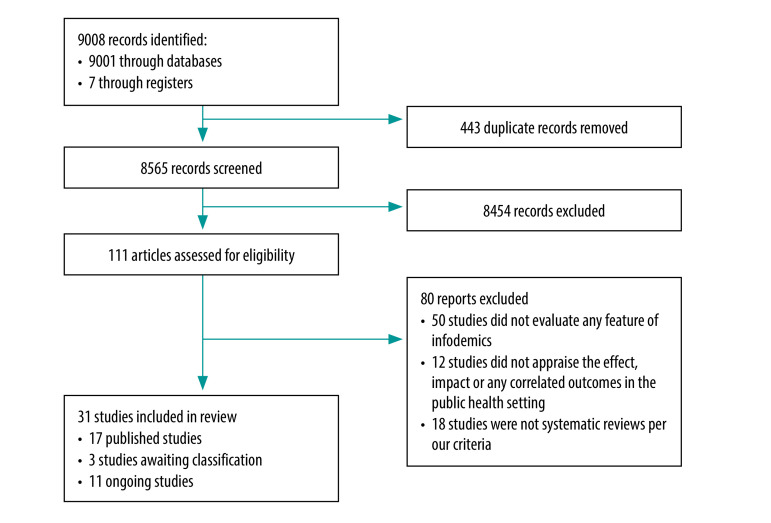
Our search identified 31 systematic reviews, of which 17 were published. The proportion of health-related misinformation on social media ranged from 0.2% to 28.8%. Twitter, Facebook, YouTube and Instagram are critical in disseminating the rapid and far-reaching information. The most negative consequences of health misinformation are the increase of misleading or incorrect interpretations of available evidence, impact on mental health, misallocation of health resources and an increase in vaccination hesitancy. The increase of unreliable health information delays care provision and increases the occurrence of hateful and divisive rhetoric. Social media could also be a useful tool to combat misinformation during crises. Included reviews highlight the poor quality of published studies during health crises.
Available evidence suggests that infodemics during health emergencies have an adverse effect on society. Multisectoral actions to counteract infodemics and health misinformation are needed, including developing legal policies, creating and promoting awareness campaigns, improving health-related content in mass media and increasing people's digital and health literacy.
比较和总结有关信息疫情和健康错误信息的文献,并确定应对信息疫情问题的挑战和机遇。
我们于 2022 年 5 月 6 日在 MEDLINE、Embase、Cochrane 系统评价图书馆、Scopus 和 Epistemonikos 上检索了分析与健康相关的信息疫情、错误信息、虚假信息和假新闻的系统评价。我们根据相似性对研究进行分组,并检索有关挑战和机遇的证据。我们使用 AMSTAR 2 方法评估综述的方法学质量。为了评估证据的质量,我们使用了推荐评估、制定和评估指南(Grading of Recommendations Assessment, Development and Evaluation guidelines)。
我们的搜索共确定了 31 篇系统评价,其中 17 篇已发表。社交媒体上与健康相关的错误信息比例从 0.2%到 28.8%不等。Twitter、Facebook、YouTube 和 Instagram 在传播快速而广泛传播的信息方面至关重要。健康错误信息最负面的后果是增加对现有证据的误导性或不正确的解释、对心理健康的影响、对卫生资源的错误分配以及增加疫苗犹豫。不可靠的健康信息的增加会延迟护理的提供,并增加仇恨和分裂言论的发生。社交媒体也可能是在危机期间打击错误信息的有用工具。纳入的综述强调了在健康危机期间发表的研究质量较差。
现有证据表明,健康紧急情况下的信息疫情对社会有不利影响。需要采取多部门行动来对抗信息疫情和健康错误信息,包括制定法律政策、创建和宣传活动、改善大众媒体中的健康相关内容以及提高人们的数字和健康素养。