Ragon Institute of MGH, MIT, and Harvard, Cambridge, MA 02139, USA.
PhD Program in Virology, Division of Medical Sciences, Harvard University, Boston, MA 02115, USA.
Sci Transl Med. 2021 Oct 27;13(617):eabi8631. doi: 10.1126/scitranslmed.abi8631.
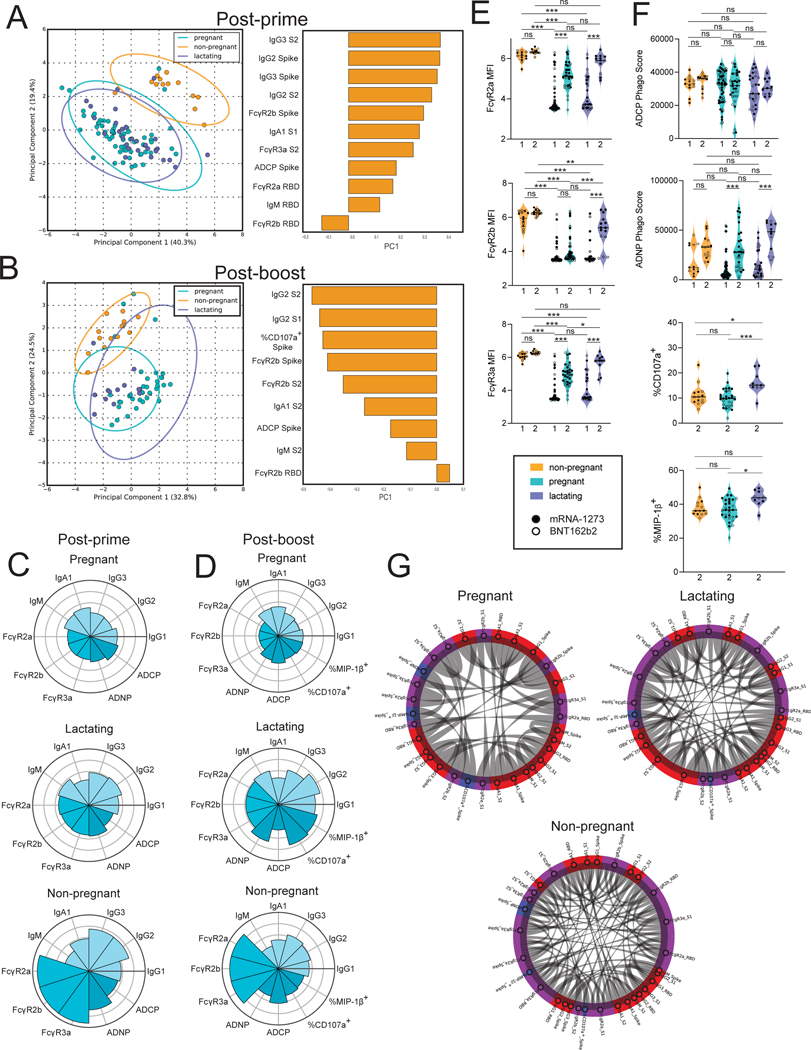
Substantial immunological changes occur throughout pregnancy to render the mother immunologically tolerant to the fetus and allow fetal growth. However, additional local and systemic immunological adaptations also occur, allowing the maternal immune system to continue to protect the dyad against pathogens both during pregnancy and after birth through lactation. This fine balance of tolerance and immunity, along with physiological and hormonal changes, contributes to increased susceptibility to particular infections in pregnancy, including more severe coronavirus disease 2019 (COVID-19). Whether these changes also make pregnant women less responsive to vaccination or induce altered immune responses to vaccination remains incompletely understood. To define potential changes in vaccine response during pregnancy and lactation, we undertook deep sequencing of the humoral vaccine response in a group of pregnant and lactating women and nonpregnant age-matched controls. Vaccine-specific titers were comparable between pregnant women, lactating women, and nonpregnant controls. However, Fc receptor (FcR) binding and antibody effector functions were induced with delayed kinetics in both pregnant and lactating women compared with nonpregnant women after the first vaccine dose, which normalized after the second dose. Vaccine boosting resulted in high FcR-binding titers in breastmilk. These data suggest that pregnancy promotes resistance to generating proinflammatory antibodies and indicates that there is a critical need to follow prime-boost timelines in this vulnerable population to ensure full immunity is attained.
在整个怀孕期间,大量的免疫变化会使母亲对胎儿产生免疫耐受,并允许胎儿生长。然而,还会发生额外的局部和全身免疫适应性变化,使母体免疫系统能够继续通过哺乳保护母婴对病原体的双重保护。这种耐受和免疫的微妙平衡,以及生理和激素变化,导致孕妇在怀孕期间对某些感染的易感性增加,包括更严重的 2019 年冠状病毒病(COVID-19)。这些变化是否也使孕妇对疫苗的反应性降低,或者诱导对疫苗接种的免疫反应改变,目前仍不完全清楚。为了确定怀孕期间和哺乳期疫苗反应的潜在变化,我们对一组孕妇、哺乳期妇女和非孕妇年龄匹配的对照组进行了体液疫苗反应的深度测序。孕妇、哺乳期妇女和非孕妇对照组之间的疫苗特异性滴度相当。然而,与非孕妇相比,在第一剂疫苗后,孕妇和哺乳期妇女的 Fc 受体(FcR)结合和抗体效应功能的诱导呈现出延迟的动力学,在第二剂疫苗后恢复正常。疫苗加强接种可使母乳中产生高 FcR 结合滴度。这些数据表明,妊娠会导致产生促炎抗体的能力下降,并表明在这个脆弱的人群中,需要按照疫苗接种的时间安排进行接种,以确保获得完全的免疫力。