Makhani Sarah S, Davies Camron, George Kevin A, Castro Grettel, Rodriguez de la Vega Pura, Barengo Noel C
Department of Medical and Population Health Sciences Research, Herbert Wertheim College of Medicine, Miami, USA.
Department of Public Health, University of Helsinki, Helsinki, FIN.
Cureus. 2021 Sep 15;13(9):e17996. doi: 10.7759/cureus.17996. eCollection 2021 Sep.
The aim of this study is to evaluate the association between a marker of dietary intake, the carbohydrate-to-fiber (CF) ratio, and moderate-to-severe depressive symptoms.
Cross-sectional study.
National Health and Nutrition Examination Survey (NHANES) database from 2013-2016.
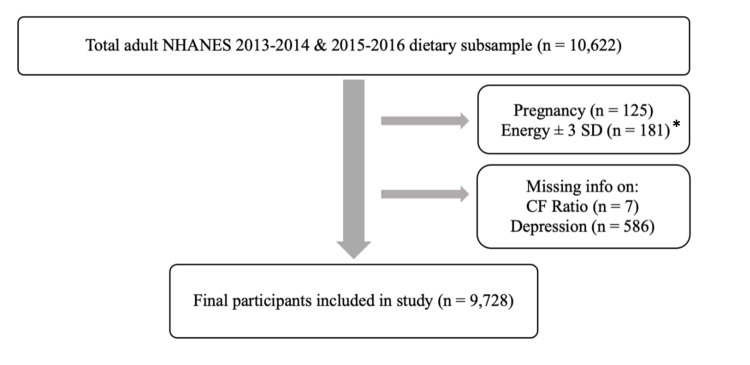
Individuals 18 years and older were included. Participants with total energy intake outside of three standard deviations of the mean, pregnant or breastfeeding women, and those with missing data were excluded.
The main independent variable, CF ratio, was generated using corresponding variables in NHANES and divided into quartiles. The main outcome was depressive symptoms using the Patient Health Questionnaire-9. Unadjusted and adjusted logistic regression analyses were used to calculate odds ratios and their corresponding 95% confidence interval (CI). Results: Among all participants (n=9,728), 8.3% reported to have moderate-to-severe depressive symptoms (n=833). The highest proportion of depressive symptoms was reported in respondents in quartile 4 (Q4), with the highest CF ratio (13.0%; p<0.001). After adjustment, the odds of depressive symptoms significantly increased in Q4 of the CF ratio compared with Q1 (adjusted odds ratio 1.4, 95% CI 1.0-1.9). The prevalence of depressive symptoms significantly increased in females, lower federal poverty levels, non-married individuals, smokers, and hypertension patients. Conclusion: This nationally representative sample suggests that a higher CF dietary intake ratio increases the risk of moderate-to-severe depressive symptoms. These results suggest that the CF ratio may help clinicians and patients evaluate their dietary risk for depressive symptoms. Further prospective studies are needed to validate this ratio as a dietary measurement.
本研究旨在评估饮食摄入标志物碳水化合物与纤维(CF)比值与中重度抑郁症状之间的关联。
横断面研究。
2013 - 2016年国家健康与营养检查调查(NHANES)数据库。
纳入18岁及以上个体。排除总能量摄入超出均值三个标准差的参与者、孕妇或哺乳期妇女以及数据缺失者。
主要自变量CF比值通过NHANES中的相应变量生成并分为四分位数。主要结局是使用患者健康问卷-9评估的抑郁症状。采用未调整和调整后的逻辑回归分析计算比值比及其相应的95%置信区间(CI)。结果:在所有参与者(n = 9728)中,8.3%报告有中重度抑郁症状(n = 833)。四分位数4(Q4)中CF比值最高的受访者报告的抑郁症状比例最高(13.0%;p < 0.001)。调整后,CF比值Q4组与Q1组相比,抑郁症状的比值显著增加(调整后比值比1.4,95% CI 1.0 - 1.9)。女性、联邦贫困水平较低者、未婚者、吸烟者和高血压患者的抑郁症状患病率显著增加。结论:这个具有全国代表性的样本表明,较高的CF饮食摄入比值会增加中重度抑郁症状的风险。这些结果表明,CF比值可能有助于临床医生和患者评估其抑郁症状的饮食风险。需要进一步的前瞻性研究来验证该比值作为一种饮食测量指标。