School of Public Health, Imperial College London, London, UK.
Department of Primary Care and Public Health, School of Public Health, Imperial College London, London, UK.
Epidemiol Psychiatr Sci. 2021 Oct 21;30:e66. doi: 10.1017/S204579602100055X.
The mental health of slum residents is under-researched globally, and depression is a significant source of worldwide morbidity. Brazil's large slum-dwelling population is often considered part of a general urban-poor demographic. This study aims to identify the prevalence and distribution of depression in Brazil and compare mental health inequalities between slum and non-slum populations.
Data were obtained from Brazil's 2019 National Health Survey. Slum residence was defined based on the UN-Habitat definition for slums and estimated from survey responses. Doctor-diagnosed depression, Patient Health Questionnaire (PHQ-9)-screened depression and presence of undiagnosed depression (PHQ-9-screened depression in the absence of a doctor's diagnosis) were analysed as primary outcomes, alongside depressive symptom severity as a secondary outcome. Prevalence estimates for all outcomes were calculated. Multivariable logistic regression models were used to investigate the association of socioeconomic characteristics, including slum residence, with primary outcomes. Depressive symptom severity was analysed using generalised ordinal logistic regression.
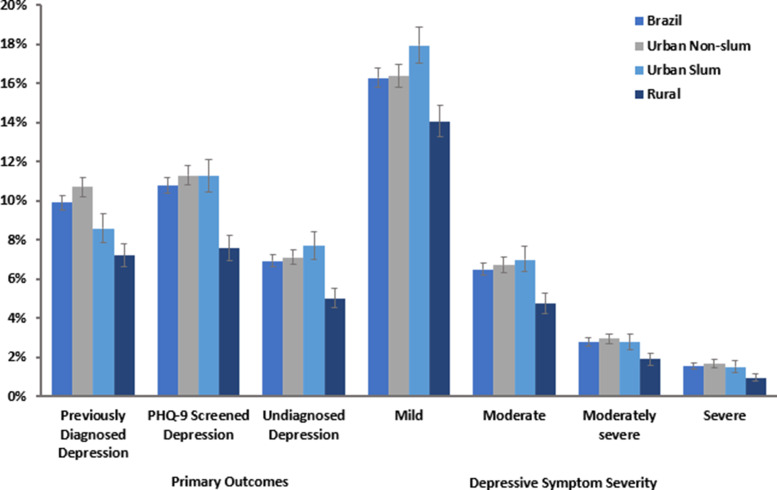
Nationally, the prevalence of doctor diagnosed, PHQ-9 screened and undiagnosed depression were 9.9% (95% confidence interval (CI): 9.5-10.3), 10.8% (95% CI: 10.4-11.2) and 6.9% (95% CI: 6.6-7.2), respectively. Slum residents exhibited lower levels of doctor-diagnosed depression than non-slum urban residents (8.6%; 95% CI: 7.9-9.3 v. 10.7%; 95% CI: 10.2-11.2), while reporting similar levels of PHQ-9-screened depression (11.3%; 95% CI: 10.4-12.1 v. 11.3%; 95% CI: 10.8-11.8). In adjusted regression models, slum residence was associated with a lower likelihood of doctor diagnosed (adjusted odds ratio (adjusted OR): 0.87; 95% CI: 0.77-0.97) and PHQ-9-screened depression (adjusted OR: 0.87; 95% CI: 0.78-0.97). Slum residents showed a greater likelihood of reporting less severe depressive symptoms. There were significant ethnic/racial disparities in the likelihood of reporting doctor-diagnosed depression. Black individuals were less likely to report doctor-diagnosed depression (adjusted OR: 0.66; 95% CI: 0.57-0.75) than white individuals. A similar pattern was observed in Mixed Black (adjusted OR: 0.72; 95% CI: 0.66-0.79) and other (adjusted OR: 0.63; 95% CI: 0.45-0.88) ethnic/racial groups. Slum residents self-reporting a diagnosis of one or more chronic non-communicable diseases had greater odds of exhibiting all three primary depression outcomes.
Substantial inequalities characterise the distribution of depression in Brazil including in slum settings. People living in slums may have lower diagnosed rates of depression than non-slum urban residents. Understanding the mechanisms behind the discrepancy in depression diagnosis between slum and non-slum populations is important to inform health policy in Brazil, including in addressing potential gaps in access to mental healthcare.
全球范围内对贫民窟居民的心理健康研究不足,而抑郁症是全球发病率的一个重要来源。巴西庞大的贫民窟居民通常被认为是一般城市贫困人口的一部分。本研究旨在确定巴西的抑郁症患病率和分布情况,并比较贫民窟和非贫民窟人口的心理健康不平等情况。
数据来自巴西 2019 年国家健康调查。贫民窟居住的定义基于联合国人居署的贫民窟定义,并根据调查结果进行估计。主要结局为医生诊断的抑郁症、患者健康问卷(PHQ-9)筛查的抑郁症和未确诊的抑郁症(PHQ-9 筛查但无医生诊断),同时分析抑郁症状严重程度作为次要结局。计算所有结局的患病率估计值。使用多变量逻辑回归模型研究包括贫民窟居住在内的社会经济特征与主要结局之间的关联。使用广义有序逻辑回归分析抑郁症状严重程度。
在全国范围内,医生诊断的、PHQ-9 筛查的和未确诊的抑郁症的患病率分别为 9.9%(95%置信区间[CI]:9.5-10.3)、10.8%(95% CI:10.4-11.2)和 6.9%(95% CI:6.6-7.2)。与非贫民窟城市居民相比,贫民窟居民的医生诊断抑郁症水平较低(8.6%;95%CI:7.9-9.3 v. 10.7%;95%CI:10.2-11.2),但报告的 PHQ-9 筛查抑郁症水平相似(11.3%;95%CI:10.4-12.1 v. 11.3%;95%CI:10.8-11.8)。在调整后的回归模型中,贫民窟居住与医生诊断抑郁症的可能性较低相关(调整后的优势比[调整后 OR]:0.87;95%CI:0.77-0.97)和 PHQ-9 筛查的抑郁症(调整后 OR:0.87;95%CI:0.78-0.97)。贫民窟居民更有可能报告抑郁症状较轻。在报告医生诊断的抑郁症方面存在显著的种族/民族差异。与白人相比,黑人报告医生诊断的抑郁症的可能性较低(调整后 OR:0.66;95%CI:0.57-0.75)。在混合黑人(调整后 OR:0.72;95%CI:0.66-0.79)和其他(调整后 OR:0.63;95%CI:0.45-0.88)种族/民族群体中也观察到类似的模式。自我报告患有一种或多种慢性非传染性疾病的贫民窟居民出现所有三种主要抑郁症结局的可能性更高。
巴西的抑郁症分布存在显著的不平等,包括在贫民窟环境中。与非贫民窟城市居民相比,贫民窟居民的抑郁症诊断率可能较低。了解贫民窟和非贫民窟人群之间抑郁症诊断差异的背后机制,对于为巴西的卫生政策提供信息很重要,包括解决精神保健获取方面的潜在差距。
