Qian Xiangyu, Qiu Ye, He Qingzu, Lu Yuer, Lin Hai, Xu Fei, Zhu Fangfang, Liu Zhilong, Li Xiang, Cao Yuping, Shuai Jianwei
Department of Physics, and Fujian Provincial Key Laboratory for Soft Functional Materials Research, Xiamen University, Xiamen 361005, China.
Department of Psychiatry of Second Xiangya Hospital, Central South University, Changsha 410011, China.
Brain Sci. 2021 Sep 26;11(10):1274. doi: 10.3390/brainsci11101274.
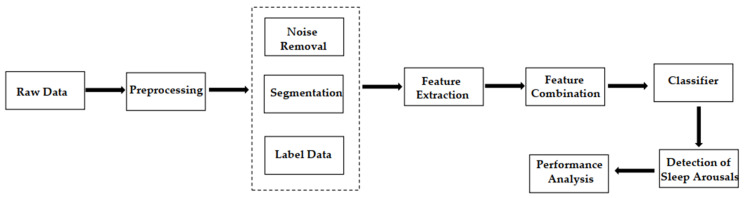
Multiple types of sleep arousal account for a large proportion of the causes of sleep disorders. The detection of sleep arousals is very important for diagnosing sleep disorders and reducing the risk of further complications including heart disease and cognitive impairment. Sleep arousal scoring is manually completed by sleep experts by checking the recordings of several periods of sleep polysomnography (PSG), which is a time-consuming and tedious work. Therefore, the development of efficient, fast, and reliable automatic sleep arousal detection system from PSG may provide powerful help for clinicians. This paper reviews the automatic arousal detection methods in recent years, which are based on statistical rules and deep learning methods. For statistical detection methods, three important processes are typically involved, including preprocessing, feature extraction and classifier selection. For deep learning methods, different models are discussed by now, including convolution neural network (CNN), recurrent neural network (RNN), long-term and short-term memory neural network (LSTM), residual neural network (ResNet), and the combinations of these neural networks. The prediction results of these neural network models are close to the judgments of human experts, and these methods have shown robust generalization capabilities on different data sets. Therefore, we conclude that the deep neural network will be the main research method of automatic arousal detection in the future.
多种类型的睡眠觉醒占睡眠障碍病因的很大比例。睡眠觉醒的检测对于诊断睡眠障碍以及降低包括心脏病和认知障碍在内的进一步并发症风险非常重要。睡眠觉醒评分由睡眠专家通过检查多个时段的睡眠多导睡眠图(PSG)记录手动完成,这是一项耗时且繁琐的工作。因此,从PSG开发高效、快速且可靠的自动睡眠觉醒检测系统可能会为临床医生提供有力帮助。本文综述了近年来基于统计规则和深度学习方法的自动觉醒检测方法。对于统计检测方法,通常涉及三个重要过程,包括预处理、特征提取和分类器选择。对于深度学习方法,目前讨论了不同的模型,包括卷积神经网络(CNN)、循环神经网络(RNN)、长短时记忆神经网络(LSTM)、残差神经网络(ResNet)以及这些神经网络的组合。这些神经网络模型的预测结果接近人类专家的判断,并且这些方法在不同数据集上都表现出了强大的泛化能力。因此,我们得出结论,深度神经网络将是未来自动觉醒检测的主要研究方法。