Pappas Vasileios M, Lakka Achillia, Palaiogiannis Dimitrios, Athanasiadis Vassilis, Bozinou Eleni, Ntourtoglou George, Makris Dimitris P, Dourtoglou Vassilis G, Lalas Stavros I
Department of Food Science & Nutrition, University of Thessaly, Terma N. Temponera Str., GR-43100 Karditsa, Greece.
Department of Wine, Vine & Beverage Sciences, School of Food Science, University of West Attica, Ag. Spyridonos Str., Egaleo, GR-12243 Athens, Greece.
Antioxidants (Basel). 2021 Sep 29;10(10):1554. doi: 10.3390/antiox10101554.
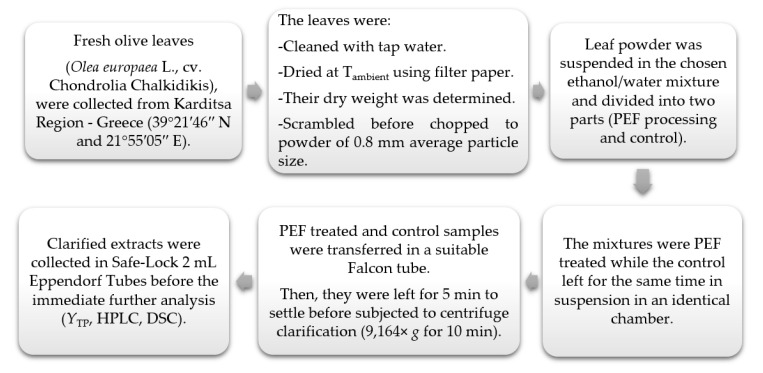
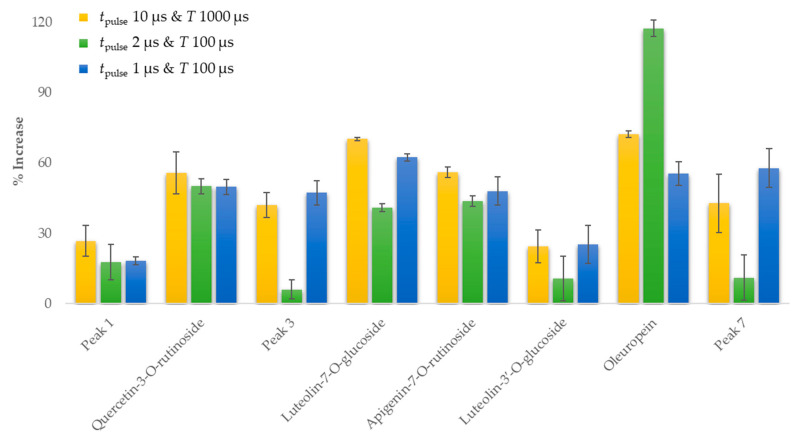
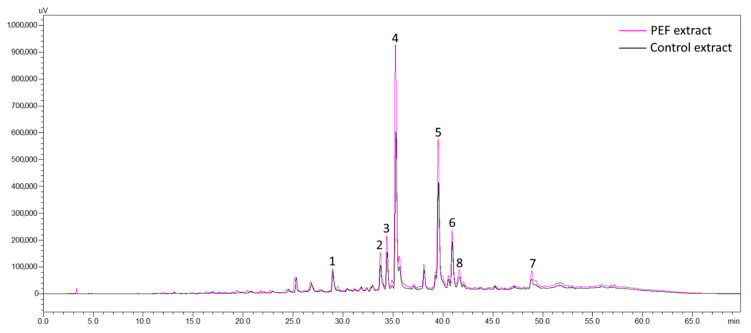
Olive leaves (OLL) are reported as a source of valuable antioxidants and as an agricultural by-product/waste. Thus, a twofold objective with multi-level cost and environmental benefits arises for a "green" standalone extraction technology. This study evaluates the OLL waste valorization through maximizing OLL extracts polyphenol concentration utilizing an emerging "green" non-thermal technology, Pulsed Electric Field (PEF). It also provides further insight into the PEF assistance span for static solid-liquid extraction of OLL by choosing and fine-tuning important PEF parameters such as the extraction chamber geometry, electric field strength, pulse duration, pulse period (and frequency), and extraction duration. The produced extracts were evaluated via comparison amongst them and against extracts obtained without the application of PEF. The Folin-Ciocalteu method, high-performance liquid chromatography, and differential scanning calorimetry were used to determine the extraction efficiency. The optimal PEF contribution on the total polyphenols extractability (38% increase with a 117% increase for specific metabolites) was presented for rectangular extraction chamber, 25% / ethanol:water solvent, pulse duration () 2 μs, electric field strength () 0.85 kV cm, 100 μs period (), and 15 min extraction duration (), ascertaining a significant dependence of PEF assisting extraction performance to the parameters chosen.
橄榄叶(OLL)被报道为有价值的抗氧化剂来源以及一种农业副产品/废弃物。因此,一种具有多层次成本和环境效益的双重目标产生了,即需要一种“绿色”的独立提取技术。本研究通过利用新兴的“绿色”非热技术——脉冲电场(PEF),最大化OLL提取物中的多酚浓度,来评估OLL废弃物的价值。它还通过选择和微调重要的PEF参数,如提取室几何形状、电场强度、脉冲持续时间、脉冲周期(和频率)以及提取持续时间,进一步深入了解PEF对OLL静态固液提取的辅助作用范围。通过对所生产的提取物相互之间以及与未应用PEF获得的提取物进行比较来评估它们。采用福林 - 西奥尔特法、高效液相色谱法和差示扫描量热法来确定提取效率。对于矩形提取室、25%/乙醇:水溶剂、脉冲持续时间()2 μs、电场强度()0.85 kV/cm、100 μs周期()和15分钟提取持续时间(),展示了PEF对总多酚提取率的最佳贡献(提高38%,特定代谢物提高117%),确定了PEF辅助提取性能对所选参数有显著依赖性。