Department of Pharmacology, Institute of Health Sciences, College of Medicine, Gyeongsang National University, Jinju 52727, Korea.
Department of Convergence Medical Science (BK21 Plus), Gyeongsang National University, Jinju 52727, Korea.
Biomolecules. 2021 Oct 6;11(10):1470. doi: 10.3390/biom11101470.
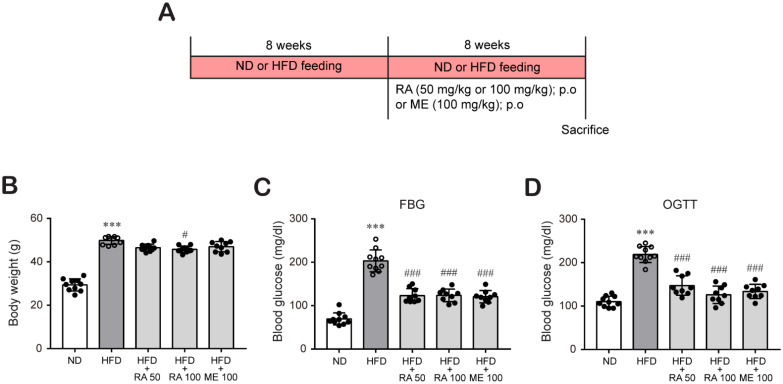
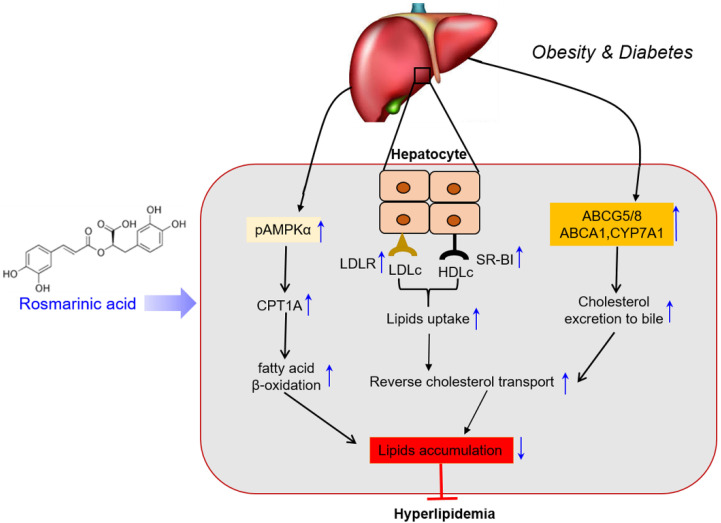
Hyperlipidemia is a potent risk factor for the development of cardiovascular diseases. The reverse cholesterol transport (RCT) process has been shown to alleviate hyperlipidemia and protect against cardiovascular diseases. Recently, rosmarinic acid was reported to exhibit lipid-lowering effects. However, the underlying mechanism is still unclear. This study aims to investigate whether rosmarinic acid lowers lipids by modulating the RCT process in high-fat diet (HFD)-induced hyperlipidemic C57BL/6J mice. Our results indicated that rosmarinic acid treatment significantly decreased body weight, blood glucose, and plasma total cholesterol and triglyceride levels in HFD-fed mice. Rosmarinic acid increased the expression levels of cholesterol uptake-associated receptors in liver tissues, including scavenger receptor B type 1 (SR-B1) and low-density lipoprotein receptor (LDL-R). Furthermore, rosmarinic acid treatment notably increased the expression of cholesterol excretion molecules, ATP-binding cassette G5 (ABCG5) and G8 (ABCG8) transporters, and cholesterol 7 alpha-hydroxylase A1 (CYP7A1) as well as markedly reduced cholesterol and triglyceride levels in liver tissues. In addition, rosmarinic acid facilitated fatty acid oxidation through AMP-activated protein kinase (AMPK)-mediated carnitine palmitoyltransferase 1A (CPT1A) induction. In conclusion, rosmarinic acid exhibited a lipid-lowering effect by modulating the expression of RCT-related proteins and lipid metabolism-associated molecules, confirming its potential for the prevention or treatment of hyperlipidemia-derived diseases.
高脂血症是心血管疾病发展的一个强有力的风险因素。胆固醇逆转运(RCT)过程已被证明可以缓解高脂血症并预防心血管疾病。最近,迷迭香酸被报道具有降低血脂的作用。然而,其潜在机制尚不清楚。本研究旨在探讨迷迭香酸是否通过调节高脂肪饮食(HFD)诱导的高脂血症 C57BL/6J 小鼠的 RCT 过程来降低血脂。我们的结果表明,迷迭香酸治疗可显著降低 HFD 喂养小鼠的体重、血糖和血浆总胆固醇和甘油三酯水平。迷迭香酸增加了肝脏组织中胆固醇摄取相关受体的表达水平,包括清道夫受体 B 型 1(SR-B1)和低密度脂蛋白受体(LDL-R)。此外,迷迭香酸治疗还显著增加了胆固醇排泄分子 ATP 结合盒转运体 G5(ABCG5)和 G8(ABCG8)以及胆固醇 7α-羟化酶 A1(CYP7A1)的表达,并显著降低了肝脏组织中的胆固醇和甘油三酯水平。此外,迷迭香酸通过 AMP 激活的蛋白激酶(AMPK)介导的肉碱棕榈酰转移酶 1A(CPT1A)诱导促进脂肪酸氧化。总之,迷迭香酸通过调节 RCT 相关蛋白和脂质代谢相关分子的表达发挥了降低血脂的作用,证实了其在预防或治疗由高脂血症引起的疾病方面的潜力。