Sanmukh Swapnil Ganesh, Santos Nilton J, Barquilha Caroline Nascimento, Dos Santos Sérgio Alexandre Alcantara, Duran Bruno Oliveira Silva, Delella Flávia Karina, Moroz Andrei, Justulin Luis Antonio, Carvalho Hernandes F, Felisbino Sérgio Luis
Laboratory of Extracellular Matrix Biology, Department of Structural and Functional Biology, Institute of Biosciences of Botucatu, Sao Paulo State University (UNESP), Botucatu 18618-689, SP, Brazil.
Laboratory of Extracellular Matrix and Gene Regulation, Department of Structural and Functional Biology, Institute of Biology, State University of Campinas, Campinas 13083-970, SP, Brazil.
Antibiotics (Basel). 2021 Oct 3;10(10):1202. doi: 10.3390/antibiotics10101202.
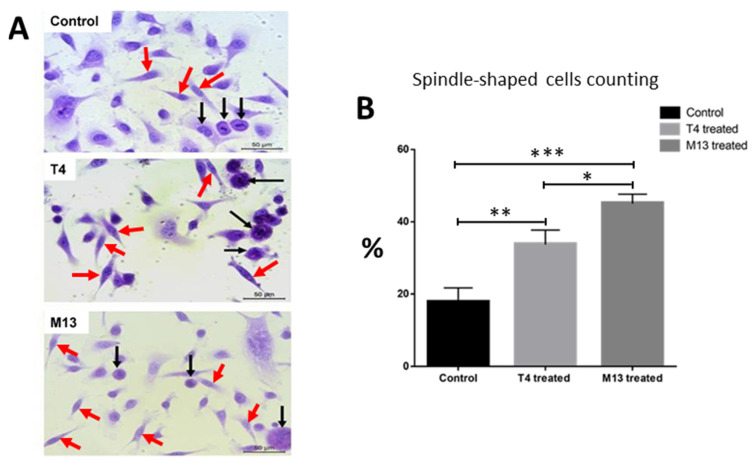
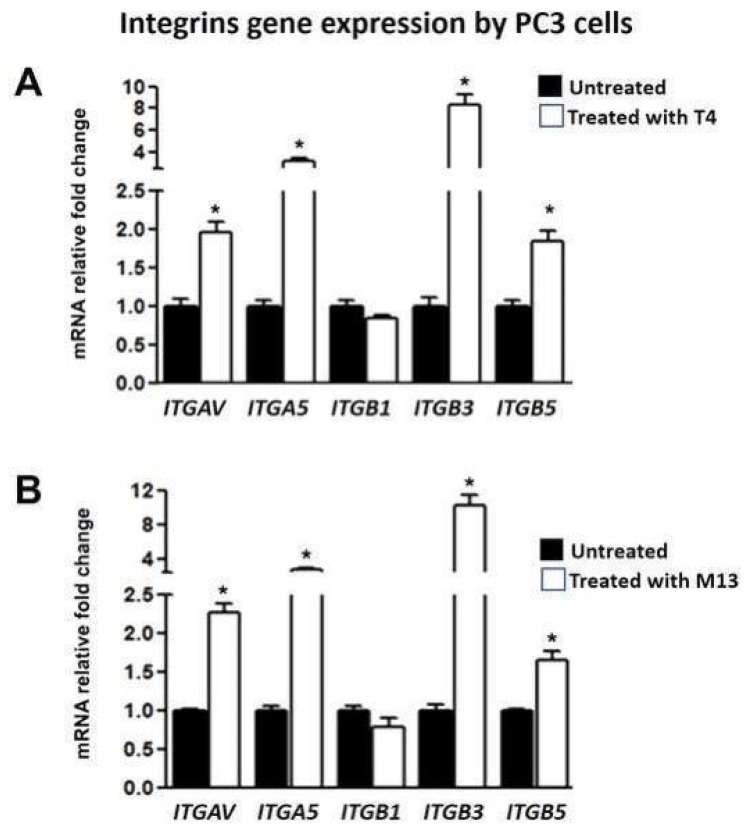
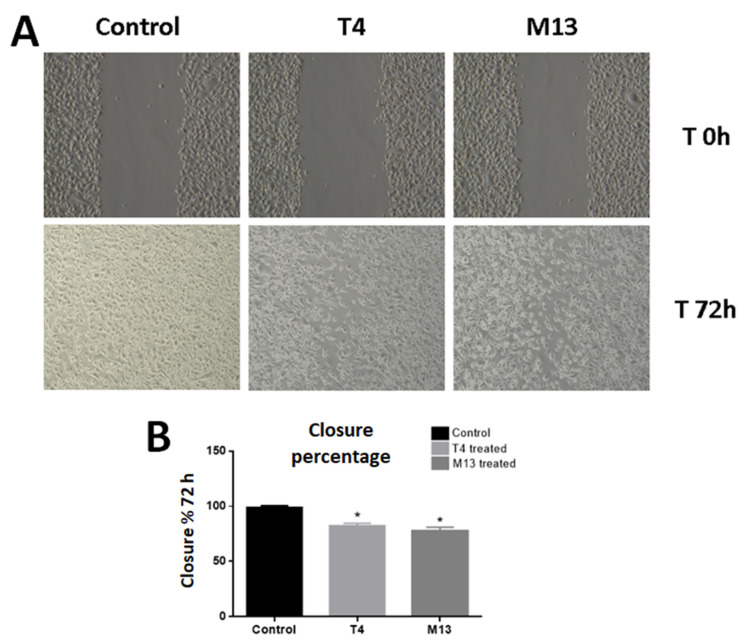
The interaction between bacteriophages and integrins has been reported in different cancer cell lines, and efforts have been undertaken to understand these interactions in tumor cells along with their possible role in gene alterations, with the aim to develop new cancer therapies. Here, we report that the non-specific interaction of T4 and M13 bacteriophages with human PC-3 cells results in differential migration and varied expression of different integrins. PC-3 tumor cells (at 70% confluence) were exposed to 1 × 10 pfu/mL of either lytic T4 bacteriophage or filamentous M13 bacteriophage. After 24 h of exposure, cells were processed for a histochemical analysis, wound-healing migration assay, and gene expression profile using quantitative real-time PCR (qPCR). qPCR was performed to analyze the expression profiles of integrins , , , , and . Our findings revealed that PC-3 cells interacted with T4 and M13 bacteriophages, with significant upregulation of , , , genes after phage exposure. PC-3 cells also exhibited reduced migration activity when exposed to either T4 or M13 phages. These results suggest that wildtype bacteriophages interact non-specifically with PC-3 cells, thereby modulating the expression of integrin genes and affecting cell migration. Therefore, bacteriophages have future potential applications in anticancer therapies.
噬菌体与整合素之间的相互作用已在不同癌细胞系中被报道,人们已努力去了解肿瘤细胞中的这些相互作用及其在基因改变中可能发挥的作用,旨在开发新的癌症治疗方法。在此,我们报道T4和M13噬菌体与人类PC-3细胞的非特异性相互作用导致不同的整合素迁移和表达变化。将PC-3肿瘤细胞(处于70%汇合状态)暴露于1×10噬菌斑形成单位/毫升的裂解性T4噬菌体或丝状M13噬菌体中。暴露24小时后,对细胞进行组织化学分析、伤口愈合迁移试验以及使用定量实时PCR(qPCR)进行基因表达谱分析。进行qPCR以分析整合素α1、α2、α3、α5和β1的表达谱。我们的研究结果显示,PC-3细胞与T4和M13噬菌体相互作用,噬菌体暴露后α1、α2、α3、α5基因显著上调。当暴露于T4或M13噬菌体时,PC-3细胞的迁移活性也降低。这些结果表明野生型噬菌体与PC-3细胞非特异性相互作用,从而调节整合素基因的表达并影响细胞迁移。因此,噬菌体在抗癌治疗中具有潜在的应用前景。