Long Carrie Mae
Laboratory of Bacteriology, Division of Intramural Research, National Institute of Allergy and Infectious Disease, National Institutes of Health, Hamilton, MT 59828, USA.
Pathogens. 2021 Sep 22;10(10):1223. doi: 10.3390/pathogens10101223.
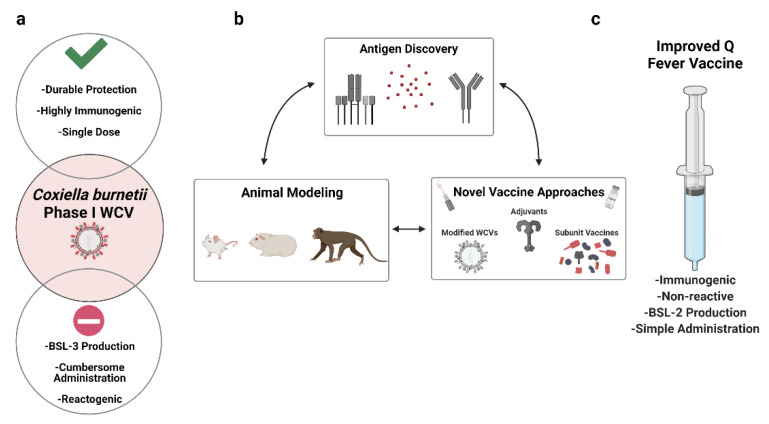
Q fever is a zoonotic disease caused by the intracellular pathogen . This disease typically manifests as a self-limiting, febrile illness known as acute Q fever. Due to the aerosol transmissibility, environmental persistence, and infectivity of , this pathogen is a notable bioterrorism threat. Despite extensive efforts to develop next-generation human Q fever vaccines, only one vaccine, Q-Vax®, is commercially available. Q-Vax® is a phase I whole-cell vaccine, and its licensed use is limited to Australia, presumably due to the potential for a post-vaccination hypersensitivity response. Pre-clinical Q fever vaccine development is a major area of interest, and diverse approaches have been undertaken to develop an improved Q fever vaccine. Following a brief history of Q fever vaccine development, current approaches will be discussed along with future considerations for an improved Q fever vaccine.
Q热是一种由细胞内病原体引起的人畜共患病。这种疾病通常表现为一种自限性发热疾病,称为急性Q热。由于该病原体具有气溶胶传播性、环境持久性和传染性,它是一种显著的生物恐怖主义威胁。尽管人们为开发下一代人用Q热疫苗付出了巨大努力,但目前只有一种疫苗Q-Vax®可在市场上买到。Q-Vax®是一种I期全细胞疫苗,其许可使用仅限于澳大利亚,可能是由于接种后存在超敏反应的可能性。临床前Q热疫苗的开发是一个主要的研究领域,人们已经采用了多种方法来开发改进的Q热疫苗。在简要介绍Q热疫苗开发的历史之后,将讨论当前的方法以及改进Q热疫苗的未来考虑因素。