Platt-Samoraj Aleksandra, Kończyk-Kmiecik Klaudia, Bakuła Tadeusz
Department of Epizootiology, Faculty of Veterinary Medicine, University of Warmia and Mazury in Olsztyn, Oczapowskiego 13 Str., 10-718 Olsztyn, Poland.
Department of Veterinary Prevention and Feed Hygiene, Faculty of Veterinary Medicine, University of Warmia and Mazury in Olsztyn, Oczapowskiego 13 Str., 10-718 Olsztyn, Poland.
Pathogens. 2021 Sep 27;10(10):1247. doi: 10.3390/pathogens10101247.
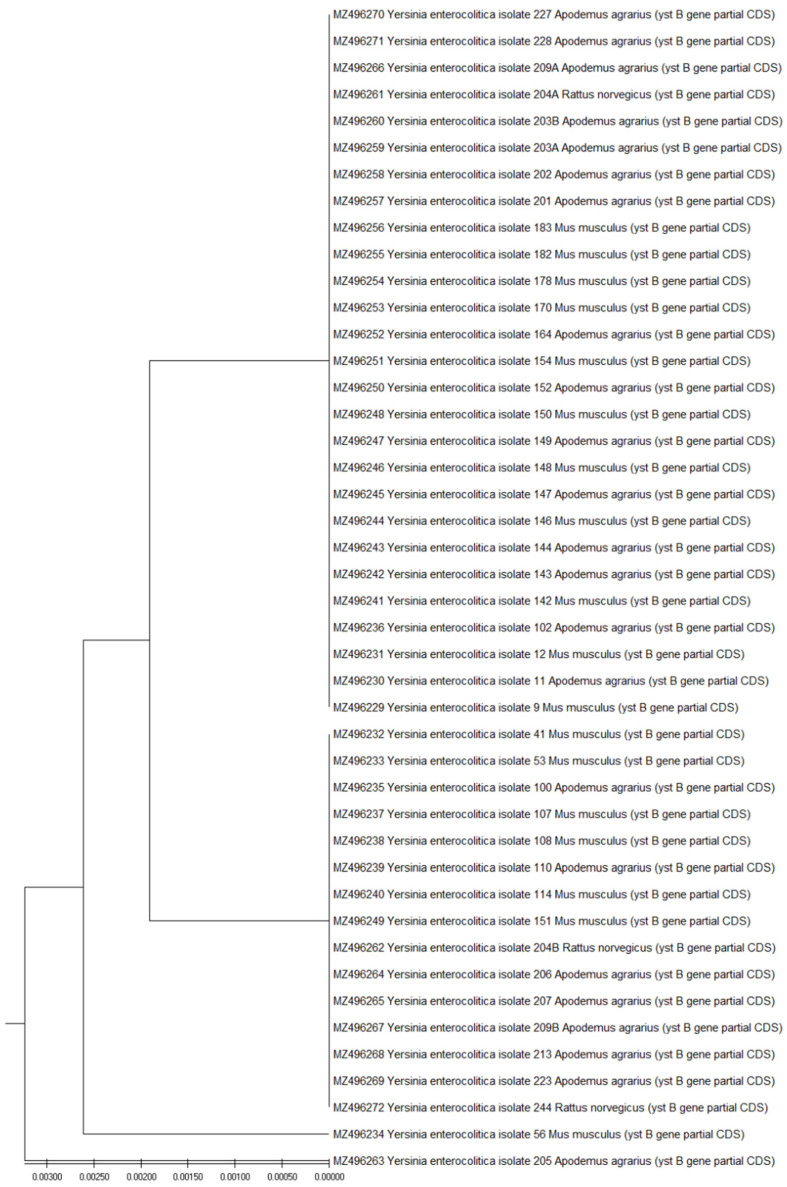
Rodents can be a potential spp. vector responsible for farm facilities contamination. The aim of the study was to determine the prevalence of spp. in commensal rodents found in the farms and fodder factory areas to characterize the obtained isolates and epidemiological risk. Intestinal samples were subjected to bacteriological, bioserotype, and PCR examination for virulence markers and presence. spp. was isolated from 43 out of 244 (17.6%) rodents ( n = 132, n = 102, n = 8, n = 2). was isolated from 41 rodents (16.8%), and from one and one . In three cases, two isolates were obtained from one rodent. All contained and belonged to biotype 1A, considered as potentially pathogenic. One isolate additionally had the gene typical for pathogenic strains. The sequence analysis of the and fragments showed a high similarity to those from clinical cases. The current study revealed a high prevalence of among commensal rodents, but the classification of all of isolates into biotype 1A and the sporadic isolation of do not indicate a high epidemiological risk.
啮齿动物可能是导致农场设施污染的潜在物种载体。本研究的目的是确定在农场和饲料厂区域发现的共生啮齿动物中该物种的流行情况,对获得的分离株进行特征描述并评估流行病学风险。对肠道样本进行细菌学、生物血清型和PCR检测,以检测毒力标记物的存在情况。从244只啮齿动物中的43只(17.6%)分离出该物种(n = 132,n = 102,n = 8,n = 2)。从41只啮齿动物(16.8%)中分离出该菌,从1只和1只中分离出该菌。在3例中,从1只啮齿动物中获得了2株该菌的分离株。所有分离株都含有该菌,且属于1A生物型,被认为具有潜在致病性。1株分离株还具有致病菌株典型的该基因。该菌和该片段的序列分析显示与临床病例的序列高度相似。当前研究表明共生啮齿动物中该菌的流行率很高,但所有分离株均归类为1A生物型且该菌的零星分离并不表明存在高流行病学风险。