Terentjeva Margarita, Ķibilds Juris, Meistere Irēna, Gradovska Silva, Alksne Laura, Streikiša Madara, Ošmjana Jevgēnija, Valciņa Olga
Institute of Food and Environmental Hygiene, Faculty of Veterinary Medicine, Latvia University of Life Sciences and Technologies, LV-3004 Jelgava, Latvia.
Institute of Food Safety, Animal Health and Environment BIOR, LV-1076 Riga, Latvia.
Pathogens. 2021 Dec 29;11(1):37. doi: 10.3390/pathogens11010037.
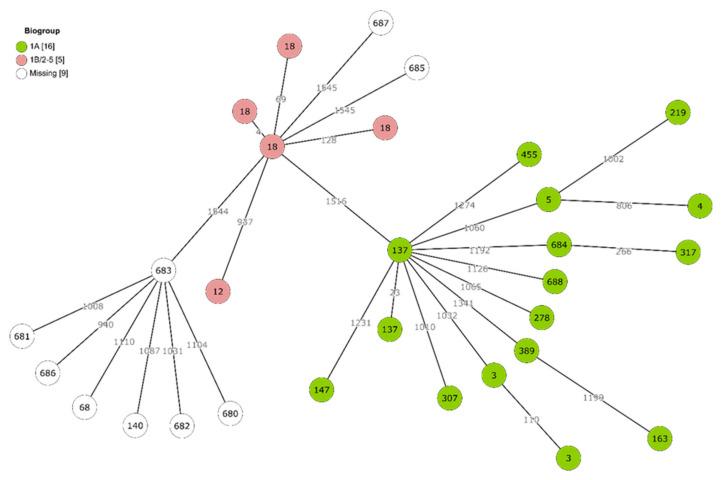
is an important foodborne pathogen, and the determination of its virulence factors and genetic diversity within the food chain could help understand the epidemiology of yersiniosis. The aim of the present study was to detect the prevalence, and characterize the virulence determinants and genetic diversity, of species isolated from meat. A total of 330 samples of retailed beef (n = 150) and pork (n = 180) in Latvia were investigated with culture and molecular methods. Whole genome sequencing (WGS) was applied for the detection of virulence and genetic diversity. The antimicrobial resistance of pathogenic isolates was detected in accordance with EUCAST. species were isolated from 24% (79/330) of meats, and the prevalence of in pork (24%, 44/180) was significantly higher ( < 0.05) than in beef (13%, 19/150). pathogenic bioserovars 2/O:9 and 4/O:3 were isolated from pork samples (3%, 6/180). Only resistance to ampicillin was confirmed in 4/O:3 and 2/O:9 isolates, but not in other antimicrobials. Major virulence determinants, including , , , and , were confirmed with WGS in 2/O:9 and 4/O:3. MLST typing revealed 15 STs (sequence types) of with ST12 and ST18, which were associated with pathogenic bioserovars. For 1A, , and , novel STs were registered (ST680-688). The presence of virulence genes and genetic characteristics of certain STs confirm the common knowledge that pork could be an important source of pathogenic .
是一种重要的食源性病原体,确定其在食物链中的毒力因子和遗传多样性有助于了解耶尔森氏菌病的流行病学。本研究的目的是检测从肉类中分离出的该物种的流行情况,并对其毒力决定因素和遗传多样性进行表征。采用培养和分子方法对拉脱维亚零售的330份牛肉样本(n = 150)和猪肉样本(n = 180)进行了调查。应用全基因组测序(WGS)检测毒力和遗传多样性。根据欧盟CAST检测致病性分离株的抗菌药物耐药性。从24%(79/330)的肉类中分离出该物种,猪肉中该物种的流行率(24%,44/180)显著高于牛肉(13%,19/150)(P < 0.05)。从猪肉样本中分离出致病性生物血清型2/O:9和4/O:3(3%,6/180)。在4/O:3和2/O:9分离株中仅证实对氨苄西林耐药,对其他抗菌药物不耐药。通过WGS在2/O:9和4/O:3中证实了主要毒力决定因素,包括、、、和。多位点序列分型(MLST)显示该物种有15种序列类型(STs),其中ST12和ST18与致病性生物血清型相关。对于1A、、和,登记了新的STs(ST680 - 688)。某些该物种STs的毒力基因存在和遗传特征证实了猪肉可能是致病性该物种重要来源这一常识。