Department of Nutrition and Food Hygiene, School of Public Health, Peking University, NO.38 Xueyuan Road, Beijing 100083, China.
PKUHSC-China Feihe Joint Research Institute of Nutrition and Healthy Lifespan Development, NO.38 Xueyuan Road, Beijing 100083, China.
Nutrients. 2021 Oct 18;13(10):3644. doi: 10.3390/nu13103644.
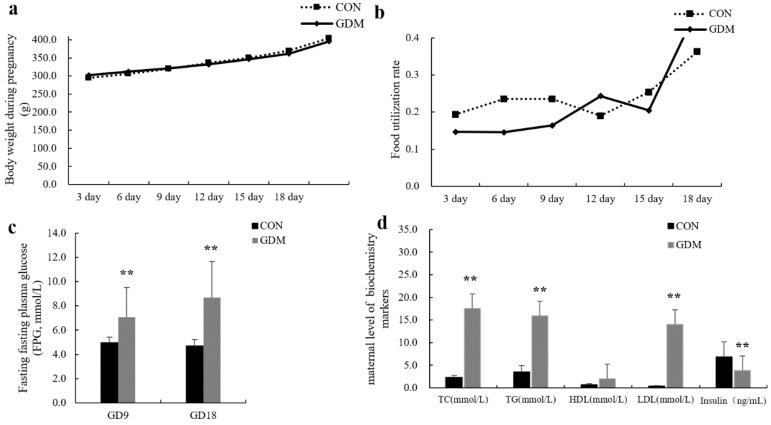
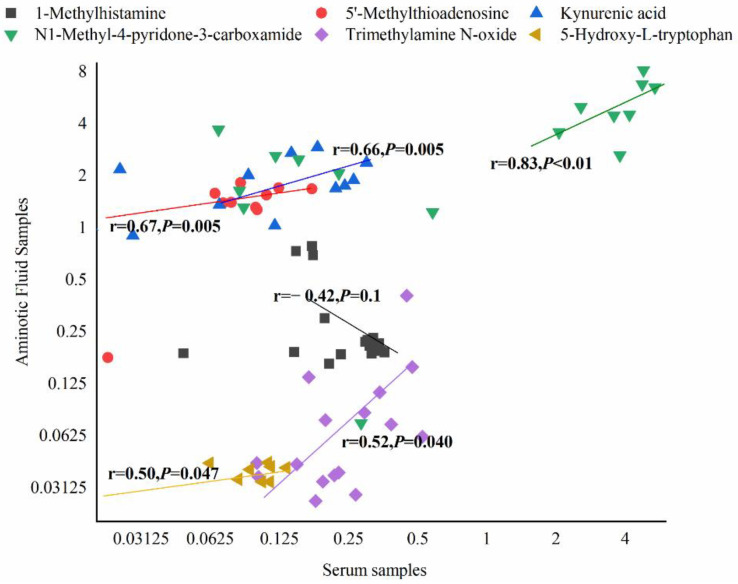
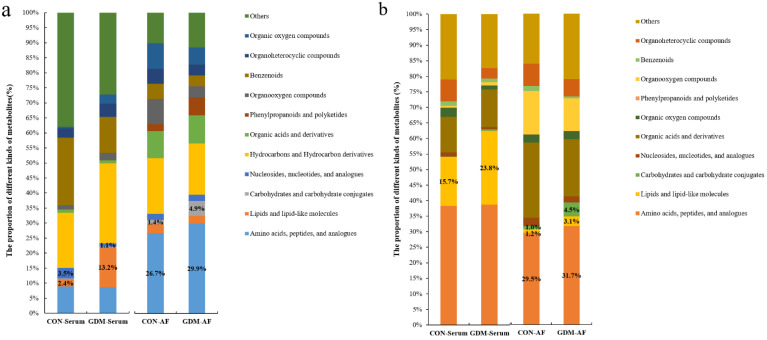
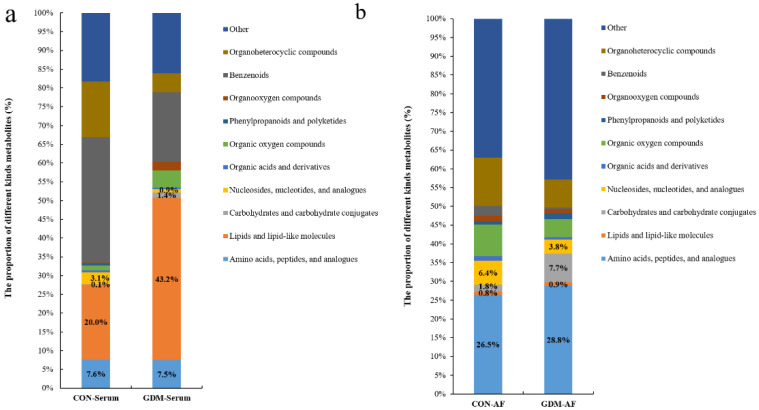
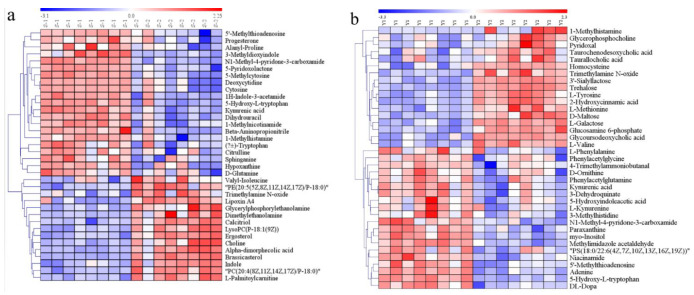
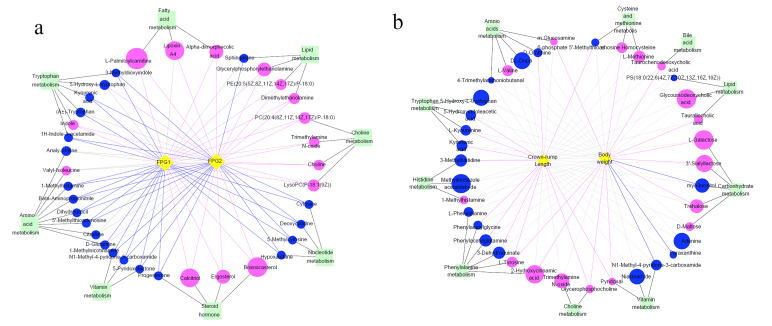
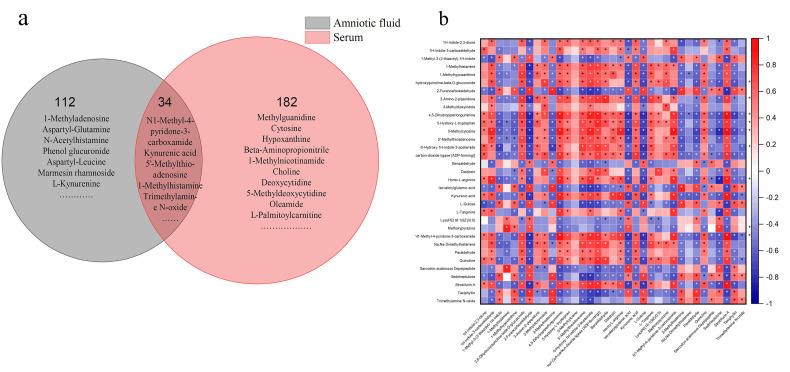
This study was designed to identify serum and amniotic fluid (AF) metabolic profile changes in response to gestational diabetes mellitus (GDM) and explore the association with maternal-fetal outcomes. We established the GDM rat models by combining a high-fat diet (HFD) with an injection of low-dose streptozotocin (STZ), detected the fasting plasma glucose (FPG) of pregnant rats in the second and third trimester, and collected AF and fetal rats by cesarean section on gestational day 19 (GD19), as well as measuring the weight and crown-rump length (CRL) of fetal rats. We applied liquid chromatography-tandem mass spectrometry (LC-MS/MS) for the untargeted metabolomics analyses of serum and AF samples and then explored their correlation with maternal-fetal outcomes via the co-occurrence network. The results showed that 91 and 68 metabolites were upregulated and 125 and 78 metabolites were downregulated in serum and AF samples exposed to GDM, respectively. In maternal serum, the obvious alterations emerged in lipids and lipid-like molecules, while there were great changes in carbohydrate and carbohydrate conjugates, followed by amino acids, peptides, and analogs in amniotic fluid. The altered pathways both in serum and AF samples were amino acid, lipid, nucleotide, and vitamin metabolism pathways. In response to GDM, changes in the steroid hormone metabolic pathway occurred in serum, and an altered carbohydrate metabolism pathway was found in AF samples. Among differential metabolites in two kinds of samples, there were 34 common biochemicals shared by serum and AF samples, and a mutual significant association existed. These shared differential metabolites were implicated in several metabolism pathways, including choline, tryptophan, histidine, and nicotinate and nicotinamide metabolism, and among them, N1-methyl-4-pyridone-3-carboxamide, 5'-methylthioadenosine, and kynurenic acid were significantly associated with both maternal FPG and fetal growth. In conclusion, serum and AF metabolic profiles were remarkably altered in response to GDM. N1-Methyl-4-pyridone-3-carboxamide, 5'-methylthioadenosine, and kynurenic acid have the potential to be taken as biomarkers for maternal-fetal health status of GDM. The common and inter-related differential metabolites both in the serum and AF implied the feasibility of predicting fetal health outcomes via detecting the metabolites in maternal serum exposed to GDM.
本研究旨在鉴定血清和羊水(AF)代谢谱的变化,以响应妊娠糖尿病(GDM)并探讨与母婴结局的关联。我们通过结合高脂肪饮食(HFD)和低剂量链脲佐菌素(STZ)注射来建立 GDM 大鼠模型,检测妊娠大鼠在第二和第三个三个月的空腹血糖(FPG),并通过剖宫产收集 AF 和胎儿大鼠在妊娠第 19 天(GD19),并测量胎儿大鼠的体重和头臀长(CRL)。我们应用液相色谱-串联质谱(LC-MS/MS)对血清和 AF 样本进行非靶向代谢组学分析,然后通过共现网络探索它们与母婴结局的相关性。结果表明,血清和 AF 样本中分别有 91 种和 68 种代谢物上调,125 种和 78 种代谢物下调。在母体血清中,脂质和类脂分子的变化明显,而碳水化合物和碳水化合物缀合物变化较大,其次是氨基酸、肽和类似物在羊水中。血清和 AF 样本中改变的途径都是氨基酸、脂质、核苷酸和维生素代谢途径。对 GDM 有反应,血清中的类固醇激素代谢途径发生变化,而 AF 样本中的碳水化合物代谢途径发生改变。在两种样本中的差异代谢物中,血清和 AF 样本中有 34 种共同的生化物质,并且存在相互显著的关联。这些共同的差异代谢物涉及几个代谢途径,包括胆碱、色氨酸、组氨酸和烟酰胺和烟酸代谢,其中 N1-甲基-4-吡啶酮-3-甲酰胺、5'-甲基硫腺苷和犬尿氨酸与母体 FPG 和胎儿生长均有显著关联。总之,血清和 AF 代谢谱在响应 GDM 时发生显著改变。N1-甲基-4-吡啶酮-3-甲酰胺、5'-甲基硫腺苷和犬尿氨酸有可能成为 GDM 母婴健康状况的生物标志物。血清和 AF 中常见的和相互关联的差异代谢物暗示了通过检测暴露于 GDM 的母体血清中的代谢物来预测胎儿健康结局的可行性。