Centre for Epidemiology and Population Health (U1018), Exposome and Heredity Team, Faculté de Médecine, Université Paris-Saclay, UVSQ, INSERM, Gustave Roussy, F-94805, Villejuif, France.
Nutrition and Metabolism Branch, International Agency for Research on Cancer (IARC), Lyon, France.
Clin Gastroenterol Hepatol. 2022 Jun;20(6):e1338-e1352. doi: 10.1016/j.cgh.2021.10.016. Epub 2021 Oct 20.
BACKGROUND & AIMS: Gastrointestinal cancer risk is influenced by the presence of metabolic syndrome (MetS). However, previous epidemiologic studies lacked full serological biomarker data for the classification of MetS, and the interaction of MetS with germline cancer risk variants is unknown.
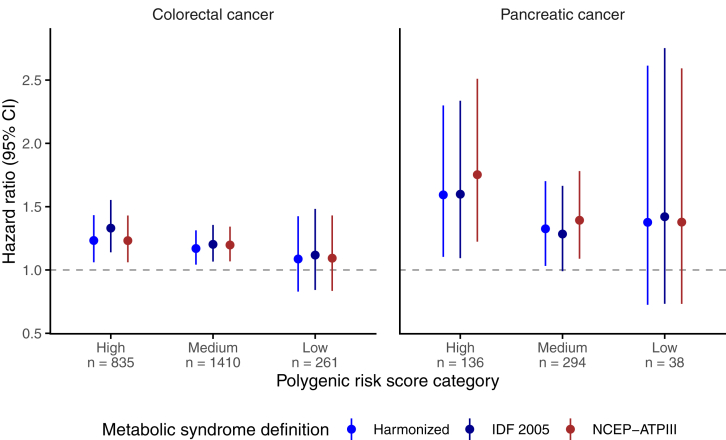
We investigated the associations between MetS and gastrointestinal cancer risk (overall, colorectal, pancreatic, esophageal adenocarcinoma, esophageal squamous cell carcinoma, stomach cardia, stomach non-cardia, hepatocellular carcinoma, and intrahepatic bile duct cancer) in 366,016 United Kingdom Biobank participants with comprehensive serum biomarker and genotype data. MetS status was determined by 3 different definitions at baseline, and, in 15,152 participants, at a repeat assessment after a median of 4.3 years of follow-up. Multivariable hazard ratios and 95% confidence intervals for cancer outcomes were estimated using Cox proportional hazards models. Analyses stratified by polygenic risk score were conducted for colorectal and pancreatic cancers.
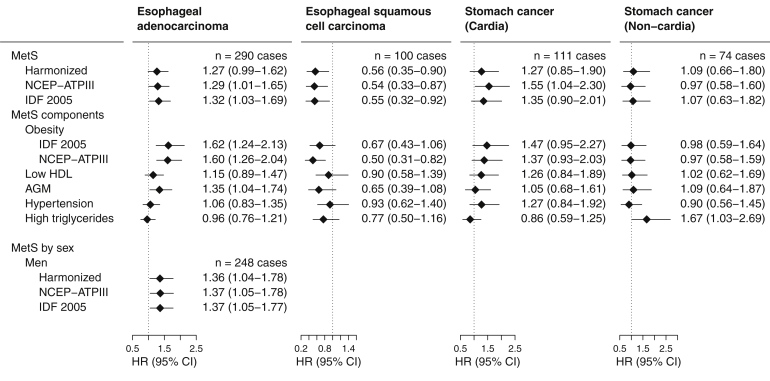
During a median follow-up of 7.1 years, 4238 incident cases of a gastrointestinal cancer occurred. MetS at baseline was associated with higher risk of overall gastrointestinal cancer by any definition (hazard ratio, 1.21; 95% confidence interval, 1.13-1.29, harmonized definition). MetS was associated with increased risks of colorectal cancer, colon cancer, rectal cancer, hepatocellular carcinoma, pancreatic cancer in women, and esophageal adenocarcinoma in men. Associations for colorectal cancer and pancreatic cancer did not differ by polygenic risk score strata (P-heterogeneity 0.70 and 0.69, respectively), and 80% of participants with MetS at baseline retained this status at the repeat assessment.
These findings underscore the importance of maintaining good metabolic health in reducing the burden of gastrointestinal cancers, irrespective of genetic predisposition.
胃肠道癌症的风险受代谢综合征(MetS)的影响。然而,以前的流行病学研究缺乏用于 MetS 分类的完整血清生物标志物数据,并且 MetS 与种系癌症风险变异体的相互作用尚不清楚。
我们使用具有全面血清生物标志物和基因型数据的 366,016 名英国生物库参与者的数据,研究了基线时 MetS 与胃肠道癌症风险(总体、结直肠癌、胰腺癌、食管腺癌、食管鳞状细胞癌、胃贲门、胃非贲门、肝细胞癌和肝内胆管癌)之间的关联。MetS 状态通过 3 种不同的定义在基线时确定,并在 15,152 名参与者中,在中位数为 4.3 年的随访后进行重复评估。使用 Cox 比例风险模型估计癌症结局的多变量风险比和 95%置信区间。对结直肠癌和胰腺癌进行了按多基因风险评分分层的分析。
在中位数为 7.1 年的随访期间,发生了 4238 例胃肠道癌症。根据任何定义,基线时的 MetS 与总体胃肠道癌症风险升高相关(风险比,1.21;95%置信区间,1.13-1.29,协调定义)。MetS 与结直肠癌、结肠癌、直肠癌、肝细胞癌、女性胰腺癌和男性食管腺癌的风险增加相关。结直肠癌和胰腺癌的关联在多基因风险评分分层中没有差异(P-异质性分别为 0.70 和 0.69),并且 80%基线时患有 MetS 的参与者在重复评估中保留了这种状态。
这些发现强调了保持良好的代谢健康对于降低胃肠道癌症负担的重要性,而与遗传易感性无关。