Department of Entomology, Purdue University, West Lafayette, IN 47907
Department of Entomology, Purdue University, West Lafayette, IN 47907.
Proc Natl Acad Sci U S A. 2021 Nov 2;118(44). doi: 10.1073/pnas.2108429118.
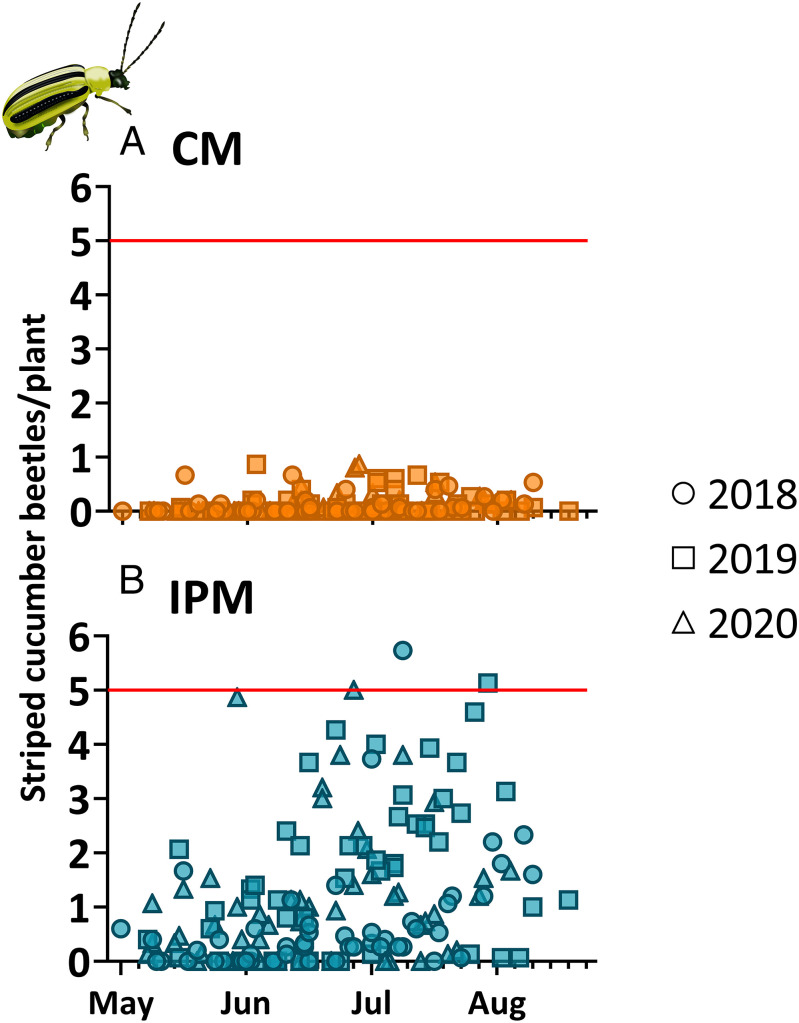
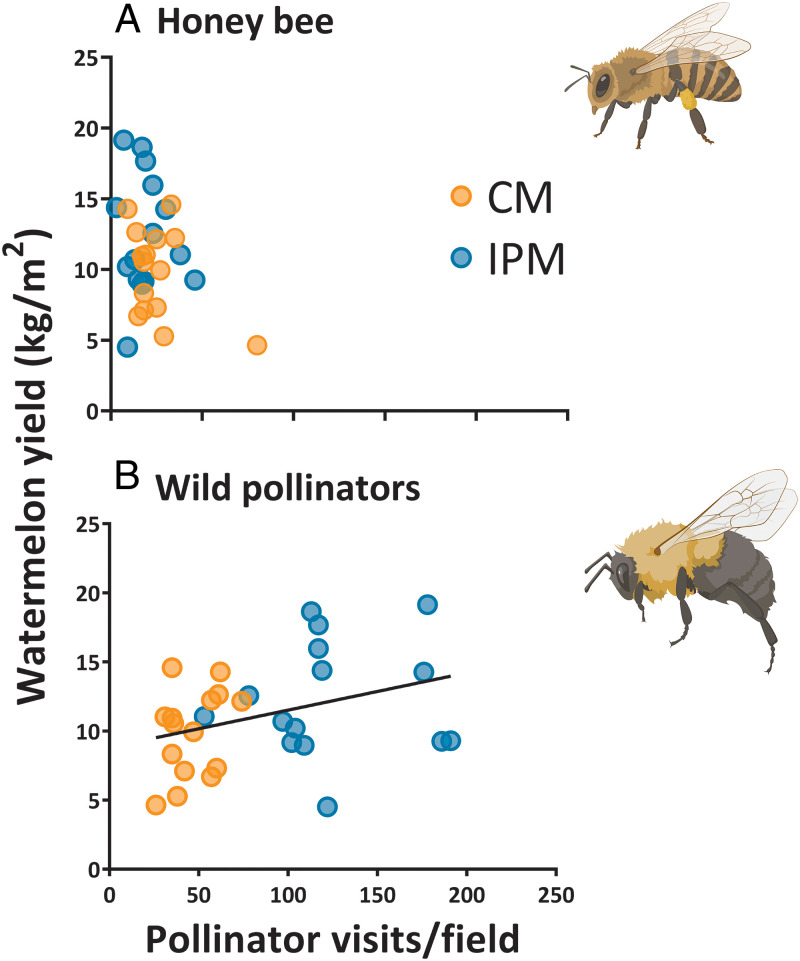
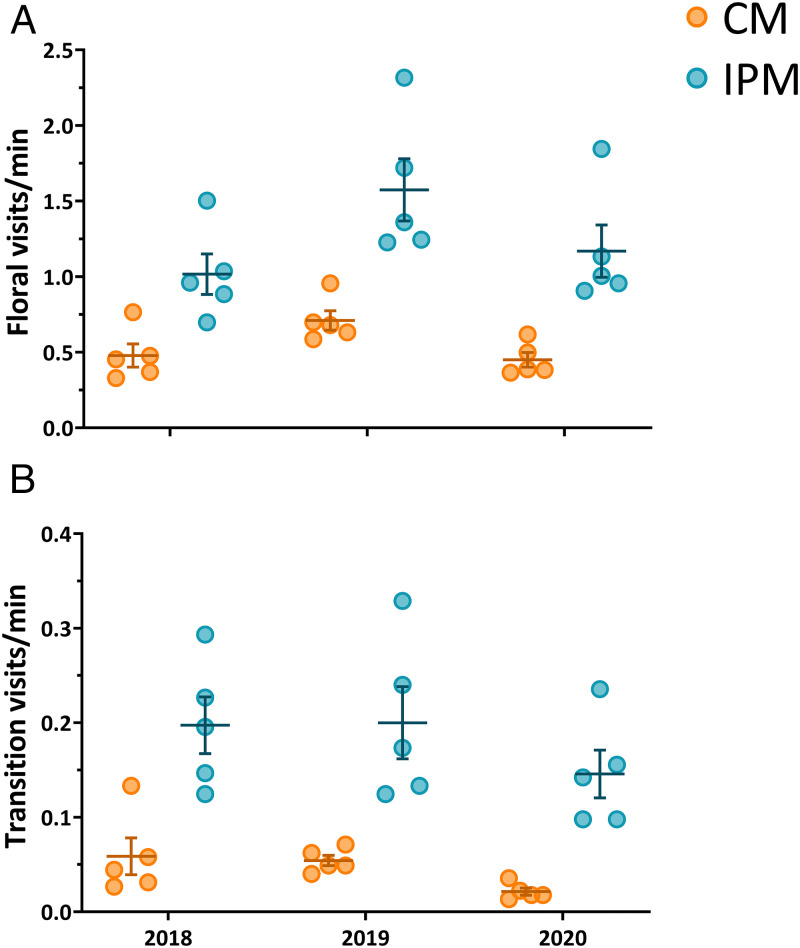
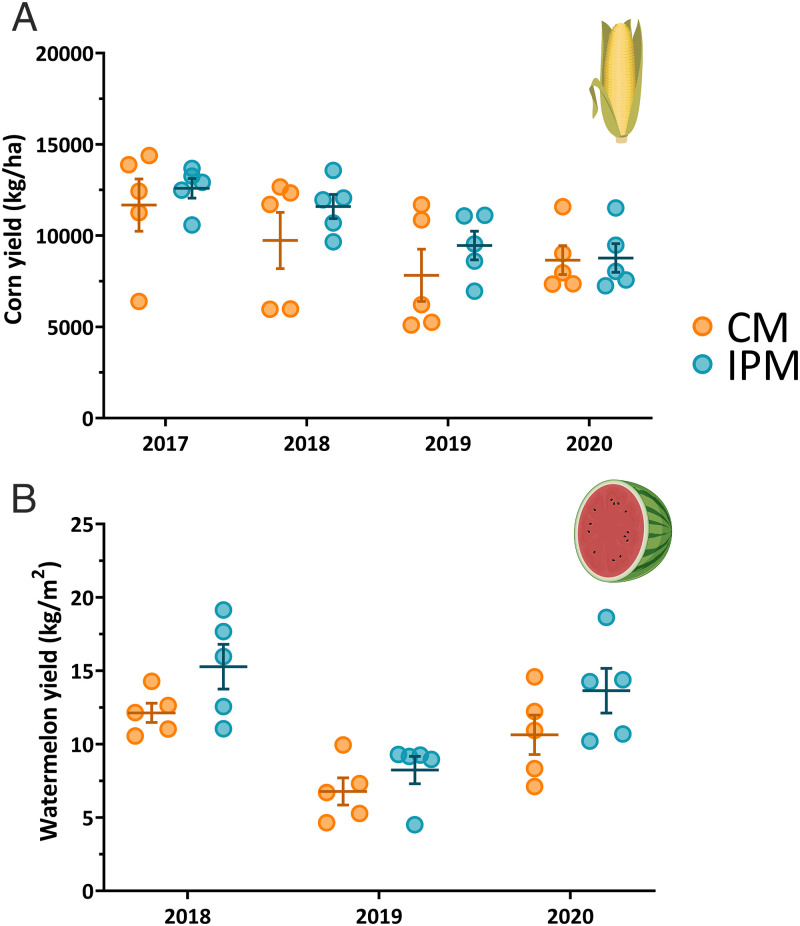
Pest management practices in modern industrial agriculture have increasingly relied on insurance-based insecticides such as seed treatments that are poorly correlated with pest density or crop damage. This approach, combined with high invertebrate toxicity for newer products like neonicotinoids, makes it challenging to conserve beneficial insects and the services that they provide. We used a 4-y experiment using commercial-scale fields replicated across multiple sites in the midwestern United States to evaluate the consequences of adopting integrated pest management (IPM) using pest thresholds compared with standard conventional management (CM). To do so, we employed a systems approach that integrated coproduction of a regionally dominant row crop (corn) with a pollinator-dependent specialty crop (watermelon). Pest populations, pollination rates, crop yields, and system profitability were measured. Despite higher pest densities and/or damage in both crops, IPM-managed pests rarely reached economic thresholds, resulting in 95% lower insecticide use (97 versus 4 treatments in CM and IPM, respectively, across all sites, crops, and years). In IPM corn, the absence of a neonicotinoid seed treatment had no impact on yields, whereas IPM watermelon experienced a 129% increase in flower visitation rate by pollinators, resulting in 26% higher yields. The pollinator-enhancement effect under IPM management was mediated entirely by wild bees; foraging by managed honey bees was unaffected by treatments and, overall, did not correlate with crop yield. This proof-of-concept experiment mimicking on-farm practices illustrates that cropping systems in major agricultural commodities can be redesigned via IPM to exploit ecosystem services without compromising, and in some cases increasing, yields.
现代农业的害虫管理实践越来越依赖于基于保险的杀虫剂,例如种子处理剂,而这些杀虫剂与害虫密度或作物损害的相关性很差。这种方法,加上新型产品如新烟碱类杀虫剂对无脊椎动物的高毒性,使得保护有益昆虫及其提供的服务变得具有挑战性。我们使用了在美国中西部多个地点进行的为期 4 年的实验,评估了采用基于害虫阈值的综合虫害管理 (IPM) 与标准常规管理 (CM) 的后果。为此,我们采用了一种系统方法,将一个地区主导的农作物(玉米)和一个依赖传粉者的特种作物(西瓜)的共生结合起来。测量了害虫种群、授粉率、作物产量和系统盈利能力。尽管两种作物的害虫密度和/或损害都更高,但 IPM 管理的害虫很少达到经济阈值,导致杀虫剂使用量降低了 95%(在所有地点、作物和年份,CM 和 IPM 分别为 97 和 4 次处理)。在 IPM 玉米中,不使用新烟碱类种子处理剂对产量没有影响,而 IPM 西瓜中传粉者的访花率增加了 129%,产量增加了 26%。在 IPM 管理下的传粉者增强效应完全是由野生蜜蜂介导的;管理的蜜蜂的觅食不受处理的影响,而且总体上与作物产量没有相关性。这个模拟农场实践的概念验证实验表明,主要农业商品的种植系统可以通过 IPM 进行重新设计,以利用生态系统服务,而不会损害,并且在某些情况下还会增加产量。