Computational Biology Unit, Department of Informatics, University of Bergen, Bergen, Norway.
BMC Bioinformatics. 2021 Oct 27;22(1):525. doi: 10.1186/s12859-021-04447-3.
Molecular interaction networks summarize complex biological processes as graphs, whose structure is informative of biological function at multiple scales. Simultaneously, omics technologies measure the variation or activity of genes, proteins, or metabolites across individuals or experimental conditions. Integrating the complementary viewpoints of biological networks and omics data is an important task in bioinformatics, but existing methods treat networks as discrete structures, which are intrinsically difficult to integrate with continuous node features or activity measures. Graph neural networks map graph nodes into a low-dimensional vector space representation, and can be trained to preserve both the local graph structure and the similarity between node features.
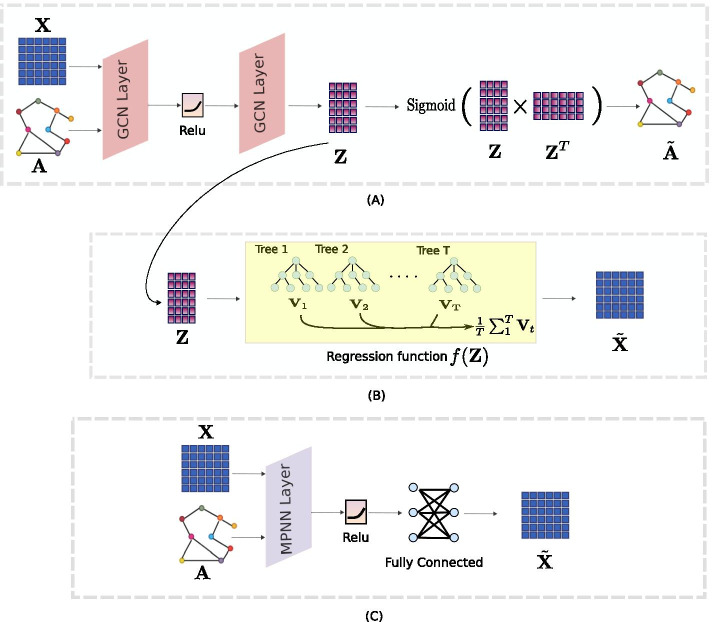
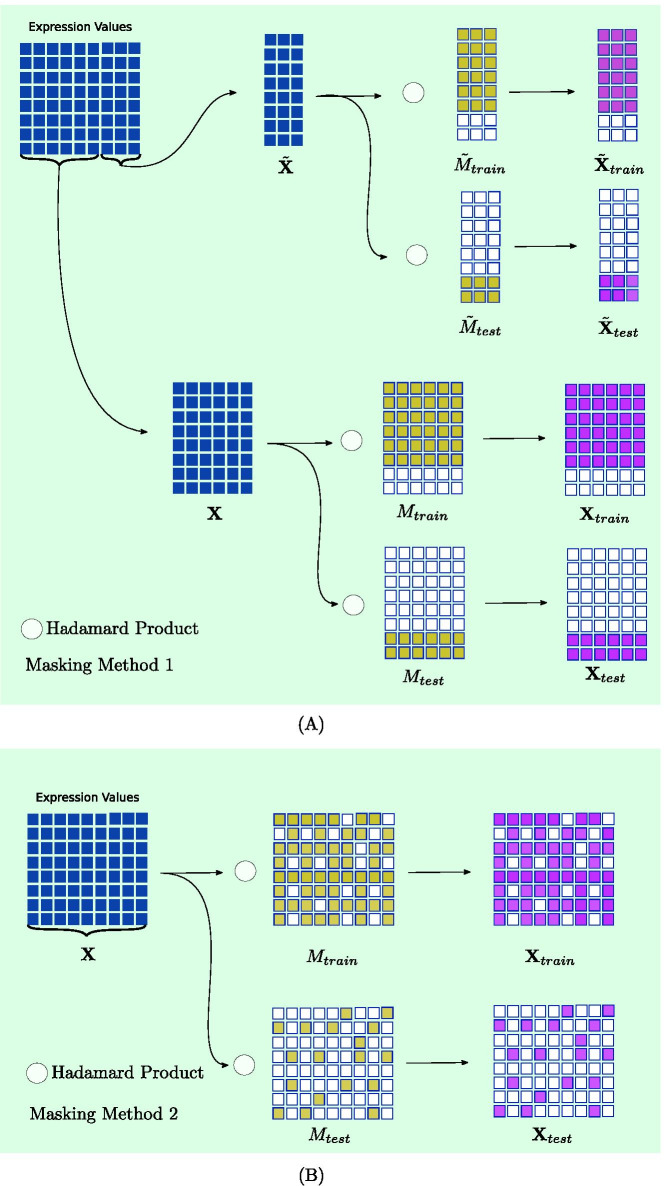
We studied the representation of transcriptional, protein-protein and genetic interaction networks in E. coli and mouse using graph neural networks. We found that such representations explain a large proportion of variation in gene expression data, and that using gene expression data as node features improves the reconstruction of the graph from the embedding. We further proposed a new end-to-end Graph Feature Auto-Encoder framework for the prediction of node features utilizing the structure of the gene networks, which is trained on the feature prediction task, and showed that it performs better at predicting unobserved node features than regular MultiLayer Perceptrons. When applied to the problem of imputing missing data in single-cell RNAseq data, the Graph Feature Auto-Encoder utilizing our new graph convolution layer called FeatGraphConv outperformed a state-of-the-art imputation method that does not use protein interaction information, showing the benefit of integrating biological networks and omics data with our proposed approach.
Our proposed Graph Feature Auto-Encoder framework is a powerful approach for integrating and exploiting the close relation between molecular interaction networks and functional genomics data.
分子相互作用网络将复杂的生物过程总结为图,其结构在多个尺度上提供了有关生物功能的信息。同时,组学技术测量基因、蛋白质或代谢物在个体或实验条件下的变化或活性。将生物网络和组学数据的互补观点整合在一起是生物信息学中的一项重要任务,但现有方法将网络视为离散结构,这本质上难以与连续的节点特征或活性测量相结合。图神经网络将图节点映射到低维向量空间表示中,并可以进行训练以保留局部图结构和节点特征之间的相似性。
我们使用图神经网络研究了转录、蛋白质-蛋白质和遗传相互作用网络在大肠杆菌和小鼠中的表示。我们发现,这种表示解释了基因表达数据中很大一部分变化,并且使用基因表达数据作为节点特征可以提高从嵌入中重建图的能力。我们进一步提出了一种新的端到端图特征自动编码器框架,用于利用基因网络的结构预测节点特征,该框架在特征预测任务上进行训练,并表明它在预测未观察到的节点特征方面比常规多层感知机表现更好。当应用于单细胞 RNAseq 数据中缺失数据的插补问题时,利用我们新的图卷积层 FeatGraphConv 的图特征自动编码器优于不使用蛋白质相互作用信息的最新插补方法,表明了我们提出的方法与生物网络和组学数据集成和利用的密切关系的益处。
我们提出的图特征自动编码器框架是一种强大的方法,用于整合和利用分子相互作用网络和功能基因组学数据之间的密切关系。