Ntracha Anastasia, Iakovakis Dimitrios, Hadjidimitriou Stelios, Charisis Vasileios S, Tsolaki Magda, Hadjileontiadis Leontios J
Department of Electrical and Computer Engineering, Aristotle University of Thessaloniki, Thessaloniki, Greece.
Third Department of Neurology, Medical School, Aristotle University of Thessaloniki, Thessaloniki, Greece.
Front Digit Health. 2020 Oct 8;2:567158. doi: 10.3389/fdgth.2020.567158. eCollection 2020.
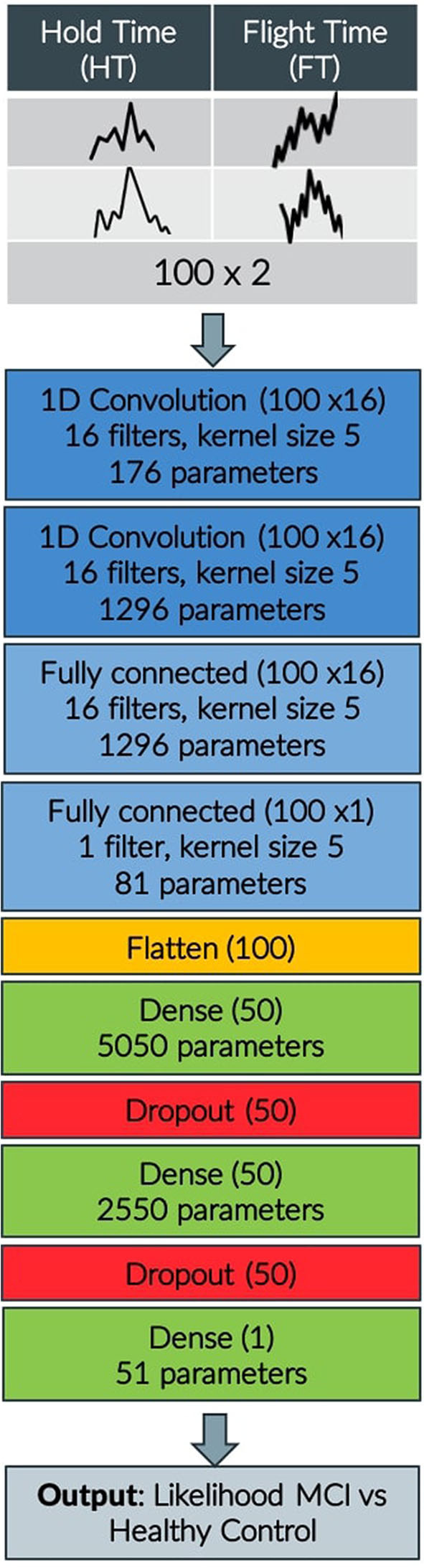
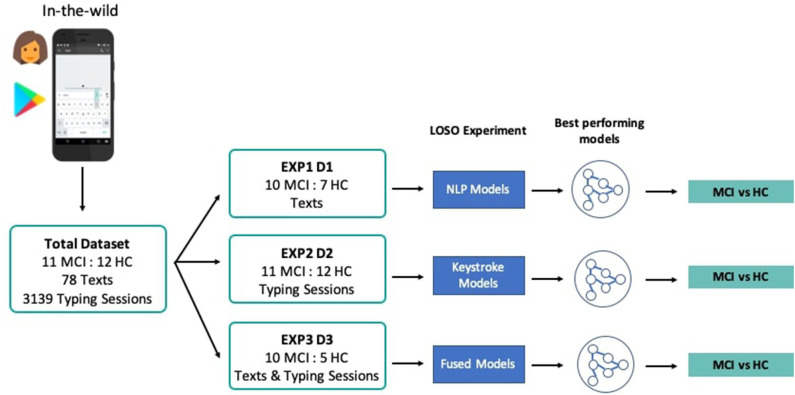
Mild cognitive impairment (MCI), an identified prodromal stage of Alzheimer's Disease (AD), often evades detection in the early stages of the condition, when existing diagnostic methods are employed in the clinical setting. From an alternative perspective, smartphone interaction behavioral data, unobtrusively acquired in a non-clinical setting, can assist the screening and monitoring of MCI and its symptoms' progression. In this vein, the diagnostic ability of digital biomarkers, drawn from Fine Motor Impairment (FMI)- and Spontaneous Written Speech (SWS)-related data analysis, are examined here. In particular, keystroke dynamics derived from touchscreen typing activities, using Convolutional Neural Networks, along with linguistic features of SWS through Natural Language Processing (NLP), were used to distinguish amongst MCI patients and healthy controls (HC). Analytically, three indices of FMI (rigidity, bradykinesia and alternate finger tapping) and nine NLP features, related with lexical richness, grammatical, syntactical complexity, and word deficits, formed the feature space. The proposed approach was tested on two demographically matched groups of 11 MCI patients and 12 HC, having undergone the same neuropsychological tests, producing 4,930 typing sessions and 78 short texts, within 6 months, for analysis. A cascaded-classifier scheme was realized under three different feature combinations and validated via a Leave-One-Subject-Out cross-validation scheme. The acquired results have shown: (a) keystroke features with a k-NN classifier achieved an Area Under Curve (AUC) of 0.78 [95% confidence interval (CI):0.68-0.88; specificity/sensitivity (SP/SE): 0.64/0.92], (b) NLP features with a Logistic regression classifier achieved an AUC of 0.76 (95% CI: 0.65-0.85; SP/SE: 0.80/0.71), and (c) an ensemble model with the fusion of keystroke and NLP features resulted in AUC of 0.75 (95% CI:0.63-0.86; SP/SE 0.90/0.60). The current findings indicate the potentiality of new digital biomarkers to capture early stages of cognitive decline, providing a highly specific remote screening tool in-the-wild.
轻度认知障碍(MCI)是已确定的阿尔茨海默病(AD)前驱阶段,在临床环境中采用现有诊断方法时,该病早期往往难以被检测到。从另一个角度来看,在非临床环境中不引人注意地获取的智能手机交互行为数据,可以辅助MCI的筛查及其症状进展的监测。为此,本文研究了从精细运动障碍(FMI)和自发书面言语(SWS)相关数据分析中提取的数字生物标志物的诊断能力。具体而言,利用卷积神经网络从触摸屏打字活动中提取击键动力学,并通过自然语言处理(NLP)分析SWS的语言特征,以区分MCI患者和健康对照(HC)。分析上,FMI的三个指标(僵硬、运动迟缓及交替手指敲击)和九个与词汇丰富度、语法、句法复杂性及词汇缺陷相关的NLP特征构成了特征空间。该方法在两组人口统计学匹配的人群中进行了测试,一组为11名MCI患者,另一组为12名HC,他们都接受了相同的神经心理学测试,在6个月内产生了4930次打字记录和78篇短文用于分析。在三种不同的特征组合下实现了级联分类器方案,并通过留一受试者交叉验证方案进行了验证。获得的结果表明:(a)使用k近邻分类器的击键特征的曲线下面积(AUC)为0.78 [95%置信区间(CI):0.68 - 0.88;特异性/敏感性(SP/SE):0.64/0.92],(b)使用逻辑回归分类器的NLP特征的AUC为0.76(95% CI:0.65 -
0.85;SP/SE:0.80/0.71),以及(c)融合击键和NLP特征的集成模型的AUC为0.75(95% CI:0.63 - 0.86;SP/SE 0.90/0.60)。当前研究结果表明新数字生物标志物在捕捉认知衰退早期阶段的潜力,为野外提供了一种高度特异的远程筛查工具。