Whittingslow Daniel C, Zia Jonathan, Gharehbaghi Sevda, Gergely Talia, Ponder Lori A, Prahalad Sampath, Inan Omer T
Coulter Department of Biomedical Engineering, Georgia Institute of Technology, Emory University, Atlanta, GA, United States.
Emory University School of Medicine, Atlanta, GA, United States.
Front Digit Health. 2020 Nov 19;2:571839. doi: 10.3389/fdgth.2020.571839. eCollection 2020.
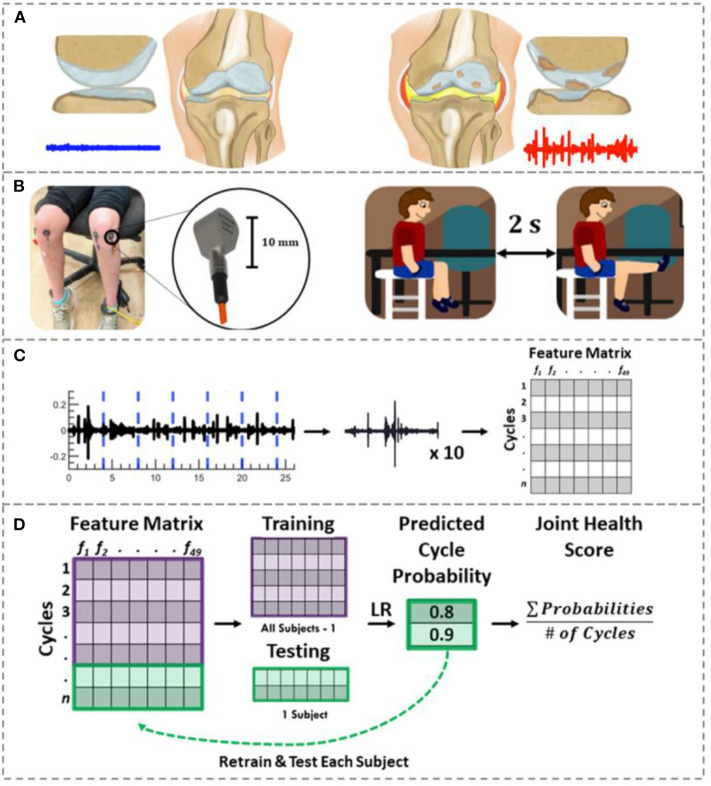
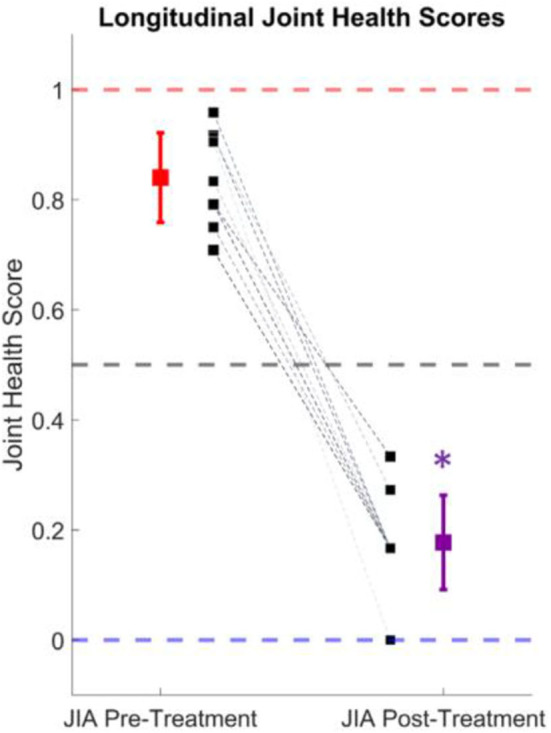
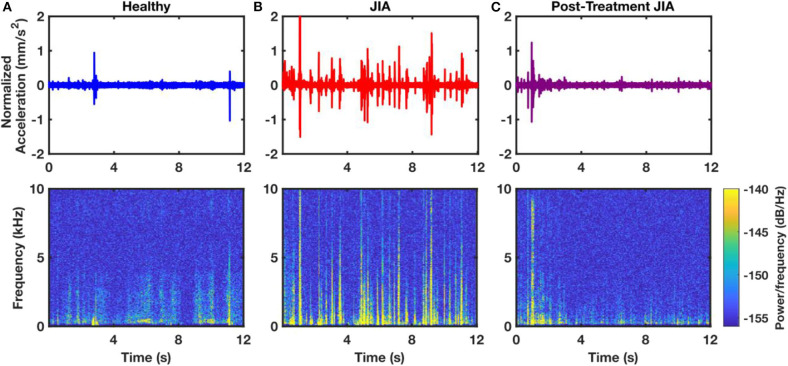
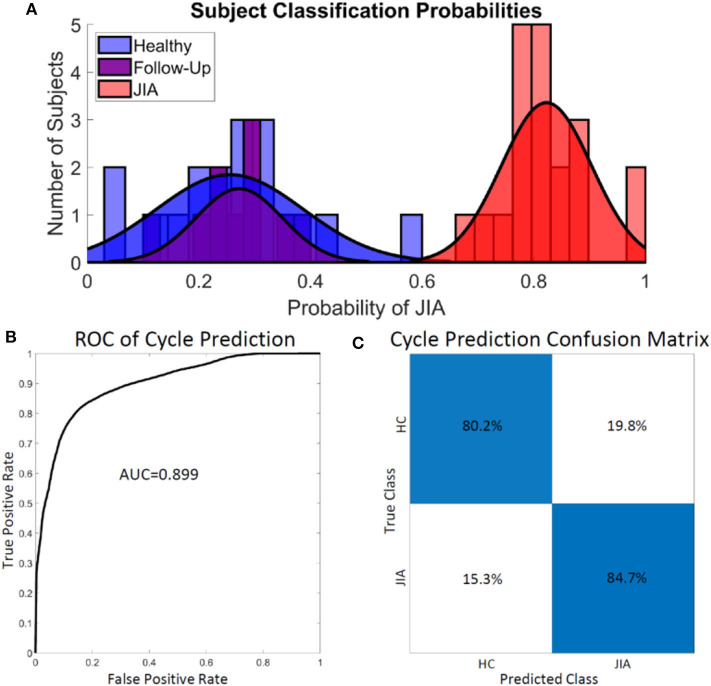
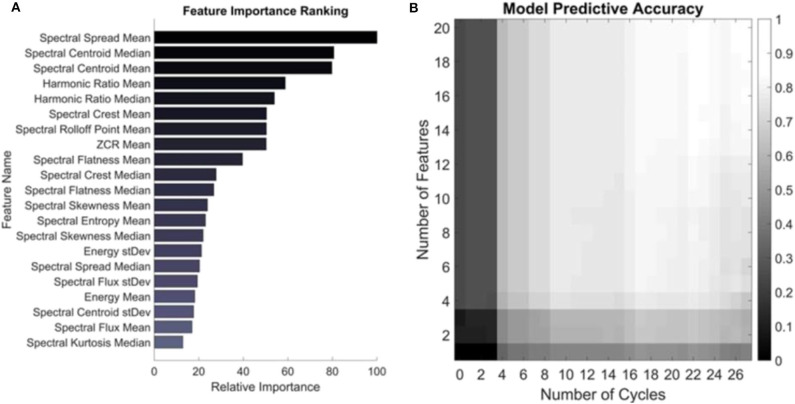
In this paper, we quantify the joint acoustic emissions (JAEs) from the knees of children with juvenile idiopathic arthritis (JIA) and support their use as a novel biomarker of the disease. JIA is the most common rheumatic disease of childhood; it has a highly variable presentation, and few reliable biomarkers which makes diagnosis and personalization of care difficult. The knee is the most commonly affected joint with hallmark synovitis and inflammation that can extend to damage the underlying cartilage and bone. During movement of the knee, internal friction creates JAEs that can be non-invasively measured. We hypothesize that these JAEs contain clinically relevant information that could be used for the diagnosis and personalization of treatment of JIA. In this study, we record and compare the JAEs from 25 patients with JIA-10 of whom were recorded a second time 3-6 months later-and 18 healthy age- and sex-matched controls. We compute signal features from each of those record cycles of flexion/extension and train a logistic regression classification model. The model classified each cycle as having JIA or being healthy with 84.4% accuracy using leave-one-subject-out cross validation (LOSO-CV). When assessing the full JAE recording of a subject (which contained at least 8 cycles of flexion/extension), a majority vote of the cycle labels accurately classified the subjects as having JIA or being healthy 100% of the time. Using the output probabilities of a JIA class as a basis for a joint health score and test it on the follow-up patient recordings. In all 10 of our 6-week follow-up recordings, the score accurately tracked with successful treatment of the condition. Our proposed JAE-based classification model of JIA presents a compelling case for incorporating this novel joint health assessment technique into the clinical work-up and monitoring of JIA.
在本文中,我们对幼年特发性关节炎(JIA)患儿膝关节的联合声发射(JAE)进行了量化,并支持将其用作该疾病的一种新型生物标志物。JIA是儿童期最常见的风湿性疾病;其表现高度可变,且可靠的生物标志物很少,这使得诊断和个性化护理变得困难。膝关节是最常受累的关节,具有标志性的滑膜炎和炎症,可延伸至损伤下方的软骨和骨骼。在膝关节运动过程中,内部摩擦会产生可通过非侵入性测量的JAE。我们假设这些JAE包含可用于JIA诊断和治疗个性化的临床相关信息。在本研究中,我们记录并比较了25例JIA患者的JAE——其中10例在3 - 6个月后进行了第二次记录——以及18名年龄和性别匹配的健康对照者的JAE。我们从每个屈伸记录周期中计算信号特征,并训练一个逻辑回归分类模型。使用留一法交叉验证(LOSO - CV),该模型将每个周期分类为患有JIA或健康,准确率为84.4%。当评估受试者的完整JAE记录(其中包含至少8个屈伸周期)时,周期标签的多数投票在100%的时间内准确地将受试者分类为患有JIA或健康。以JIA类别的输出概率为基础计算关节健康评分,并在后续患者记录上进行测试。在我们所有10次为期6周的随访记录中,该评分随着病情的成功治疗而准确跟踪。我们提出的基于JAE的JIA分类模型为将这种新型关节健康评估技术纳入JIA的临床检查和监测提供了令人信服的理由。