Massey Philip M, Chiang Shawn C, Rose Meredith, Murray Regan M, Rockett Madeline, Togo Elikem, Klassen Ann C, Manganello Jennifer A, Leader Amy E
Department of Community Health and Prevention, Dornsife School of Public Health, Drexel University, Philadelphia, PA, United States.
Department of Health Policy, Management and Behavior, School of Public Health, University at Albany, State University of New York (SUNY), Albany, NY, United States.
Front Digit Health. 2021 Aug 4;3:682639. doi: 10.3389/fdgth.2021.682639. eCollection 2021.
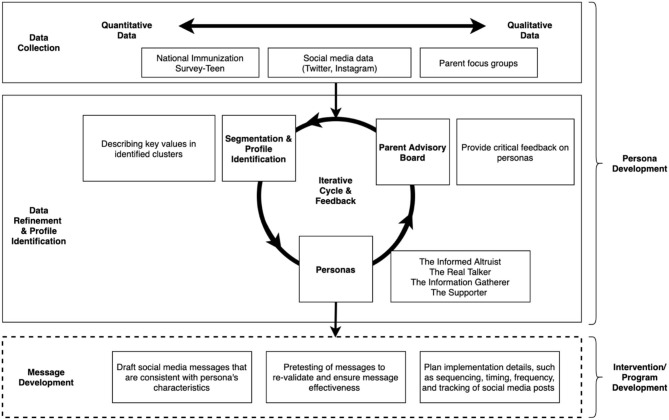
Personas are based on real-life typologies of people that can be used to create characters and messages to communicate important health information through relatable narrative storylines. Persona development is data-driven and can involve multiple phases of formative research and evaluation; however, personas are largely underutilized in digital health research. The purpose of this study was to create and document persona development to deliver narrative-focused health education for parents on Twitter with the goal of increasing uptake of HPV vaccination among adolescents. Leveraging data from a mixed-method study conducted in the U.S. with a diverse population of parents with adolescents ages 9-14, we used both qualitative and quantitative data (e.g., the National Immunization Survey-Teen, focus groups, and social media) to create personas. These data sources were used to identify and develop key characteristics for personas to reflect a range of parents and their diverse understandings and experiences related to HPV vaccination. A parent advisory board provided insight and helped refine persona development. Four personas emerged and were characterized as the (1) Informed Altruist, (2) Real Talker, (3) Information Gatherer, and (4) Supporter. Characteristics differed across personas and provided insights into targeted narrative strategies. Described attributes included demographics, psychographics, communication style, vaccine goals and aspirations, vaccine challenges and frustrations, and vaccine hesitancy. This work demonstrates how multiple data sources can be used to create personas to deliver social media messages that can address the diverse preferences and needs of parents for HPV vaccine information. With increasing usage of social media for health information among parents, it is important for researchers to consider marketing and design thinking to create health communication messages that resonate with audiences.
人物角色基于现实生活中的人群类型,可用于创建角色和信息,通过相关的叙事情节来传达重要的健康信息。人物角色的开发以数据为驱动,可能涉及多个形成性研究和评估阶段;然而,人物角色在数字健康研究中大多未得到充分利用。本研究的目的是创建并记录人物角色的开发过程,以便在推特上为家长提供以叙事为重点的健康教育,目标是提高青少年人乳头瘤病毒(HPV)疫苗的接种率。利用在美国对9至14岁青少年的家长进行的一项混合方法研究的数据,我们使用定性和定量数据(如全国青少年免疫调查、焦点小组和社交媒体)来创建人物角色。这些数据源用于识别和开发人物角色的关键特征,以反映一系列家长及其对HPV疫苗接种的不同理解和经历。一个家长咨询委员会提供了见解并帮助完善人物角色的开发。出现了四个人物角色,分别被描述为(1)明智的利他主义者,(2)直言不讳者,(3)信息收集者,以及(4)支持者。不同人物角色的特征各不相同,为有针对性的叙事策略提供了见解。所描述的属性包括人口统计学特征、心理特征、沟通风格、疫苗目标和期望、疫苗接种面临的挑战和挫折,以及对疫苗的犹豫态度。这项工作展示了如何利用多个数据源来创建人物角色,以传递能够满足家长对HPV疫苗信息的不同偏好和需求的社交媒体信息。随着家长越来越多地使用社交媒体获取健康信息,研究人员考虑运用营销和设计思维来创建能引起受众共鸣的健康传播信息非常重要。