Fujieda Kaoru, Nozue Akiko, Watanabe Akie, Shi Keiko, Itagaki Hiroya, Hosokawa Yoshihiko, Nishida Keiko, Tasaka Nobutaka, Satoh Toyomi, Nishide Ken
Tsukuba Medical Center Hospital, Tsukuba, Ibaraki, Japan.
Department of Obstetrics and Gynecology, Faculty of Medicine, University of Tsukuba, 1-1-1 Tennoudai, Tsukuba, Ibaraki, 305-8575, Japan.
Thromb J. 2021 Oct 30;19(1):77. doi: 10.1186/s12959-021-00334-2.
This study aimed to investigate the background of patients who presented with pulmonary embolism (PE) on contrast-enhanced chest computed tomography (CT) and to explore the risk factors for PE.
This study included a review of the medical records of all 50,621 patients who were admitted to one community hospital between January 1, 2013 and December 31, 2017. Data on sex, age, risk factors related to blood flow stagnation (obesity, long-term bed rest, cardiopulmonary disease, cast fixation, long-term sitting), risk factors related to vascular endothelial disorder (surgery, trauma/fracture, central venous catheterization, catheter tests/treatments, vasculitis, antiphospholipid antibody syndrome, history of venous thromboembolism (VTE)), and risk factors related to hypercoagulability (malignant tumor, use of oral contraceptives/low-dose estrogen progestin/steroids, infection, inflammatory enteric disease, polycythemia, protein C or protein S deficiency, dehydration) were evaluated.
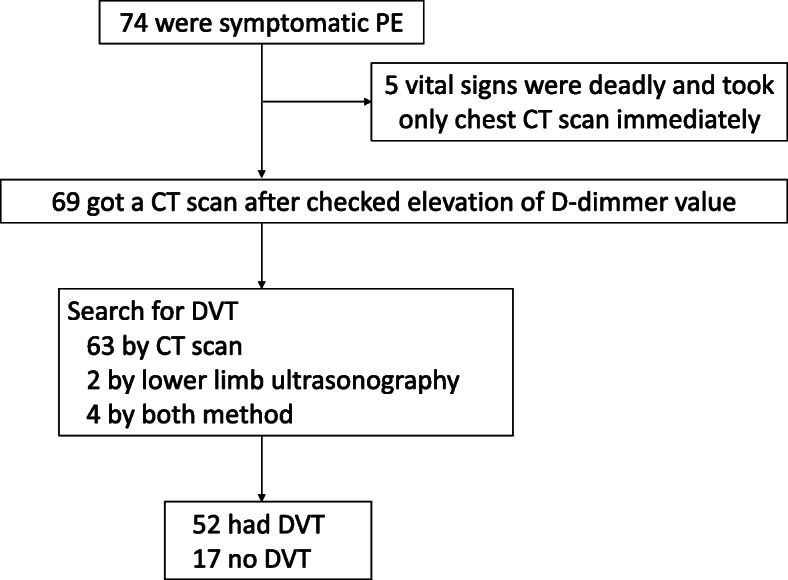
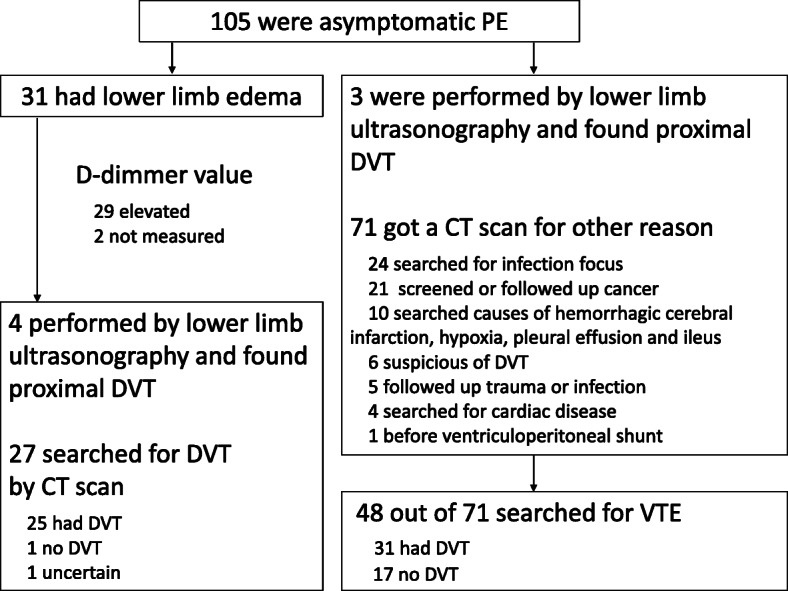
Of all inpatients, 179(0.35%) out of 50,621 were diagnosed with PE after contrast-enhanced chest CT examination, in which 74 patients were symptomatic and 105 patients had no symptom. Among asymptomatic 105 patients, 71 patients got CT scans for other reasons including cancer screening and searching infection focus, and 34 patients got CT scans for searching PE due to either apparent or suspicious DVT. The rate of discovering PE was significantly greater in women (0.46%, 90/19,409) than men (0.29%, 89/31,212) (P = 0.008). Of the 179 patients with PE, 164 (92%) had some type of risk factor. For both men and women, the most frequent risk factor was a malignant tumor, followed by obesity, long-term bed rest and infection for men and long-term bed rest, obesity and infection for women. The most common malignant tumor was lung cancer. Although taking antipsychotic agent is not advocated as a risk factor, there is a possibility of involvement.
The risk factors for PE were identified in this single-center, retrospective study.
本研究旨在调查在对比增强胸部计算机断层扫描(CT)中发现肺栓塞(PE)的患者的背景情况,并探索PE的危险因素。
本研究回顾了2013年1月1日至2017年12月31日期间在一家社区医院住院的所有50621例患者的病历。评估了性别、年龄、与血流停滞相关的危险因素(肥胖、长期卧床休息、心肺疾病、石膏固定、长期久坐)、与血管内皮功能障碍相关的危险因素(手术、创伤/骨折、中心静脉置管、导管检查/治疗、血管炎、抗磷脂抗体综合征、静脉血栓栓塞症(VTE)病史)以及与高凝状态相关的危险因素(恶性肿瘤、口服避孕药/低剂量雌激素孕激素/类固醇的使用、感染、炎症性肠病、红细胞增多症、蛋白C或蛋白S缺乏、脱水)。
在所有住院患者中,50621例中有179例(0.35%)在对比增强胸部CT检查后被诊断为PE,其中74例有症状,105例无症状。在105例无症状患者中,71例因其他原因进行CT扫描,包括癌症筛查和寻找感染灶,34例因明显或可疑的深静脉血栓形成(DVT)而进行CT扫描以寻找PE。女性发现PE的比率(0.46%,90/19409)显著高于男性(0.29%,89/31212)(P = 0.008)。在179例PE患者中,164例(92%)有某种类型的危险因素。对于男性和女性,最常见的危险因素都是恶性肿瘤,其次是肥胖、长期卧床休息和感染,男性依次为恶性肿瘤、肥胖、长期卧床休息和感染,女性依次为长期卧床休息、肥胖和感染。最常见的恶性肿瘤是肺癌。虽然不主张将服用抗精神病药物作为危险因素,但有可能与之相关。
在这项单中心回顾性研究中确定了PE的危险因素。