Department of Pharmacology, Amiens University Medical Center, Amiens, France.
MP3CV Laboratory, EA7517, University of Picardie Jules Verne, Amiens, France.
Nephrol Dial Transplant. 2021 Dec 28;37(Suppl 2):ii33-ii44. doi: 10.1093/ndt/gfab223.
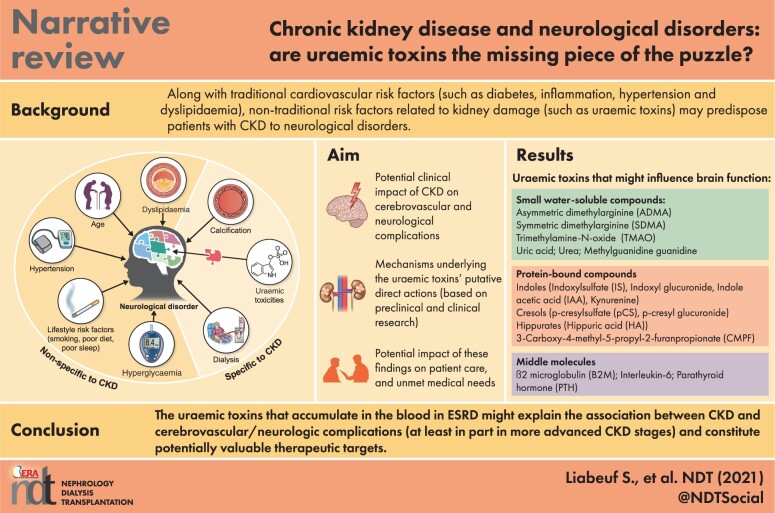
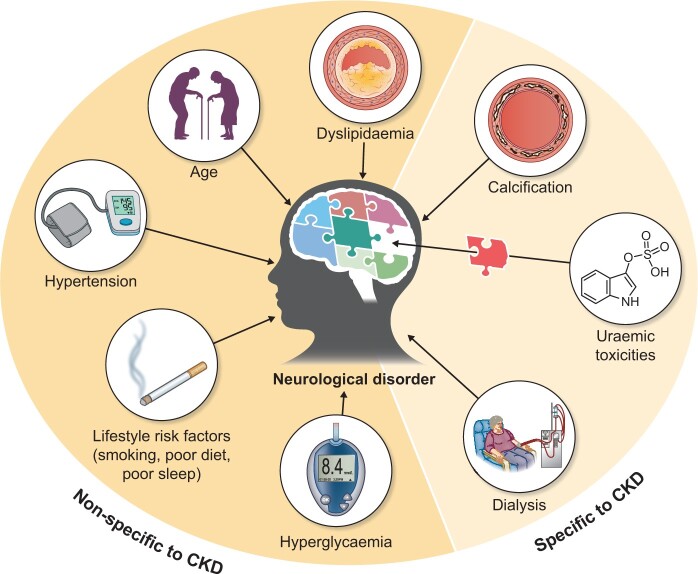
Chronic kidney disease (CKD) perturbs the crosstalk with others organs, with the interaction between the kidneys and the heart having been studied most intensively. However, a growing body of data indicates that there is an association between kidney dysfunction and disorders of the central nervous system. In epidemiological studies, CKD is associated with a high prevalence of neurological complications, such as cerebrovascular disorders, movement disorders, cognitive impairment and depression. Along with traditional cardiovascular risk factors (such as diabetes, inflammation, hypertension and dyslipidaemia), non-traditional risk factors related to kidney damage (such as uraemic toxins) may predispose patients with CKD to neurological disorders. There is increasing evidence to show that uraemic toxins, for example indoxyl sulphate, have a neurotoxic effect. A better understanding of factors responsible for the elevated prevalence of neurological disorders among patients with CKD might facilitate the development of novel treatments. Here, we review (i) the potential clinical impact of CKD on cerebrovascular and neurological complications, (ii) the mechanisms underlying the uraemic toxins' putative action (based on pre-clinical and clinical research) and (iii) the potential impact of these findings on patient care.
慢性肾脏病(CKD)扰乱了与其他器官的交流,其中肾脏和心脏之间的相互作用研究得最为深入。然而,越来越多的数据表明,肾功能障碍与中枢神经系统疾病之间存在关联。在流行病学研究中,CKD 与神经系统并发症的高发密切相关,如脑血管疾病、运动障碍、认知障碍和抑郁症。除了传统的心血管危险因素(如糖尿病、炎症、高血压和血脂异常)外,与肾脏损伤相关的非传统危险因素(如尿毒症毒素)可能使 CKD 患者易患神经疾病。越来越多的证据表明,尿毒症毒素(如硫酸吲哚酚)具有神经毒性作用。更好地了解导致 CKD 患者神经系统疾病高发的因素,可能有助于开发新的治疗方法。在这里,我们综述了(i)CKD 对脑血管和神经并发症的潜在临床影响,(ii)尿毒症毒素潜在作用的机制(基于临床前和临床研究),以及(iii)这些发现对患者治疗的潜在影响。