Xu Gang, Jiang Yuhan, Wang Shuai, Qin Kun, Ding Jingchen, Liu Yang, Lu Binbin
School of Remote Sensing and Information Engineering, Wuhan University, 129 Luoyu Road, Wuhan 430079, China.
State Key Laboratory of Information Engineering in Surveying, Mapping and Remote Sensing, Wuhan University, Wuhan 430079, China.
Sustain Cities Soc. 2022 Jan;76:103485. doi: 10.1016/j.scs.2021.103485. Epub 2021 Oct 25.
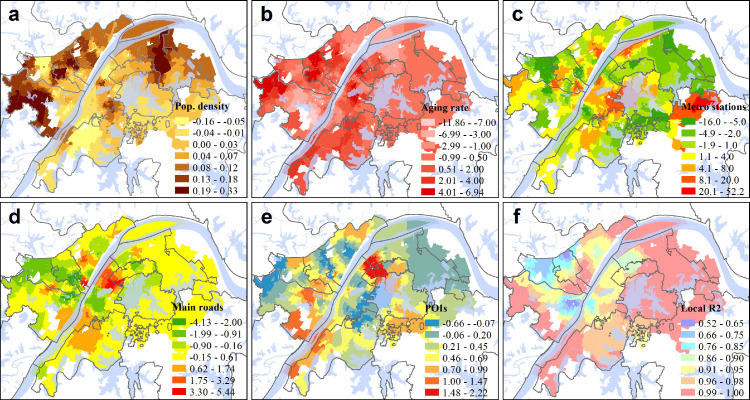
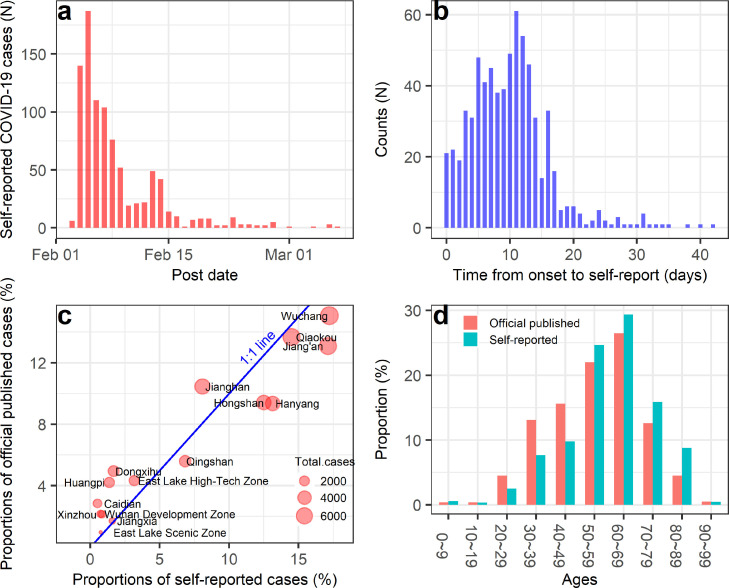
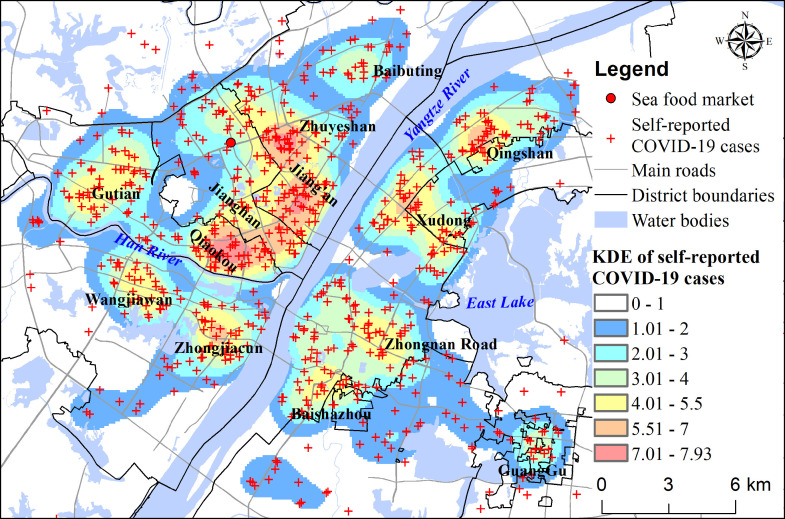
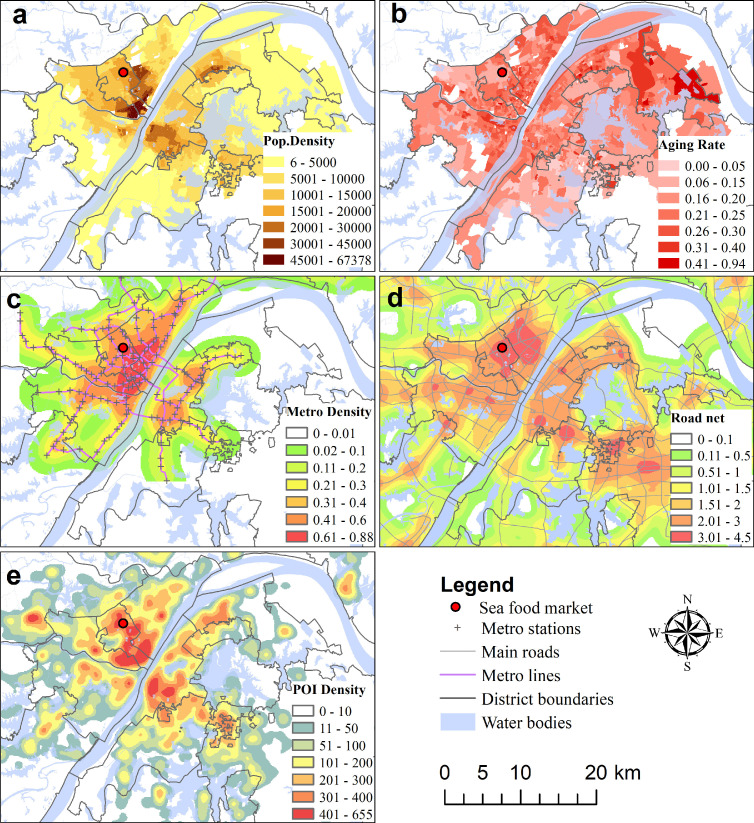
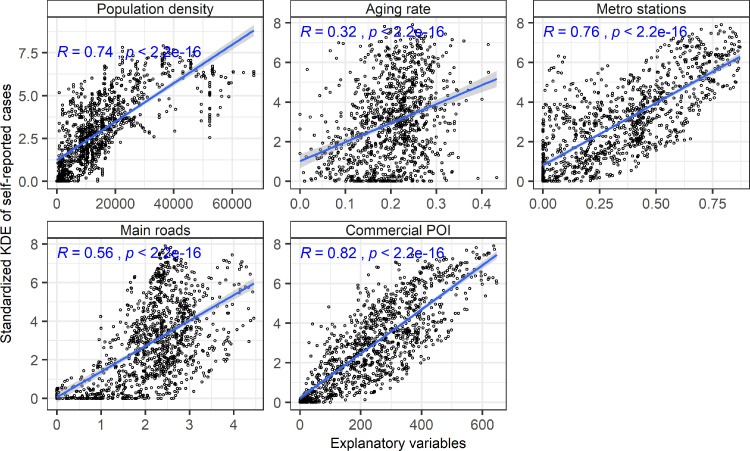
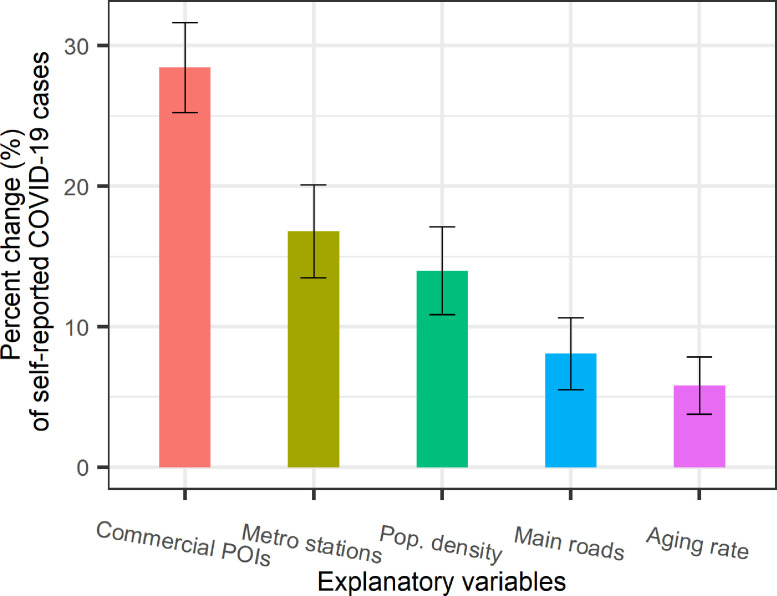
The lack of detailed COVID-19 cases at a fine spatial resolution restricts the investigation of spatial disparities of its attack rate. Here, we collected nearly one thousand self-reported cases from a social media platform during the early stage of COVID-19 epidemic in Wuhan, China. We used kernel density estimation (KDE) to explore spatial disparities of epidemic intensity and adopted geographically weighted regression (GWR) model to quantify influences of population dynamics, transportation, and social interactions on COVID-19 epidemic. Results show that self-reported COVID-19 cases concentrated in commercial centers and populous residential areas. Blocks with higher population density, higher aging rate, more metro stations, more main roads, and more commercial point-of-interests (POIs) have a higher density of COVID-19 cases. These five explanatory variables explain 76% variance of self-reported cases using an OLS model. Commercial POIs have the strongest influence, which increase COVID-19 cases by 28% with one standard deviation increase. The GWR model performs better than OLS model with the adjusted of 0.96. Spatial heterogeneities of coefficients in the GWR model show that influencing factors play different roles in diverse communities. We further discussed potential implications for the healthy city and urban planning for the sustainable development of cities.
缺乏高空间分辨率的详细新冠疫情病例数据,限制了对其感染率空间差异的调查。在此,我们在中国武汉新冠疫情早期阶段,从一个社交媒体平台收集了近一千例自我报告病例。我们使用核密度估计(KDE)来探究疫情强度的空间差异,并采用地理加权回归(GWR)模型来量化人口动态、交通和社会互动对新冠疫情的影响。结果表明,自我报告的新冠病例集中在商业中心和人口密集的居民区。人口密度较高、老龄化率较高、地铁站较多、主干道较多以及商业兴趣点(POI)较多的街区,新冠病例密度较高。使用普通最小二乘法(OLS)模型,这五个解释变量解释了自我报告病例76%的方差。商业POI的影响最强,标准差每增加一个单位,新冠病例增加28%。GWR模型的表现优于OLS模型,调整后的 为0.96。GWR模型中系数的空间异质性表明,影响因素在不同社区发挥着不同作用。我们进一步讨论了对健康城市和城市规划以实现城市可持续发展的潜在影响。