Khodabakhshi Zahra, Hosseinkhah Nazanin, Ghadiri Hossein
MSc, Department of Medical Physics and Biomedical Engineering, Tehran University of Medical Science, Tehran, Iran.
MSc, Research Center for Molecular and Cellular Imaging (RCMCI), Tehran, Iran.
J Biomed Phys Eng. 2021 Oct 1;11(5):629-640. doi: 10.31661/jbpe.v0i0.1131. eCollection 2021 Oct.
Microbubbles are widely used in diagnostic ultrasound applications as contrast agents. Recently, many studies have shown that microbubbles have good potential for the use in therapeutic applications such as drug and gene delivery and opening of blood- brain barrier locally and transiently. When microbubbles are located inside an elastic microvessel and activated by ultrasound, they oscillate and induce mechanical stresses on the vessel wall. However, the mechanical stresses have beneficial therapeutic effects, they may induce vessel damage if they are too high. Microstreaming-induced shear stress is one of the most important wall stresses.
The overall aim of this study is to simulate the interaction between confined bubble inside an elastic microvessel and ultrasound field and investigate the effective parameters on microstreaming-induced shear stress.
In this Simulation study, we conducted a 2D finite element simulation to study confined microbubble dynamics, also we investigated both acoustical and bubble material parameters on microbubble oscillation and wall stress.
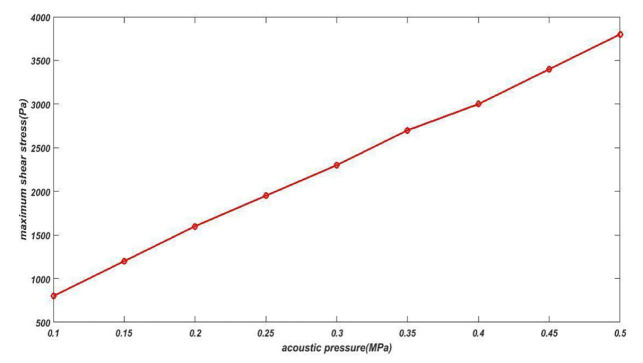
Based on our results, for acoustic parameters in the range of therapeutic applications, the maximum shear stress was lower than 4 kPa. Shear stress was approximately independent from shell viscosity whereas it decreased by increasing the shell stiffness. Moreover, shear stress showed an increasing trend with acoustic pressure.
Beside the acoustical parameters, bubble properties have important effects on bubble behavior so that the softer and larger bubbles are more appropriate for therapeutic application as they can decrease the required frequency and acoustic pressure while inducing the same biological effects.
微泡作为造影剂广泛应用于诊断超声领域。最近,许多研究表明微泡在治疗应用中具有良好的潜力,如药物和基因递送以及局部和短暂地打开血脑屏障。当微泡位于弹性微血管内并被超声激活时,它们会振荡并在血管壁上产生机械应力。然而,尽管机械应力具有有益的治疗效果,但如果过高可能会导致血管损伤。微流诱导的剪切应力是最重要的壁应力之一。
本研究的总体目标是模拟弹性微血管内受限气泡与超声场之间的相互作用,并研究影响微流诱导剪切应力的有效参数。
在本模拟研究中,我们进行了二维有限元模拟以研究受限微泡动力学,还研究了声学和气泡材料参数对微泡振荡和壁应力的影响。
根据我们的结果,对于治疗应用范围内的声学参数,最大剪切应力低于4kPa。剪切应力大致与壳粘度无关,而随着壳刚度的增加而降低。此外,剪切应力随声压呈增加趋势。
除了声学参数外,气泡特性对气泡行为也有重要影响,因此较软和较大的气泡更适合治疗应用,因为它们可以在诱导相同生物学效应的同时降低所需的频率和声压。