Department of Bacteria, Parasites and, Fungi, Statens Serum Institut, Artillerivej 5, DK-2300, Copenhagen, Denmark.
Department of Clinical Microbiology, Vejle Hospital, University Hospital of Southern Denmark, Vejle, Denmark.
BMC Infect Dis. 2021 Nov 1;21(1):1129. doi: 10.1186/s12879-021-06820-2.
We describe the serotype distribution of Streptococcus agalactiae (GBS) carriage isolates from women in labor and among GBS isolates causing invasive infections during the same period to see if the distribution of carriage serotypes reflects the GBS serotypes causing invasive diseases including early-onset disease (EOGBS).
Data on invasive isolates from 2019 including serotype, erythromycin and clindamycin susceptibility was retrieved from the Danish national reference laboratory, Statens Serum Institut. Carriage isolates were collected from women with risk factors for EOGBS enrolled at delivery at the maternity ward at a Danish University Hospital, first half of 2019.
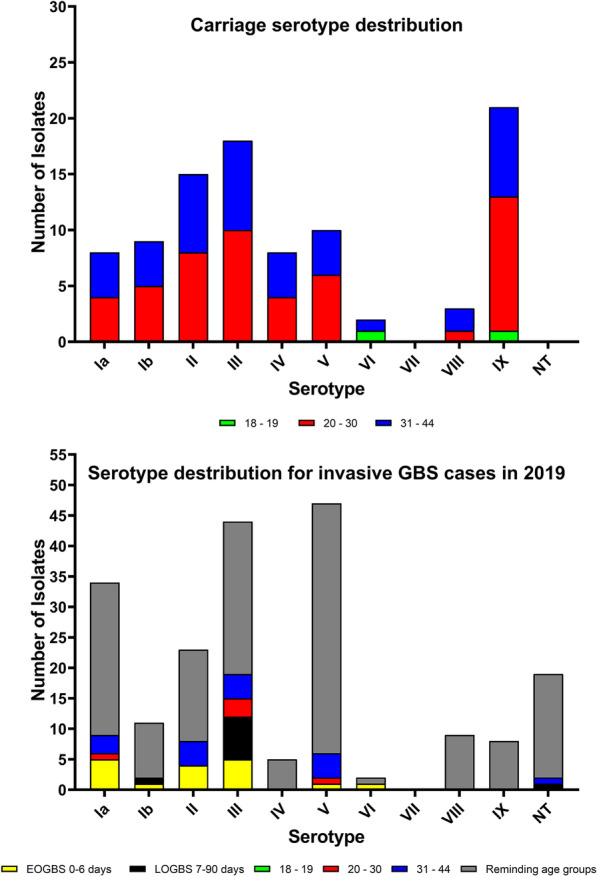
Among carriage isolates, the dominant serotype was IX (21 %) followed by serotype III (19 %). The resistance to erythromycin and clindamycin was 21 and 26 %, respectively. Among invasive GBS isolates, no case of EOGBS with serotype IX was detected but the distribution of serotypes were otherwise similar to the GBS carrier strains. The corresponding resistance to erythromycin and clindamycin was 23 and 15 %, respectively. Penicillin resistance was not detected among carriage nor invasive isolates.
The distribution of serotypes among carriage and invasive GBS reflects the assumption that EOGBS occur following transmission of GBS from mother to newborn, with the exception of serotype IX.
我们描述了分娩妇女中无乳链球菌(GBS)带菌分离株的血清型分布,以及同期引起侵袭性感染的 GBS 分离株,以观察带菌血清型是否反映了引起侵袭性疾病(包括早发性疾病)的 GBS 血清型。
从丹麦国家参考实验室 Statens Serum Institut 检索了 2019 年侵袭性分离株的数据,包括血清型、红霉素和克林霉素药敏性。携带分离株是从丹麦大学医院分娩病房有 EOGBS 风险因素的妇女中收集的,时间是 2019 年上半年。
在带菌分离株中,占主导地位的血清型是 IX(21%),其次是 III 型(19%)。对红霉素和克林霉素的耐药率分别为 21%和 26%。在侵袭性 GBS 分离株中,未发现血清型 IX 的 EOGBS 病例,但血清型分布与 GBS 携带者菌株相似。相应的红霉素和克林霉素耐药率分别为 23%和 15%。青霉素耐药性在带菌和侵袭性分离株中均未检出。
带菌和侵袭性 GBS 中的血清型分布反映了 EOGBS 是由母亲向新生儿传播 GBS 引起的假设,除了血清型 IX 以外。