Centre for Public Health Data Science, Institute of Health Informatics, University College, 222 Euston Rd, London NW1 2DA, UK.
Centre for Public Health Data Science, Institute of Health Informatics, University College, 222 Euston Rd, London NW1 2DA, UK.
Vaccine. 2021 Nov 26;39(48):7108-7116. doi: 10.1016/j.vaccine.2021.09.066. Epub 2021 Oct 8.
Vaccination intention is key to the success of any vaccination programme, alongside vaccine availability and access. Public intention to take a COVID-19 vaccine is high in England and Wales compared to other countries, but vaccination rate disparities between ethnic, social and age groups has led to concern.
Online survey of prospective household community cohort study participants across England and Wales (Virus Watch). Vaccination intention was measured by individual participant responses to 'Would you accept a COVID-19 vaccine if offered?', collected in December 2020 and February 2021. Responses to a 13-item questionnaire collected in January 2021 were analysed using factor analysis to investigate psychological influences on vaccination intention.
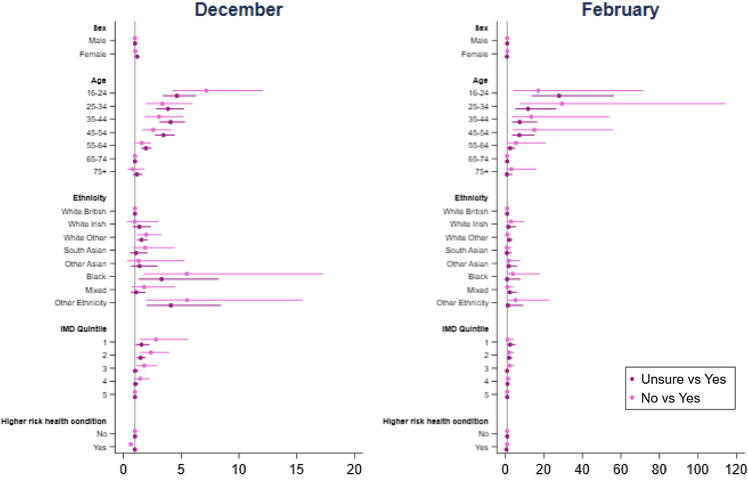
Survey response rate was 56% (20,785/36,998) in December 2020 and 53% (20,590/38,727) in February 2021, with 14,880 adults reporting across both time points. In December 2020, 1,469 (10%) participants responded 'No' or 'Unsure'. Of these people, 1,266 (86%) changed their mind and responded 'Yes' or 'Already had a COVID-19 vaccine' by February 2021. Vaccination intention increased across all ethnic groups and levels of social deprivation. Age was most strongly associated with vaccination intention, with 16-24-year-olds more likely to respond "Unsure" or "No" versus "Yes" than 65-74-year-olds in December 2020 (OR: 4.63, 95 %CI: 3.42, 6.27 & OR 7.17 95 %CI: 4.26, 12.07 respectively) and February 2021 (OR: 27.92 95 %CI: 13.79, 56.51 & OR 17.16 95 %CI: 4.12, 71.55). The association between ethnicity and vaccination intention weakened, but did not disappear, over time. Both vaccine- and illness-related psychological factors were shown to influence vaccination intention.
Four in five adults (86%) who were reluctant or intending to refuse a COVID-19 vaccine in December 2020 had changed their mind in February 2021 and planned to accept, or had already accepted, a vaccine.
疫苗接种意愿是任何疫苗接种计划成功的关键,与疫苗的可及性和可获得性并列。与其他国家相比,英格兰和威尔士的公众对 COVID-19 疫苗的接种意愿较高,但在族裔、社会和年龄群体之间的疫苗接种率存在差异,这引起了人们的关注。
对英格兰和威尔士(Virus Watch)的未来家庭社区队列研究参与者进行在线调查。2020 年 12 月和 2021 年 2 月,通过个人参与者对“如果提供 COVID-19 疫苗,您会接受吗?”的回答来衡量疫苗接种意愿。2021 年 1 月收集的 13 项问卷回答使用因素分析进行分析,以调查对疫苗接种意愿的心理影响。
2020 年 12 月的调查回复率为 56%(20785/36998),2021 年 2 月为 53%(20590/38727),两个时间点均有 14880 名成年人进行了报告。2020 年 12 月,有 1469 名(10%)参与者回答“否”或“不确定”。其中,有 1266 名(86%)人改变了主意,到 2021 年 2 月,他们回答“是”或“已接种 COVID-19 疫苗”。所有族裔群体和社会贫困程度的疫苗接种意愿都有所增加。年龄与疫苗接种意愿的关联最强,与 65-74 岁的人相比,16-24 岁的人更有可能在 2020 年 12 月和 2021 年 2 月回答“不确定”或“否”而不是“是”(2020 年 12 月 OR:4.63,95%CI:3.42,6.27;OR 7.17 95%CI:4.26,12.07;2021 年 2 月 OR:27.92 95%CI:13.79,56.51;OR 17.16 95%CI:4.12,71.55)。随着时间的推移,族裔与疫苗接种意愿之间的关联虽然减弱,但并未消失。疫苗和疾病相关的心理因素都被证明会影响疫苗接种意愿。
在 2020 年 12 月,五分之四的成年人(86%)原本不愿意或打算拒绝 COVID-19 疫苗,但到 2021 年 2 月,他们改变了主意,计划接受或已经接受了疫苗。