Schneider Robert H, Grim Clarence, Kotchen Theodore, Marwaha Komal, Kotchen Jane, Salerno John W, King Carolyn Gaylord, Nidich Sanford, Alexander Charles N
Institute for Prevention Research, 2100 Mansion Drive, Vedic City, Iowa 52556, USA.
College of Integrative Medicine, Institute for Natural Medicine and Prevention, Department of Physiology and Health, Maharishi International University, Fairfield, Iowa USA.
Am J Prev Cardiol. 2021 Oct 4;8:100279. doi: 10.1016/j.ajpc.2021.100279. eCollection 2021 Dec.
Black men and women suffer from disparities in morbidity and mortality from hypertension, cardiovascular disease, and currently, COVID-19. These conditions are associated with social determinants of health and psychosocial stress. While previous trials demonstrated that stress reduction with meditation lowered BP in the grade I range in Black adults, there is a paucity of evidence for high normal and normal BP.
This randomized controlled trial was conducted to evaluate the effect of stress reduction with the Transcendental Meditation (TM) technique in Black adults with high normal BP and normal BP using international classifications.
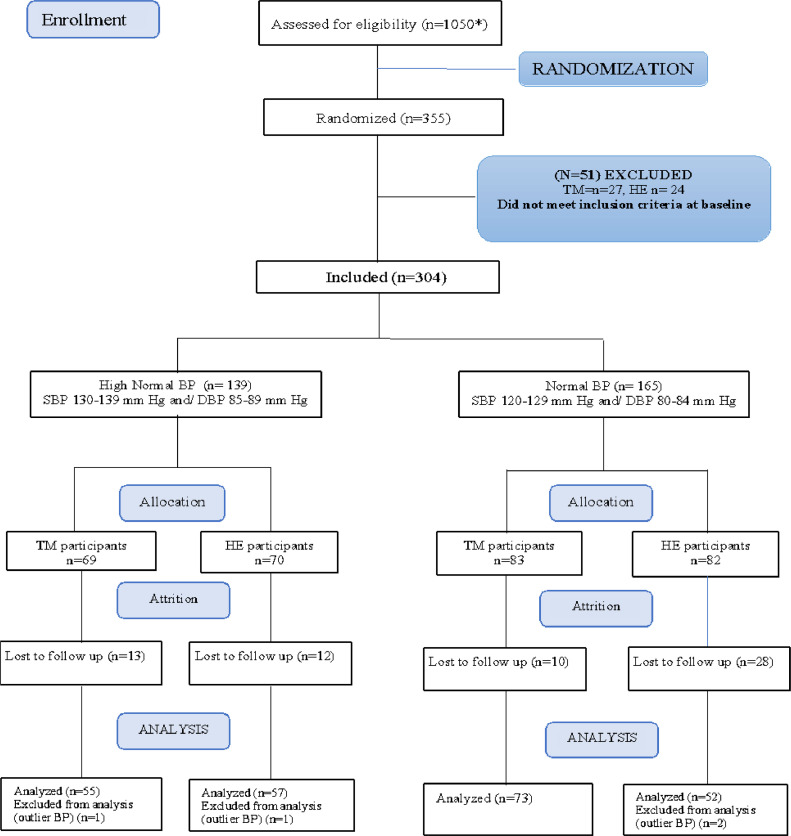
A total of 304 Black men and women with high normal (130-139/85-89 mm Hg) and normal BP (120-129/80-84 mm Hg) were randomized to either TM or health education (HE) groups. BP was recorded at 3, 6, 9, 12, 24, 30 and 36 months after baseline. Linear mixed model analysis was conducted to compare the BP change between TM and HE participants in the high-normal BP and normal-BP groups. Survival analysis for hypertensive events was conducted.
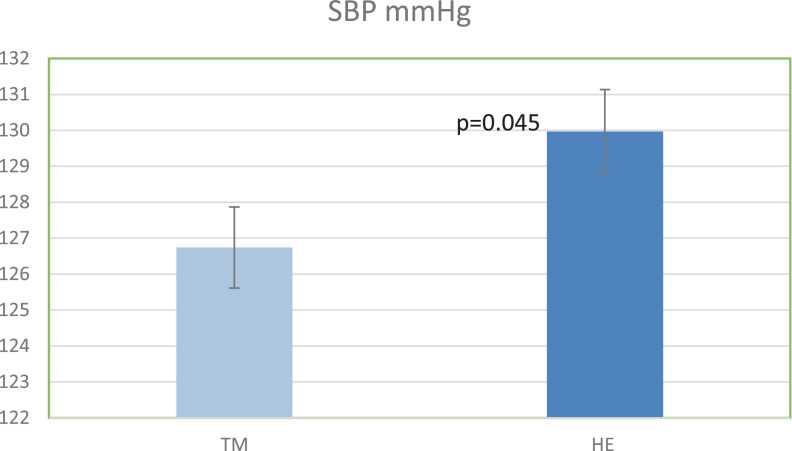
After an average of 19.9 ± 11.1 months follow-up, TM participants in the high-normal BP group showed significantly lower posttest SBP (-3.33 mm Hg, = 0.045). There was no difference in DBP (-0.785 mm Hg, = 0.367) compared to HE participants. In the normal BP group, the SBP and DBP were not different between the TM and HE participants. The hazard ratio for hypertensive events was 0.52 ( = 0.15) in the high normal BP group (7 TM vs 13 HE) with no difference in the normal BP group.
This RCT found that meditation lowered systolic BP in Black men and women with high normal BP but not in normal BP participants. These results may be relevant to reducing health disparities in CVD and related co-morbidities.
黑人男性和女性在高血压、心血管疾病以及当前的 COVID-19 发病率和死亡率方面存在差异。这些疾病与健康的社会决定因素和心理社会压力有关。虽然先前的试验表明,冥想减压可使黑人成年人的血压降低到一级范围,但对于血压高正常和正常的情况,证据不足。
本随机对照试验旨在使用国际分类法评估超觉静心(TM)技术减压对血压高正常和正常的黑人成年人的影响。
总共 304 名血压高正常(130 - 139/85 - 89 毫米汞柱)和正常(120 - 129/80 - 84 毫米汞柱)的黑人男性和女性被随机分为 TM 组或健康教育(HE)组。在基线后的 3、6、9、12、24、30 和 36 个月记录血压。进行线性混合模型分析以比较血压高正常组和正常血压组中 TM 参与者与 HE 参与者之间的血压变化。对高血压事件进行生存分析。
平均随访 19.9 ± 11.1 个月后,血压高正常组的 TM 参与者的测试后收缩压显著降低(-3.33 毫米汞柱,P = 0.045)。与 HE 参与者相比,舒张压无差异(-0.785 毫米汞柱,P = 0.367)。在正常血压组中,TM 参与者与 HE 参与者之间的收缩压和舒张压无差异。血压高正常组中高血压事件的风险比为 0.52(P = 0.15)(7 名 TM 参与者对 13 名 HE 参与者),正常血压组无差异。
本随机对照试验发现,冥想可降低血压高正常的黑人男性和女性的收缩压,但对血压正常的参与者无效。这些结果可能与减少心血管疾病及相关合并症中的健康差异有关。