Faith, Justice and Health and Men's Health Collaboratories, University of Houston Population Health, University of Houston, Houston, TX, United States of America.
Department of Behavioral and Social Science, University of Houston Tilman J. Fertitta Family College of Medicine, Houston, TX, United States of America.
PLoS One. 2022 Sep 2;17(9):e0273806. doi: 10.1371/journal.pone.0273806. eCollection 2022.
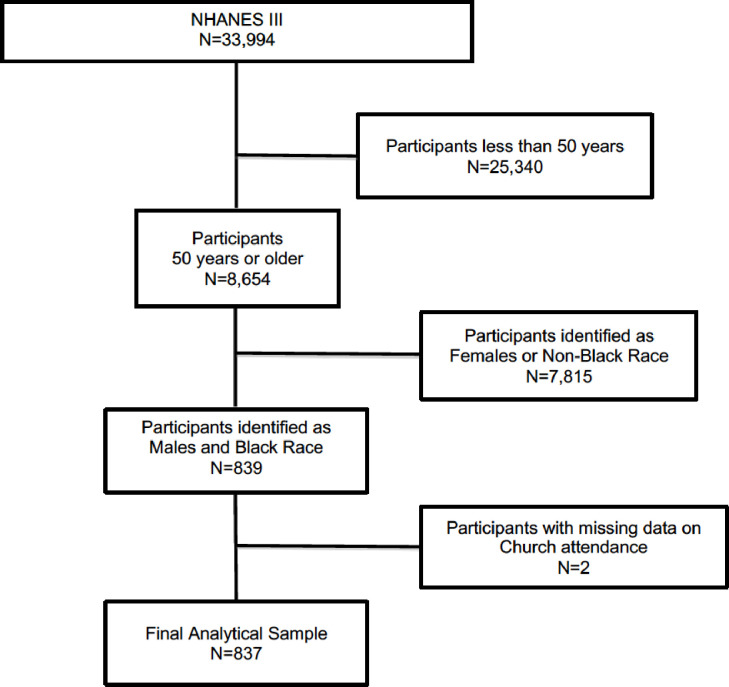
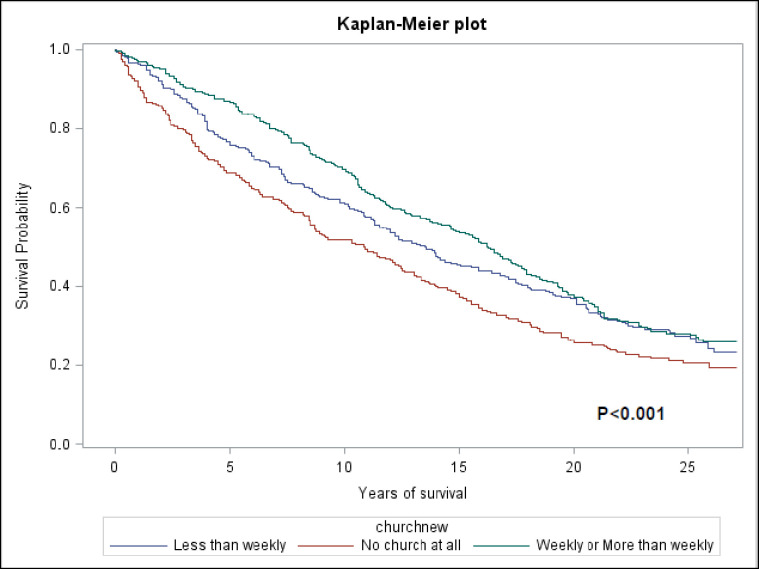
Religious institutions have been responsive to the needs of Black men and other marginalized populations. Religious service attendance is a common practice that has been associated with stress management and extended longevity. The objective of this study was to examine the relationship between religious service attendance and all-cause mortality among Black men 50 years of age and older. Data for this study were from NHANES III (1988-1994). The analytic sample (n = 839) was restricted to participants at least 50 years of age at the time of interview who self-identified as Black and male. Mortality was the primary outcome for this study and the NHANES III Linked Mortality File was used to estimate race-specific, non-injury-related death rates using a probabilistic matching algorithm, linked to the National Death Index through December 31, 2015, providing up to 27 years follow-up. The primary independent variable was religious service attendance, a categorical variable indicating that participants attended religious services at least weekly, three or fewer times per month, or not at all. The mean age of participants was 63.6±0.3 years and 36.4% of sample members reported that they attended religious services one or more times per week, exceeding those attending three or fewer times per month (31.7%), or not at all (31.9%). Cox proportional hazard logistic regression models were estimated to determine the association between religious service attendance and mortality. Participants with the most frequent religious service attendance had a 47% reduction of all-cause mortality risk compared their peer who did not attend religious services at all (HR 0.53, CI 0.35-0.79) in the fully adjusted model including socioeconomic status, non-cardiovascular medical conditions, health behaviors, social support and allostatic load. Our findings underscore the potential salience of religiosity and spirituality for health in Black men, an understudied group where elevated risk factors are often present.
宗教机构一直对黑人和其他边缘化群体的需求做出回应。参加宗教仪式是一种常见的做法,它与压力管理和延长寿命有关。本研究的目的是检验参加宗教仪式与 50 岁及以上黑人男性全因死亡率之间的关系。本研究的数据来自 NHANES III(1988-1994 年)。分析样本(n=839)仅限于在访谈时至少 50 岁、自我认同为黑人男性的参与者。死亡率是本研究的主要结果,使用 NHANES III 关联死亡率文件,使用概率匹配算法估计特定种族、非伤害相关死亡率,通过国家死亡指数链接,截至 2015 年 12 月 31 日,提供长达 27 年的随访。主要的独立变量是参加宗教仪式,这是一个分类变量,表示参与者每周至少参加一次宗教仪式,每月参加三到四次或根本不参加。参与者的平均年龄为 63.6±0.3 岁,36.4%的样本成员报告每周参加宗教仪式一次或多次,超过每月参加三到四次(31.7%)或根本不参加(31.9%)的人。使用 Cox 比例风险逻辑回归模型来确定参加宗教仪式与死亡率之间的关联。在包括社会经济地位、非心血管疾病状况、健康行为、社会支持和全身负荷在内的完全调整模型中,与从不参加宗教仪式的同龄人相比,最频繁参加宗教仪式的参与者的全因死亡率风险降低了 47%(HR 0.53,CI 0.35-0.79)。我们的研究结果强调了宗教信仰和灵性对黑人男性健康的潜在重要性,而黑人男性是一个研究不足的群体,他们通常存在更高的风险因素。