Syundyukov Emil, Mednis Martins, Zaharenko Linda, Pildegovica Eva, Danovska Ieva, Kistkins Svjatoslavs, Seidmann Abraham, Benis Arriel, Pirags Valdis, Tzivian Lilian
Longenesis Ltd., Zaubes str. 9A-23, LV-1013 Riga, Latvia.
Faculty of Computing, University of Latvia, Raina Boulevard 19, LV-1050 Riga, Latvia.
Vaccines (Basel). 2021 Nov 24;9(12):1384. doi: 10.3390/vaccines9121384.
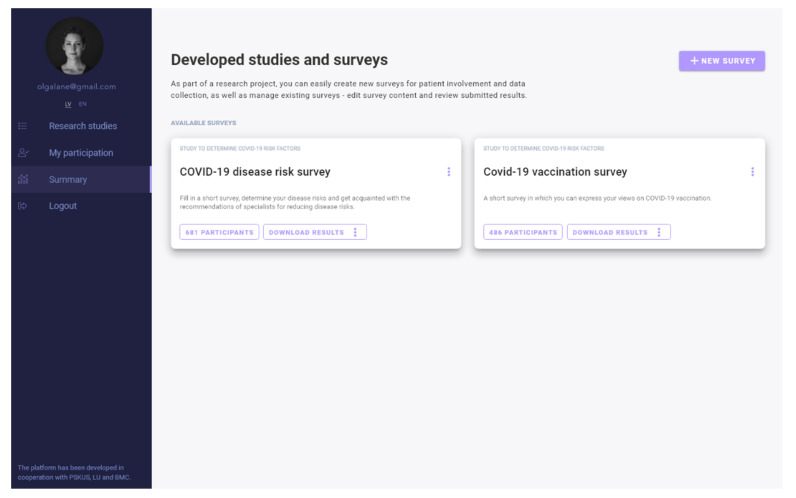
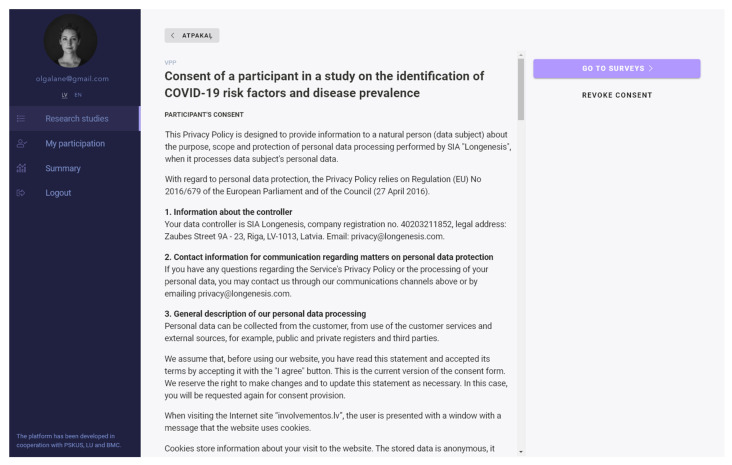
Due to the severe impact of COVID-19 on public health, rollout of the vaccines must be large-scale. Current solutions are not intended to promote an active collaboration between communities and public health researchers. We aimed to develop a digital platform for communication between scientists and the general population, and to use it for an exploratory study on factors associated with vaccination readiness. The digital platform was developed in Latvia and was equipped with dynamic consent management. During a period of six weeks 467 participants were enrolled in the population-based cross-sectional exploratory study using this platform. We assessed demographics, COVID-19-related behavioral and personal factors, and reasons for vaccination. Logistic regression models adjusted for the level of education, anxiety, factors affecting the motivation to vaccinate, and risk of infection/severe disease were built to investigate their association with vaccination readiness. In the fully adjusted multiple logistic regression model, factors associated with vaccination readiness were anxiety (odds ratio, OR = 3.09 [95% confidence interval 1.88; 5.09]), feelings of social responsibility (OR = 1.61 [1.16; 2.22]), and trust in pharmaceutical companies (OR = 1.53 [1.03; 2.27]). The assessment of a large number of participants in a six-week period show the potential of a digital platform to create a data-driven dialogue on vaccination readiness.
由于新冠疫情对公众健康造成严重影响,疫苗的推广必须大规模进行。目前的解决方案并非旨在促进社区与公共卫生研究人员之间的积极合作。我们旨在开发一个科学家与普通民众之间进行沟通的数字平台,并将其用于一项关于疫苗接种意愿相关因素的探索性研究。该数字平台在拉脱维亚开发,并配备了动态同意管理功能。在六周的时间里,有467名参与者通过这个平台参与了基于人群的横断面探索性研究。我们评估了人口统计学特征、与新冠疫情相关的行为和个人因素以及接种疫苗的原因。构建了经教育水平、焦虑程度、影响接种动机的因素以及感染/重症风险调整的逻辑回归模型,以研究它们与疫苗接种意愿的关联。在完全调整的多元逻辑回归模型中,与疫苗接种意愿相关的因素包括焦虑(比值比,OR = 3.09 [95%置信区间1.88;5.09])、社会责任感(OR = 1.61 [1.16;2.22])以及对制药公司的信任(OR = 1.53 [1.03;2.27])。在六周内对大量参与者进行的评估显示了数字平台在就疫苗接种意愿开展数据驱动对话方面的潜力。