Faculty of Health and Sport Sciences, University of Tsukuba, 1-1-1 Tennodai, Tsukuba, Ibaraki, 305-8574, Japan.
International Institute for Integrative Sleep Medicine (WPI-IIIS), University of Tsukuba, 1-1-1 Tennodai, Tsukuba, Ibaraki, 305-8575, Japan.
BMC Geriatr. 2021 Nov 3;21(1):623. doi: 10.1186/s12877-021-02589-w.
This study investigated whether daily physical activity of older adults, combined with social relationships, is associated with the risk of sleep disorder. Further, it determined whether a high level of one variable with a low level of the other, leads to a significantly lower risk of sleep disorder than low levels of both.
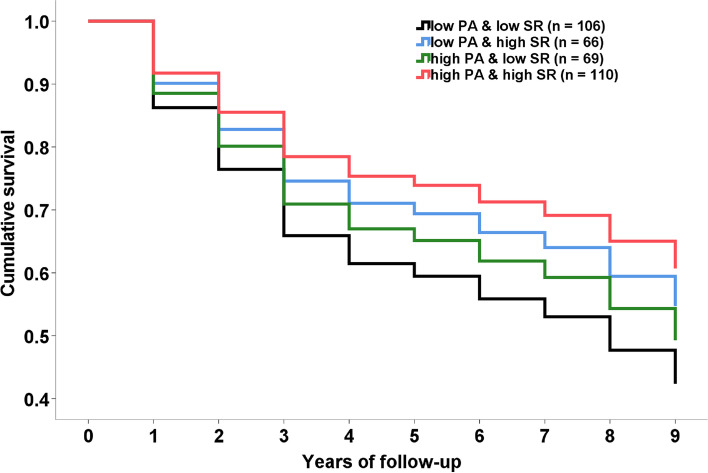
The sample comprised 1339 community-dwelling older Japanese adults: 988 in Study 1 and 351 in Study 2. The level of daily physical activity and range of social relationships were assessed using the Physical Activity Scale for the Elderly and the Lubben Social Network Scale, respectively. The Pittsburgh Sleep Quality Index was used to assess sleep disorder. To test the combined relationships and effects in Studies 1 and 2, the medians for the respective scores of each of the following four groups that the participants were categorized into, were calculated: (1) low activity group with low social relationships, (2) low activity group with high social relationships, (3) high activity group with low social relationships, and (4) high activity group with high social relationships. After adjusting for potential confounders, a logistic regression analysis was conducted in Study 1. After adjusting for potential confounders, a Cox proportional hazards regression analysis was conducted in Study 2.
Study 1 revealed that the high activity group with high social relationships showed a significantly lower risk of sleep disorder (ORs: 0.585, 95% CI: 0.404-0.847) than the low activity group with low social relationships. Study 2 also revealed that the high activity group with high social relationships showed a significantly lower prevalence of sleep disorder (HRs: 0.564, 95% CI: 0.327-0.974) than the low activity group with low social relationships.
Our findings suggest that for older adults with high social relationships, being physically active is favorably associated with sleep quality. However, a high level of one variable with a low level of the other has not been confirmed in improving sleep quality among older adults.
本研究旨在探讨老年人的日常体力活动与社会关系是否与睡眠障碍的风险相关。此外,还确定了一种变量高水平与另一种变量低水平相结合是否会导致睡眠障碍的风险显著低于两种变量的低水平。
样本包括 1339 名居住在社区的日本老年人:研究 1 中 988 人,研究 2 中 351 人。日常体力活动水平和社会关系范围分别使用老年人体力活动量表和卢本社会网络量表进行评估。匹兹堡睡眠质量指数用于评估睡眠障碍。为了检验研究 1 和研究 2 中联合关系和效应,计算了以下四组参与者各自得分的中位数:(1)低活动组与低社会关系,(2)低活动组与高社会关系,(3)高活动组与低社会关系,(4)高活动组与高社会关系。在调整潜在混杂因素后,在研究 1 中进行了逻辑回归分析。在调整潜在混杂因素后,在研究 2 中进行了 Cox 比例风险回归分析。
研究 1 表明,高社会关系高体力活动组的睡眠障碍风险显著低于低社会关系低体力活动组(ORs:0.585,95%CI:0.404-0.847)。研究 2 还表明,高社会关系高体力活动组的睡眠障碍发生率显著低于低社会关系低体力活动组(HRs:0.564,95%CI:0.327-0.974)。
我们的研究结果表明,对于社会关系良好的老年人,积极运动与睡眠质量有关。然而,在提高老年人的睡眠质量方面,一种变量高水平与另一种变量低水平相结合的情况尚未得到证实。