Li Boxun, Hon Gary C
Cecil H. and Ida Green Center for Reproductive Biology Sciences, University of Texas Southwestern Medical Center, Dallas, TX, United States.
Division of Basic Reproductive Biology Research, Department of Obstetrics and Gynecology, Department of Bioinformatics, University of Texas Southwestern Medical Center, Dallas, TX, United States.
Front Bioeng Biotechnol. 2021 Oct 18;9:748942. doi: 10.3389/fbioe.2021.748942. eCollection 2021.
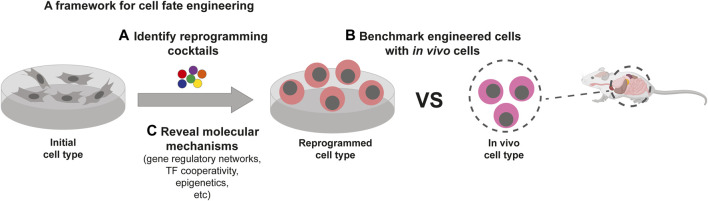
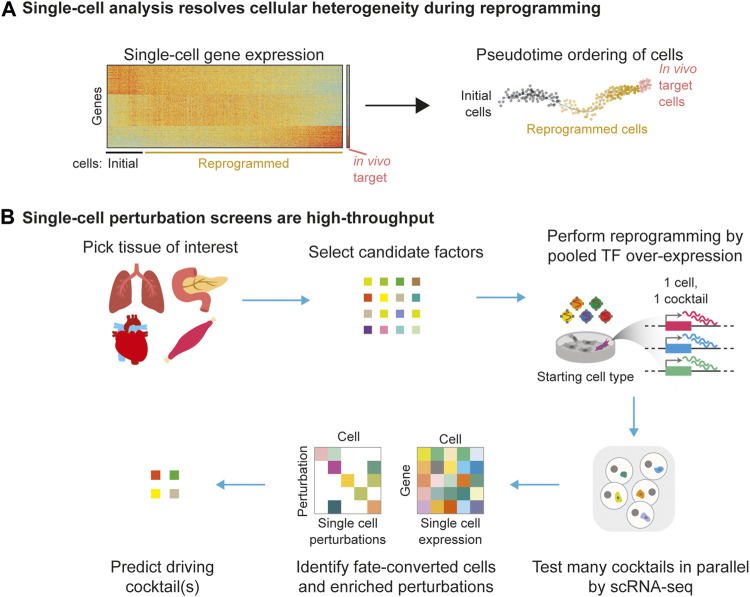
As we near a complete catalog of mammalian cell types, the capability to engineer specific cell types on demand would transform biomedical research and regenerative medicine. However, the current pace of discovering new cell types far outstrips our ability to engineer them. One attractive strategy for cellular engineering is direct reprogramming, where induction of specific transcription factor (TF) cocktails orchestrates cell state transitions. Here, we review the foundational studies of TF-mediated reprogramming in the context of a general framework for cell fate engineering, which consists of: discovering new reprogramming cocktails, assessing engineered cells, and revealing molecular mechanisms. Traditional bulk reprogramming methods established a strong foundation for TF-mediated reprogramming, but were limited by their small scale and difficulty resolving cellular heterogeneity. Recently, single-cell technologies have overcome these challenges to rapidly accelerate progress in cell fate engineering. In the next decade, we anticipate that these tools will enable unprecedented control of cell state.
随着我们接近哺乳动物细胞类型的完整目录,按需设计特定细胞类型的能力将改变生物医学研究和再生医学。然而,目前发现新细胞类型的速度远远超过了我们对其进行设计的能力。细胞工程的一种有吸引力的策略是直接重编程,即通过诱导特定的转录因子(TF)组合来协调细胞状态转变。在这里,我们在细胞命运工程的一般框架背景下回顾TF介导的重编程的基础研究,该框架包括:发现新的重编程组合、评估工程细胞以及揭示分子机制。传统的批量重编程方法为TF介导的重编程奠定了坚实的基础,但受到其小规模和难以解决细胞异质性的限制。最近,单细胞技术克服了这些挑战,迅速加速了细胞命运工程的进展。在未来十年,我们预计这些工具将实现对细胞状态前所未有的控制。