He Chao-Jie, Fei Ye-Ping, Zhu Chun-Yan, Yao Ming, Qian Gang, Hu Hui-Lin, Zhai Chang-Lin
Department of Cardiology, The First Hospital of Jiaxing, The Affiliated Hospital of Jiaxing University, Jiaxing, China.
Department of Anesthesiology, The First Hospital of Jiaxing, The Affiliated Hospital of Jiaxing University, Jiaxing, China.
Front Cardiovasc Med. 2021 Oct 18;8:750714. doi: 10.3389/fcvm.2021.750714. eCollection 2021.
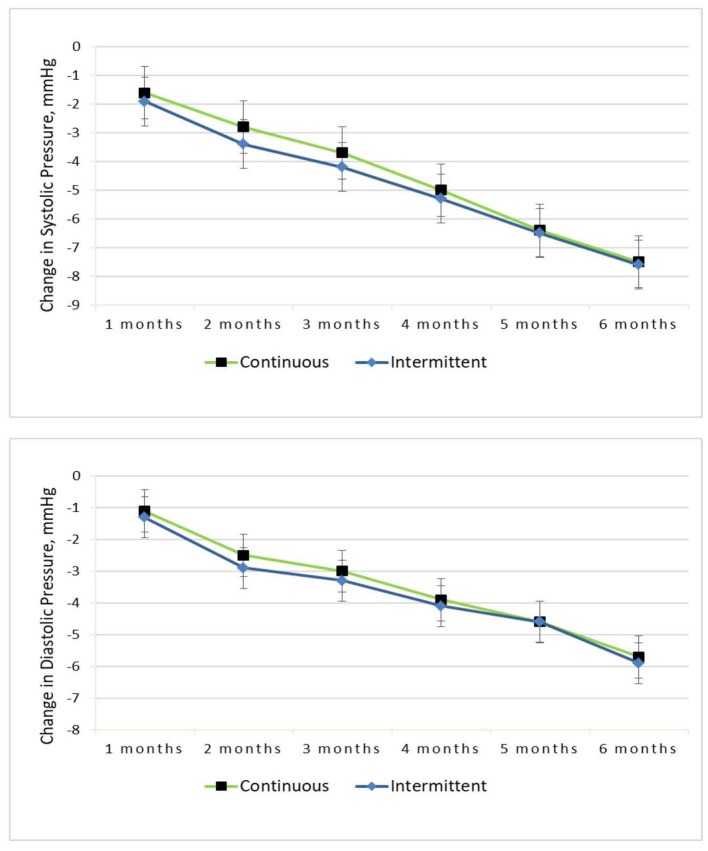
Weight-loss diets reduce body weight and improve blood pressure control in hypertensive patients. Intermittent energy restriction (IER) is an alternative to continuous energy restriction (CER) for weight reduction. We aimed to compare the effects of IER with those of CER on blood pressure control and weight loss in overweight and obese patients with hypertension during a 6-month period. Two hundred and five overweight or obese participants (BMI 28.7 kg/m) with hypertension were randomized to IER (5:2 diet, a very-low-calorie diet for 2 days per week, 500 kcal/day for women and 600 kcal/day for men, along with 5 days of a habitual diet) compared to a moderate CER diet (1,000 kcal/day for women and 1,200 kcal/day for men) for 6 months. The primary outcomes of this study were changes in blood pressure and weight, and the secondary outcomes were changes in body composition, glycosylated hemoglobin A1c (HbA1c), and blood lipids. Of the 205 randomized participants (118 women and 87 men; mean [SD] age, 50.2 [8.9] years; mean [SD] body mass index, 28.7 [2.6]; mean [SD] systolic blood pressure, 143 [10] mmHg; and mean [SD] diastolic blood pressure, 91 [9] mmHg), 173 completed the study. The intention-to-treat analysis demonstrated that IER and CER are equally effective for weight loss and blood pressure control: the mean (SEM) weight change with IER was -7.0 [0.6] kg vs. -6.8 [0.6] kg with CER, the mean (SEM) systolic blood pressure with IER was -7 [0.7] mmHg vs. -7 [0.6] mmHg with CER, and the mean (SEM) diastolic blood pressure with IER was -6 [0.5] mmHg vs. -5 [0.5] mmHg with CER, (diet by time = 0.62, 0.39, and 0.41, respectively). There were favorable improvements in body composition, HbA1c, and blood lipid levels, with no differences between groups. Effects did not differ according to completer analysis. No severe hypoglycemia occurred in either group during the trial. Intermittent energy restriction is an effective alternative diet strategy for weight loss and blood pressure control and is comparable to CER in overweight and obese patients with hypertension. http://www.chictr.org.cn, identifier: ChiCTR2000040468.
减肥饮食可降低体重,并改善高血压患者的血压控制情况。间歇性能量限制(IER)是一种用于减肥的替代连续能量限制(CER)的方法。我们旨在比较IER与CER在6个月期间对超重和肥胖高血压患者血压控制和体重减轻的影响。205名超重或肥胖的高血压参与者(BMI为28.7kg/m)被随机分为IER组(5:2饮食法,即每周2天采用极低热量饮食,女性每天500千卡,男性每天600千卡,同时5天采用习惯性饮食)和中度CER饮食组(女性每天1000千卡,男性每天1200千卡),为期6个月。本研究的主要结局是血压和体重的变化,次要结局是身体成分、糖化血红蛋白A1c(HbA1c)和血脂的变化。在205名随机分组的参与者中(118名女性和87名男性;平均[标准差]年龄为50.2[8.9]岁;平均[标准差]体重指数为28.7[2.6];平均[标准差]收缩压为143[10]mmHg;平均[标准差]舒张压为91[9]mmHg),173人完成了研究。意向性分析表明,IER和CER在减肥和血压控制方面同样有效:IER组的平均(标准误)体重变化为-7.0[0.6]kg,CER组为-6.8[0.6]kg;IER组的平均(标准误)收缩压为-7[0.7]mmHg,CER组为-7[0.6]mmHg;IER组的平均(标准误)舒张压为-6[0.5]mmHg,CER组为-5[0.5]mmHg,(饮食×时间分别为0.62、0.39和0.41)。身体成分、HbA1c和血脂水平均有良好改善,组间无差异。根据完成者分析,效果无差异。试验期间两组均未发生严重低血糖。间歇性能量限制是一种有效的减肥和血压控制饮食策略,在超重和肥胖高血压患者中与CER相当。http://www.chictr.org.cn,标识符:ChiCTR2000040468