Division of Infectious Diseases and Tropical Medicine, Department of Medicine I, Medical University of Vienna, Vienna, Austria.
Department of Dermatology, Medical University of Vienna, Vienna, Austria.
Eur J Clin Microbiol Infect Dis. 2022 Feb;41(2):245-252. doi: 10.1007/s10096-021-04365-5. Epub 2021 Nov 4.
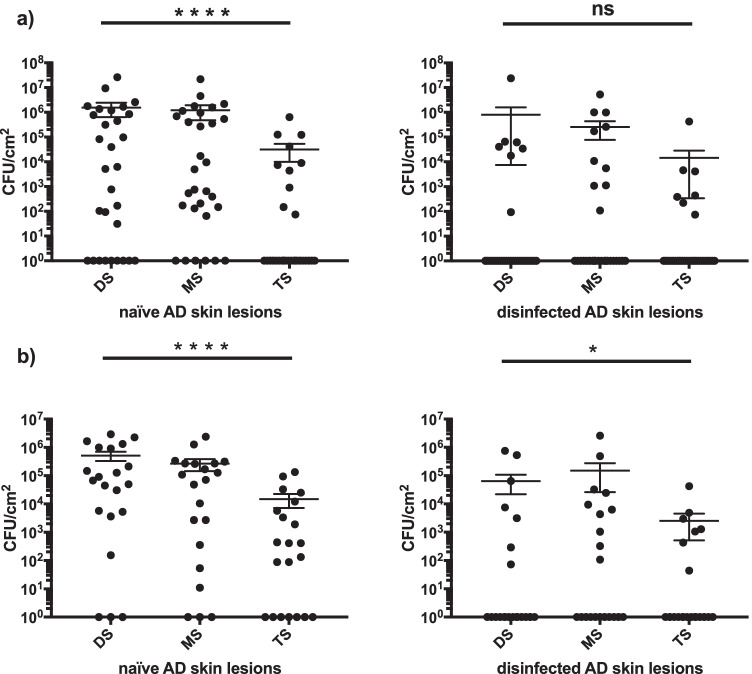
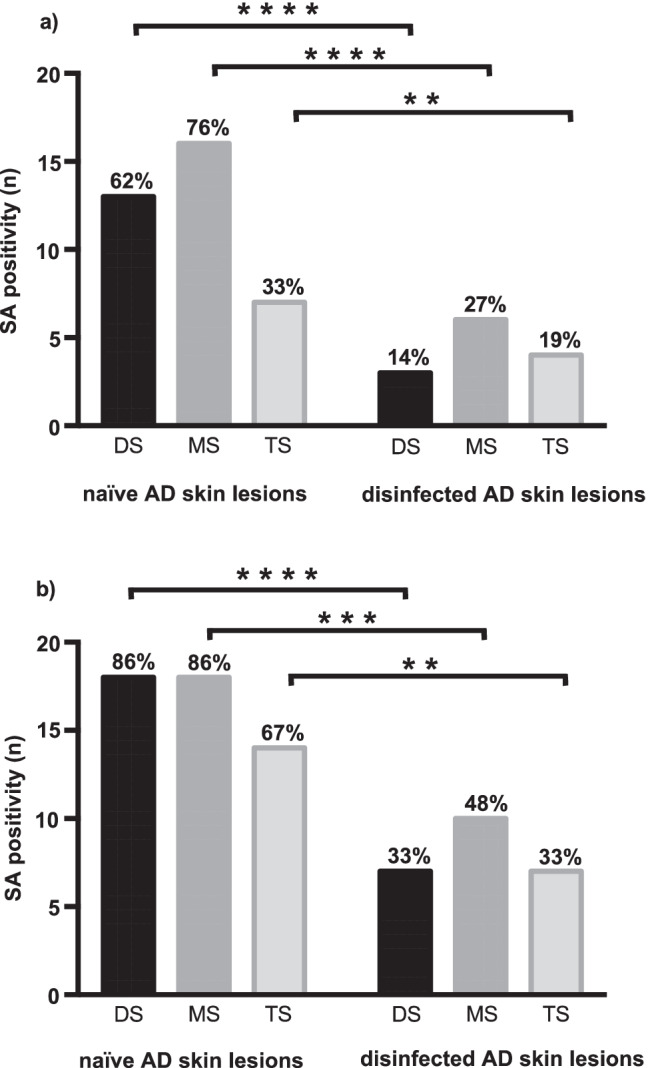
There is evidence that Staphylococcus aureus colonisation is linked to severity of atopic dermatitis. As no gold standard for S. aureus sampling on atopic dermatitis skin lesions exists, this study compared three commonly used methods. In addition, effectiveness of standard skin disinfection to remove S. aureus colonisation from these inflamed skin lesions was investigated. In 30 atopic dermatitis patients, three different S. aureus sampling methods, i.e. detergent scrubbing, moist swabbing and tape stripping, were performed on naïve and disinfected skin lesions. Two different S. aureus selective media, mannitol salt agar and chromID agar, were used for bacterial growing. Quantifying the S. aureus load varied significantly between the different sampling methods on naïve skin lesions ranging from mean 51 to 1.5 × 10 CFU/cm (p < 0.001). The qualitative detection on naïve skin was highest with the two detergent-based techniques (86% each), while for tape stripping, this value was 67% (all on chromID agar). In comparison, mannitol salt agar was less sensitive (p < 0.001). The disinfection of the skin lesions led to a significant reduction of the S. aureus load (p < 0.05) but no complete eradication in the case of previously positive swab. The obtained data highlight the importance of the selected sampling method and consecutive S. aureus selection agar plates to implement further clinical studies for the effectiveness of topical anti-staphylococcal antibiotics. Other disinfection regimes should be considered in atopic dermatitis patients when complete de-colonisation of certain skin areas is required, e.g. for surgical procedures.
有证据表明,金黄色葡萄球菌定植与特应性皮炎的严重程度有关。由于目前不存在特应性皮炎皮损部位金黄色葡萄球菌采样的金标准,本研究比较了三种常用方法。此外,还研究了标准皮肤消毒在去除这些炎症性皮肤病变中金黄色葡萄球菌定植方面的效果。在 30 例特应性皮炎患者中,对未消毒和消毒后的皮损部位分别进行了三种不同的金黄色葡萄球菌采样方法(即用去污剂擦洗、湿润拭子和胶带剥离)。使用两种不同的金黄色葡萄球菌选择性培养基(甘露醇盐琼脂和 chromID 琼脂)进行细菌培养。在未消毒的皮肤病变中,不同采样方法的金黄色葡萄球菌载量差异非常显著,范围从 51 到 1.5×10 CFU/cm(p<0.001)。在未消毒的皮肤部位,两种基于去污剂的技术(每种技术均为 86%)的定性检测最高,而胶带剥离技术的检测值为 67%(均在 chromID 琼脂上)。相比之下,甘露醇盐琼脂的灵敏度较低(p<0.001)。皮肤病变的消毒可显著降低金黄色葡萄球菌的载量(p<0.05),但对于之前拭子阳性的患者,无法完全清除。所获得的数据强调了选择的采样方法和后续金黄色葡萄球菌选择琼脂平板的重要性,这对于实施局部抗葡萄球菌抗生素有效性的进一步临床研究至关重要。对于需要对某些皮肤区域进行完全去定植的特应性皮炎患者,例如在手术过程中,应考虑其他消毒方案。