• 文献检索
  • 文档翻译
  • 深度研究
  • 学术资讯
  • Suppr Zotero 插件Zotero 插件
  • 邀请有礼
  • 套餐&价格
  • 历史记录
应用&插件
Suppr Zotero 插件Zotero 插件浏览器插件Mac 客户端Windows 客户端微信小程序
定价
高级版会员购买积分包购买API积分包
服务
文献检索文档翻译深度研究API 文档MCP 服务
关于我们
关于 Suppr公司介绍联系我们用户协议隐私条款
关注我们

Suppr 超能文献

核心技术专利:CN118964589B侵权必究
粤ICP备2023148730 号-1Suppr @ 2026

文献检索

告别复杂PubMed语法,用中文像聊天一样搜索,搜遍4000万医学文献。AI智能推荐,让科研检索更轻松。

立即免费搜索

文件翻译

保留排版,准确专业,支持PDF/Word/PPT等文件格式,支持 12+语言互译。

免费翻译文档

深度研究

AI帮你快速写综述,25分钟生成高质量综述,智能提取关键信息,辅助科研写作。

立即免费体验

基于深度卷积网络特征提取的肺结节良恶性分类。

Classification of Benign and Malignant Lung Nodules Based on Deep Convolutional Network Feature Extraction.

机构信息

School of Medical Information & Engineering, Xuzhou Medical University, Xuzhou 221004, China.

Department of Information Center, Weihai Ocean Vocational College, Rongcheng 264300, China.

出版信息

J Healthc Eng. 2021 Oct 27;2021:8769652. doi: 10.1155/2021/8769652. eCollection 2021.

DOI:10.1155/2021/8769652
PMID:34745513
原文链接:https://pmc.ncbi.nlm.nih.gov/articles/PMC8566059/
Abstract

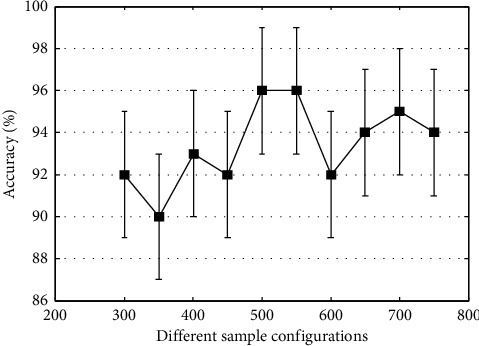
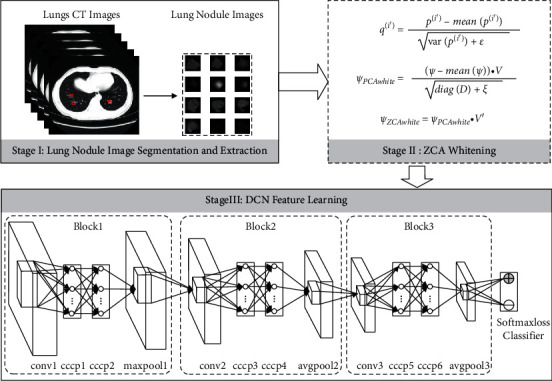
With the rapid development of detection technology, CT imaging technology has been widely used in the early clinical diagnosis of lung nodules. However, accurate assessment of the nature of the nodule remains a challenging task due to the subjective nature of the radiologist. With the increasing amount of publicly available lung image data, it has become possible to use convolutional neural networks for benign and malignant classification of lung nodules. However, as the network depth increases, network training methods based on gradient descent usually lead to gradient dispersion. Therefore, we propose a novel deep convolutional network approach to classify the benignity and malignancy of lung nodules. Firstly, we segmented, extracted, and performed zero-phase component analysis whitening on images of lung nodules. Then, a multilayer perceptron was introduced into the structure to construct a deep convolutional network. Finally, the minibatch stochastic gradient descent method with a momentum coefficient is used to fine-tune the deep convolutional network to avoid the gradient dispersion. The 750 lung nodules in the lung image database are used for experimental verification. Classification accuracy of the proposed method can reach 96.0%. The experimental results show that the proposed method can provide an objective and efficient aid to solve the problem of classifying benign and malignant lung nodules in medical images.

摘要

随着检测技术的飞速发展,CT 成像技术已广泛应用于肺结节的早期临床诊断。然而,由于放射科医生的主观性,准确评估结节的性质仍然是一项具有挑战性的任务。随着越来越多的公共肺部图像数据的出现,已经可以使用卷积神经网络对肺结节进行良性和恶性分类。然而,随着网络深度的增加,基于梯度下降的网络训练方法通常会导致梯度弥散。因此,我们提出了一种新的深度卷积网络方法来对肺结节的良恶性进行分类。首先,我们对肺结节的图像进行分割、提取和零相位分量分析白化。然后,引入多层感知器到结构中,构建一个深度卷积网络。最后,使用带有动量系数的小批量随机梯度下降法来微调深度卷积网络,以避免梯度弥散。在肺图像数据库中的 750 个肺结节用于实验验证。所提出方法的分类精度可达到 96.0%。实验结果表明,该方法可以为解决医学图像中良性和恶性肺结节的分类问题提供客观、高效的辅助。
https://cdn.ncbi.nlm.nih.gov/pmc/blobs/8eeb/8566059/50559f6a2fea/JHE2021-8769652.005.jpg
https://cdn.ncbi.nlm.nih.gov/pmc/blobs/8eeb/8566059/a80429de83d3/JHE2021-8769652.001.jpg
https://cdn.ncbi.nlm.nih.gov/pmc/blobs/8eeb/8566059/c3566efcf694/JHE2021-8769652.002.jpg
https://cdn.ncbi.nlm.nih.gov/pmc/blobs/8eeb/8566059/4fa8c450291e/JHE2021-8769652.003.jpg
https://cdn.ncbi.nlm.nih.gov/pmc/blobs/8eeb/8566059/fd865a3e5c8d/JHE2021-8769652.004.jpg
https://cdn.ncbi.nlm.nih.gov/pmc/blobs/8eeb/8566059/50559f6a2fea/JHE2021-8769652.005.jpg
https://cdn.ncbi.nlm.nih.gov/pmc/blobs/8eeb/8566059/a80429de83d3/JHE2021-8769652.001.jpg
https://cdn.ncbi.nlm.nih.gov/pmc/blobs/8eeb/8566059/c3566efcf694/JHE2021-8769652.002.jpg
https://cdn.ncbi.nlm.nih.gov/pmc/blobs/8eeb/8566059/4fa8c450291e/JHE2021-8769652.003.jpg
https://cdn.ncbi.nlm.nih.gov/pmc/blobs/8eeb/8566059/fd865a3e5c8d/JHE2021-8769652.004.jpg
https://cdn.ncbi.nlm.nih.gov/pmc/blobs/8eeb/8566059/50559f6a2fea/JHE2021-8769652.005.jpg

相似文献

1
Classification of Benign and Malignant Lung Nodules Based on Deep Convolutional Network Feature Extraction.基于深度卷积网络特征提取的肺结节良恶性分类。
J Healthc Eng. 2021 Oct 27;2021:8769652. doi: 10.1155/2021/8769652. eCollection 2021.
2
Automated Pulmonary Nodule Classification in Computed Tomography Images Using a Deep Convolutional Neural Network Trained by Generative Adversarial Networks.基于生成对抗网络训练的深度卷积神经网络在 CT 图像肺结节自动分类中的应用
Biomed Res Int. 2019 Jan 2;2019:6051939. doi: 10.1155/2019/6051939. eCollection 2019.
3
Classification of benign and malignant lung nodules from CT images based on hybrid features.基于混合特征的 CT 图像肺部良恶性结节分类。
Phys Med Biol. 2019 Jun 20;64(12):125011. doi: 10.1088/1361-6560/ab2544.
4
Improved lung nodule diagnosis accuracy using lung CT images with uncertain class.利用不确定类别的肺部 CT 图像提高肺结节诊断准确性。
Comput Methods Programs Biomed. 2018 Aug;162:197-209. doi: 10.1016/j.cmpb.2018.05.028. Epub 2018 May 18.
5
Efficacy of exponentiation method with a convolutional neural network for classifying lung nodules on CT images by malignancy level.基于卷积神经网络的指数法在按恶性程度对CT图像上的肺结节进行分类中的效能。
Eur Radiol. 2023 Dec;33(12):9309-9319. doi: 10.1007/s00330-023-09946-w. Epub 2023 Jul 21.
6
Res-trans networks for lung nodule classification.用于肺结节分类的 Res-trans 网络。
Int J Comput Assist Radiol Surg. 2022 Jun;17(6):1059-1068. doi: 10.1007/s11548-022-02576-5. Epub 2022 Mar 15.
7
Classification of lung nodules in CT scans using three-dimensional deep convolutional neural networks with a checkpoint ensemble method.使用带有检查点集成方法的三维深度卷积神经网络对CT扫描中的肺结节进行分类。
BMC Med Imaging. 2018 Dec 3;18(1):48. doi: 10.1186/s12880-018-0286-0.
8
A manifold learning regularization approach to enhance 3D CT image-based lung nodule classification.一种流形学习正则化方法,用于增强基于 3D CT 图像的肺结节分类。
Int J Comput Assist Radiol Surg. 2020 Feb;15(2):287-295. doi: 10.1007/s11548-019-02097-8. Epub 2019 Nov 25.
9
An improved 3-D attention CNN with hybrid loss and feature fusion for pulmonary nodule classification.一种用于肺结节分类的具有混合损失和特征融合的改进型三维注意力卷积神经网络。
Comput Methods Programs Biomed. 2023 Feb;229:107278. doi: 10.1016/j.cmpb.2022.107278. Epub 2022 Nov 26.
10
Detection of pulmonary nodules based on a multiscale feature 3D U-Net convolutional neural network of transfer learning.基于迁移学习的多尺度特征 3D U-Net 卷积神经网络的肺结节检测。
PLoS One. 2020 Aug 26;15(8):e0235672. doi: 10.1371/journal.pone.0235672. eCollection 2020.

引用本文的文献

1
MSA-Net: multiple self-attention mechanism for 3D lung nodule classification in CT images.MSA-Net:用于CT图像中三维肺结节分类的多重自注意力机制
BMC Med Imaging. 2025 May 27;25(1):193. doi: 10.1186/s12880-025-01725-x.
2
Application value of CT three-dimensional reconstruction technology in the identification of benign and malignant lung nodules and the characteristics of nodule distribution.CT三维重建技术在肺结节良恶性鉴别诊断中的应用价值及结节分布特征
BMC Med Imaging. 2025 Jan 6;25(1):7. doi: 10.1186/s12880-024-01505-z.
3
Applications of artificial intelligence in interventional oncology: An up-to-date review of the literature.

本文引用的文献

1
Deep learning-based CAD schemes for the detection and classification of lung nodules from CT images: A survey.基于深度学习的 CT 图像肺结节检测和分类 CAD 方案:综述。
J Xray Sci Technol. 2020;28(4):591-617. doi: 10.3233/XST-200660.
2
Combining multi-scale feature fusion with multi-attribute grading, a CNN model for benign and malignant classification of pulmonary nodules.将多尺度特征融合与多属性分级相结合,构建了一种用于肺结节良恶性分类的卷积神经网络(CNN)模型。
J Digit Imaging. 2020 Aug;33(4):869-878. doi: 10.1007/s10278-020-00333-1.
3
Improving Accuracy of Lung Nodule Classification Using Deep Learning with Focal Loss.
人工智能在介入肿瘤学中的应用:文献综述
Jpn J Radiol. 2025 Feb;43(2):164-176. doi: 10.1007/s11604-024-01668-3. Epub 2024 Oct 2.
4
New trend in artificial intelligence-based assistive technology for thoracic imaging.基于人工智能的胸像辅助技术的新趋势。
Radiol Med. 2023 Oct;128(10):1236-1249. doi: 10.1007/s11547-023-01691-w. Epub 2023 Aug 28.
5
Multimodality CT imaging contributes to improving the diagnostic accuracy of solitary pulmonary nodules: a multi-institutional and prospective study.多模态 CT 成像有助于提高孤立性肺结节的诊断准确性:一项多机构前瞻性研究。
Radiol Oncol. 2023 Feb 17;57(1):20-34. doi: 10.2478/raon-2023-0008. eCollection 2023 Mar 1.
6
Application of Artificial Intelligence in Lung Cancer.人工智能在肺癌中的应用。
Cancers (Basel). 2022 Mar 8;14(6):1370. doi: 10.3390/cancers14061370.
使用带有焦点损失的深度学习提高肺结节分类的准确性。
J Healthc Eng. 2019 Feb 4;2019:5156416. doi: 10.1155/2019/5156416. eCollection 2019.
4
Using Multi-level Convolutional Neural Network for Classification of Lung Nodules on CT images.使用多级卷积神经网络对CT图像上的肺结节进行分类。
Annu Int Conf IEEE Eng Med Biol Soc. 2018 Jul;2018:686-689. doi: 10.1109/EMBC.2018.8512376.
5
Cascaded classifiers and stacking methods for classification of pulmonary nodule characteristics.级联分类器和堆叠方法在肺结节特征分类中的应用。
Comput Methods Programs Biomed. 2018 Nov;166:77-89. doi: 10.1016/j.cmpb.2018.10.009. Epub 2018 Oct 3.
6
Highly accurate model for prediction of lung nodule malignancy with CT scans.基于 CT 扫描的肺结节良恶性预测的高精度模型。
Sci Rep. 2018 Jun 18;8(1):9286. doi: 10.1038/s41598-018-27569-w.
7
Histopathological image classification with bilinear convolutional neural networks.基于双线性卷积神经网络的组织病理学图像分类
Annu Int Conf IEEE Eng Med Biol Soc. 2017 Jul;2017:4050-4053. doi: 10.1109/EMBC.2017.8037745.
8
Pulmonary nodule classification with deep residual networks.基于深度残差网络的肺结节分类。
Int J Comput Assist Radiol Surg. 2017 Oct;12(10):1799-1808. doi: 10.1007/s11548-017-1605-6. Epub 2017 May 13.
9
Multilevel Contextual 3-D CNNs for False Positive Reduction in Pulmonary Nodule Detection.用于减少肺结节检测中假阳性的多级上下文3D卷积神经网络
IEEE Trans Biomed Eng. 2017 Jul;64(7):1558-1567. doi: 10.1109/TBME.2016.2613502. Epub 2016 Sep 26.
10
Multi-scale Convolutional Neural Networks for Lung Nodule Classification.用于肺结节分类的多尺度卷积神经网络
Inf Process Med Imaging. 2015;24:588-99. doi: 10.1007/978-3-319-19992-4_46.