Department of Computer Science, Arkansas State University, Jonesboro, Arkansas, 72467, United States of America.
The UALR/UAMS Joint Graduate Program in Bioinformatics, Little Rock, Arkansas, 72204, United States of America.
Sci Rep. 2018 Jun 18;8(1):9286. doi: 10.1038/s41598-018-27569-w.
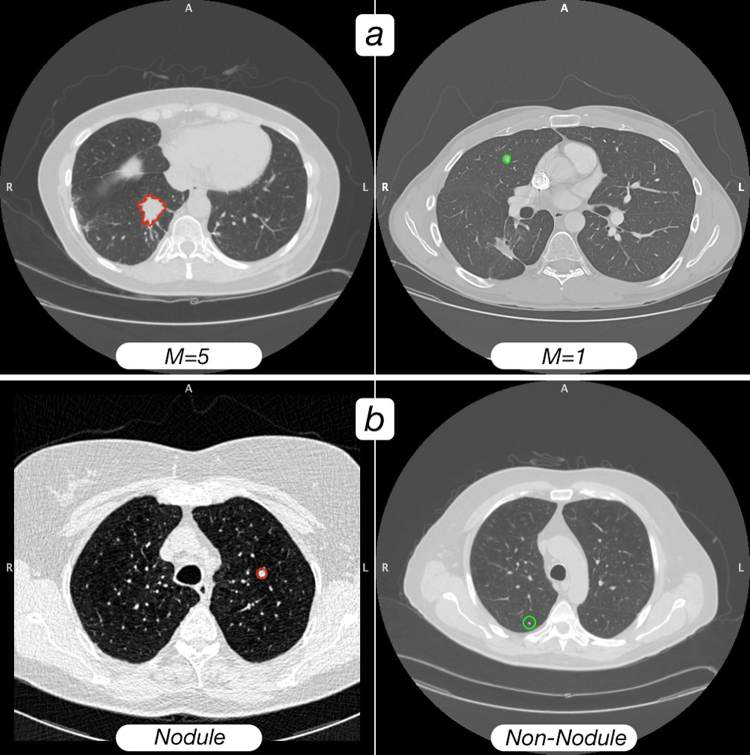
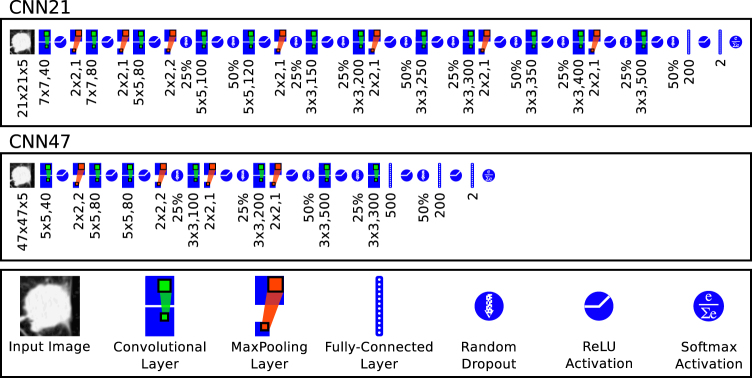
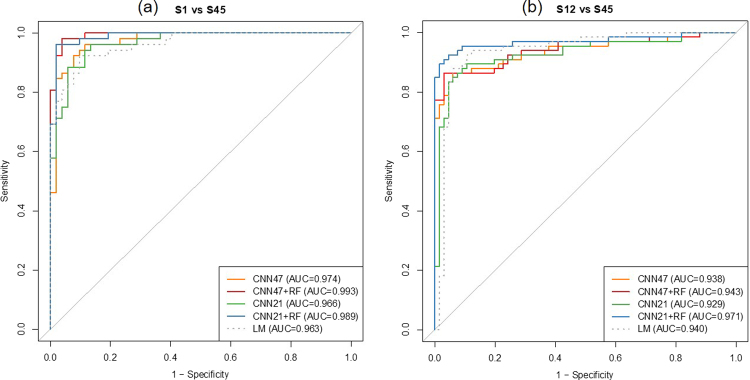
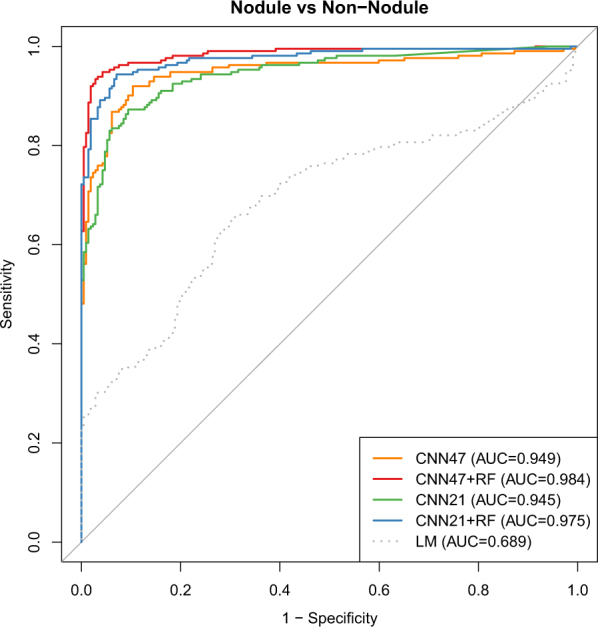
Computed tomography (CT) examinations are commonly used to predict lung nodule malignancy in patients, which are shown to improve noninvasive early diagnosis of lung cancer. It remains challenging for computational approaches to achieve performance comparable to experienced radiologists. Here we present NoduleX, a systematic approach to predict lung nodule malignancy from CT data, based on deep learning convolutional neural networks (CNN). For training and validation, we analyze >1000 lung nodules in images from the LIDC/IDRI cohort. All nodules were identified and classified by four experienced thoracic radiologists who participated in the LIDC project. NoduleX achieves high accuracy for nodule malignancy classification, with an AUC of ~0.99. This is commensurate with the analysis of the dataset by experienced radiologists. Our approach, NoduleX, provides an effective framework for highly accurate nodule malignancy prediction with the model trained on a large patient population. Our results are replicable with software available at http://bioinformatics.astate.edu/NoduleX .
计算机断层扫描(CT)检查常用于预测患者肺部结节的恶性程度,这有助于提高非侵入性早期肺癌诊断的准确性。计算方法在性能上要达到与有经验的放射科医生相当仍然具有挑战性。在这里,我们提出了一种基于深度学习卷积神经网络(CNN)的从 CT 数据预测肺结节恶性程度的系统方法,即 NoduleX。在训练和验证中,我们分析了来自 LIDC/IDRI 队列的超过 1000 个肺结节的图像。所有结节均由参加 LIDC 项目的四位有经验的胸部放射科医生识别和分类。NoduleX 实现了对结节恶性程度分类的高准确性,AUC 约为 0.99。这与有经验的放射科医生对数据集的分析是一致的。我们的方法 NoduleX 为基于大型患者群体训练的模型提供了一种用于高度准确的结节恶性预测的有效框架。我们的结果可以通过在 http://bioinformatics.astate.edu/NoduleX 上提供的软件进行复制。